Metal-case LED scrubber light safety

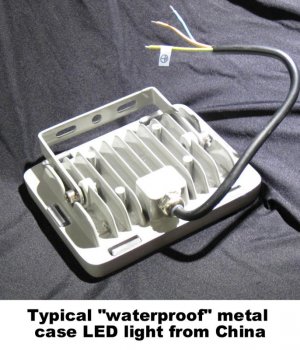
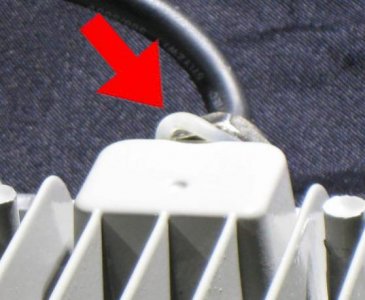
As an electrical engineer (BSEE), people like me are sometimes asked to be expert witnesses in court cases about electrical safety liability. In the USA, electrical safety is tested, and accepted most readily in industry, by Underwriter's Laboratory (UL). Unfortunately this testing is expensive, and if a Chinese LED light maker pays for the UL certification, the cost of their lights will be much higher (and the certified product will have a "œeXXXXXX" number on it). But UL certification shows that a third party has inspected the power supply to be safe, instead of just the maker of the product saying it's safe. Also unfortunately, none of the Chinese LED lights described above are UL certified, as far as I know. This problem becomes bigger because the metal case of the light (metal is needed to remove heat) is what "œprotects" the wires and electronics inside. However this metal case in not hermetically sealed (not truly "œwaterproof"), and indeed because of the $5 cost it is often rushed through assembly where even the rubber seals are incorrectly inserted, or forgotten altogether. Here is an example "waterproof" light from ebay, fresh out of the box; you can see the "waterproof" seal on the 240/120 volt wire is completely not sealed. See photos.

There have been cases on aquarium forums, and on youtube, where the metal compartment screws have not been tight, or were missing. Ground wires were loose, or just cut off. Internal drivers loose and rattling around. Heat sink compound too thin or missing, causing overheating and melting of wire insulation, and even causing steam from water that was splashed on it. Because of this, it's my personal opinion that using these metal bolt-on LED lights is potentially unsafe in the saltwater environment of scrubbers which are setting on sumps. Googling "œchinese led light danger" finds too many results to read, but here are typical ones:


Attachments

  • 240-120 grey light back.jpg
    240-120 grey light back.jpg
    94.1 KB · Views: 10
  • 240-120 grey light back seal.jpg
    240-120 grey light back seal.jpg
    32.7 KB · Views: 7
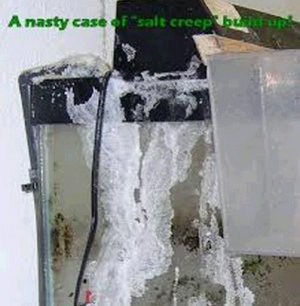
For people not familiar with salt creep (maybe you only have freshwater), it gets into everything. Any crack, surface, or other area inside a sump will eventually get at least a light coating of salt creep, even if the direction of the surface goes upwards. Areas closer to the sump top will get a coating that you can wipe with your fingers, just like dirt on the ground. Areas on the top rim of the sump where scrubbers are placed will get coatings thick enough to require scraping tools. And salt creep is always wet, so yes, it's very conductive of electricity. It's the single biggest cause of shorted-out power sockets in sump areas. Any 240/120 volt electrical device in a sump area needs to be hermetically sealed, or else it will eventually get salt creep into it. It might take months, or years, but it will happen. Here is an example video, and an example photo is attached:


And here is a more thorough description of residue build-up, which is similar to salt creep but occurs in freshwater too:


What does hermetically sealed mean? It means it's air-tight. And if it's air-tight, it's waterproof. It would be difficult to make the metal-case lights air-tight, because you would have to basically weld the case together. The most common way of making electronics air-tight and waterproof is make them a solid component.

All other aquarium sump equipment has the 240/120 volt area hermetically sealed: power heads, heaters, etc. The metal-case LED lights that are being used for algae scrubbers by some people seem to be the only equipment not sealed properly.
 

Attachments

  • salt creep.jpg
    salt creep.jpg
    34.3 KB · Views: 8
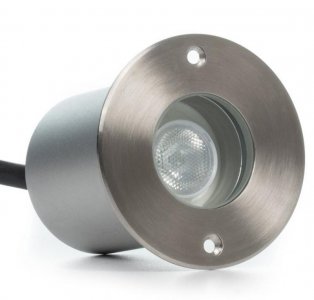
Related to salt creep, is corrosion creep. Because the metal case of the bolt-on lights is aluminum, it can corrode slowly (even in freshwater) where the seal is located, especially at the top of the light where water splashes onto it. So even a seal that is designed and assembled correctly can be pushed sideways by corrosion creep, and eventually the seal will not be sealed anymore. And if it's on the top of the light, water can now drain directly down onto the 240/120 volt electronics inside, and you won't see it because the corrosion is on the inside of the seal area. A stainless steel case would prevent this, but low cost metal-case lights are never stainless. Stainless enclosures are used in underwater 240/120 volt pool lighting, but those lights start at $100 each. Here is a pool accent light with a single 3 watt LED inside, and it is $40; note how much stainless steel is needed to protect it (see attached photo).

The best way to slow down corrosion is during disassembly inspection: coat both sides of the metal case (where they touch together) with grease or petroleum jelly, and re-insert the seal, and re-assemble. Ongoing disassembly and inspection every 6 months is advisable. Unfortunately, each month that goes by will allow more salt and corrosion creep to occur, and the seal will only get worse, not better. And, just like the Chinese do, you might actually mess up a seal during re-assembly, which was fine before you took it apart. So be careful.

Interestingly, most commercial scrubber builders use absolutely no metal in their main boxes which hold the algae growth, because of course the metal would corrode. There are many low cost metal boxes that could be used, which would not crack during shipping like acrylic/perspex does, but builders instead take the time to hand-construct boxes out of acrylic/perspex so that corrosion will not be an issue. So why then do they allow metal on the lights (the most important area for safety) if they know it will corrode?

The reason again is simple: Cost. Just $5 to $8 each, including shipping from China. But the Chinese know that if someone is injured because of these lights, nobody will be going to China to sue them. So the Chinese have absolutely no need to make things safer. It's up to the DIY person to check each light (by taking it apart), and it's up to each commercial scrubber maker to request UL certification, non-metal construction, low voltage operation, and hermetically sealed enclosures.

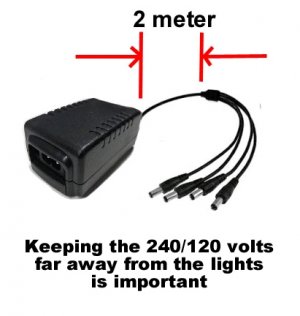
It's my opinion that all of the low cost metal-case lights are made in China, even if they have been relabeled to look otherwise. I've spent hundreds of hours trying to find lights (and other parts) in the USA, only to be directed to China every time. The cost of the metal castings for the case alone would be $10 or $20 each, if made in the USA. And the labor to assemble the electronic and other parts would be another $30 at least. So manufacturing in the USA is not an option for these types of lights, and if they say "œMade In USA" you should assume this is not true. This was yet another reason for us to abandon these metal lights (and their internal electronics design). But even if the bolt-on metal Chinese lights were made in the USA, and even if they were UL certified, you still have the problem of the electronics enclosure not being hermetically sealed. So if water, or steam, or salt creep gets inside, and you touch the metal case, it's not going to matter who made it, or who certified it, or what the warranty is. The 240/120 volts should be 2 meters away from the splashing and salt creep (see attached photo).
 

Attachments

  • stainless led.jpg
    stainless led.jpg
    38.4 KB · Views: 8
  • 2 meters.jpg
    2 meters.jpg
    66 KB · Views: 6
I, for one, appreciate information.

Nowhere does SantaMonica ask us to buy his lights. And no one here is so silly they'll blindly run out and buy his lights simply because he posted something here.

I'm new to the whole LED thing, and would not know how poorly made Chinese LED floods are had I not read this. So, thank you SantaMonica.

This guy spent a considerable amount of time with this warning, and backed up what he's saying as best he could. Yet it appears he is receiving an almost hostile reception.

This attitude may make the next person who has a product warning hesitate to post about it, and less information is never better.

So, instead of criticizing him, how 'bout we cut him some slack and simply take the information in the way it was intended?
 
I, for one, appreciate information.

Nowhere does SantaMonica ask us to buy his lights. And no one here is so silly they'll blindly run out and buy his lights simply because he posted something here.

I'm new to the whole LED thing, and would not know how poorly made Chinese LED floods are had I not read this. So, thank you SantaMonica.

This guy spent a considerable amount of time with this warning, and backed up what he's saying as best he could. Yet it appears he is receiving an almost hostile reception.

This attitude may make the next person who has a product warning hesitate to post about it, and less information is never better.

So, instead of criticizing him, how 'bout we cut him some slack and simply take the information in the way it was intended?

How is any of this different from a t5 w/ ballasts hanging over an aquarium???

Nevermind.. jumped into the middle here...

Personally.. Never use them due to many have very short lifespans..

IF one researches even the LED "household bulb" replacements can expose you to line voltage and are err hazardous..
https://www.eastcountymagazine.org/led-lights-recalled-due-fires-caused-bulbs
Description: The 120-volt LED bulbs, sold as 6- 8- and 9-watt bulbs (equivalent to 40 or 50 watts), were marketed under the brand names Definity, EcoSmart, Sylvania and Westinghouse....
Incidents/Injuries: Lighting Science Group is aware of 68 incidents of product failures, eight of which were accompanied by visible smoke or fire conditions. The incidents include damage to light sockets, melted fixtures, burned rugs/carpet/ floors, damage to a circuit and to a lamp. There have been no reports of personal injuries.
Point is.. why do you think "name brands" are always safe..?

sooo..as a personal thing.. all AC and drivers/ps's should be separate and out of harms way..
 
Last edited:
How is any of this different from a t5 w/ ballasts hanging over an aquarium???

I'll have more about this, but basically T5's are DIY installed, and you don't put your hand on them, and dripping algae is not on top of them.
 
Some people will say, "These lights are safe, because they were made for outdoor use in the rain".

First of all, this is assuming that the lights were put together correctly in the first place. Open up a few and check for yourself to see if the ground is connected properly, or if it was just cut off completely. If it's not connected properly, you can forget any safe usage, anywhere. As a matter of fact, if the ground is not connected properly, usage in the corrosive saltwater environment of a sump is (at least) very dangerous, and in my opinion could be described as deadly, when the operator is an unsuspecting and non-electrically-aware consumer (or worse, their children, standing on a wet floor) who bought the scrubber thinking the manufacturer did all the proper safety designs and certifications.

Second, even if it was put together correctly, usage in an outdoor area or garden usually means the light will be staked into the ground, or will be attached to a metal conduit, both of which provide a ground path if the internal 240/120 volt circuit gets shorted to the metal case. Plus, you don't normally touch, grab, or usually even go near these outdoor lights in a garden. So even if they shorted internally to the metal case, and even if the ground wire were missing, you would not be anywhere near it.

Third, the water falling onto the lights in a garden area is just freshwater. Compare these things to a saltwater sump:

It's bad enough that the ground might not be connected, but regardless, the installation is on the top of sump that is not grounded. It's not a garden bed, and it's not a metal conduit grounded to a house. Instead it's an electrically-floating acrylic box filled with water. It's a really, really bad place to have a possibly non-grounded product, or even a grounded product that is likely to eventually leak.

And the usage requirements of these scrubbers requires weekly, and sometimes daily, touching and grabbing of the lights. With wet hands, and while standing on a wet floor. Ask any licensed electrician if he would like to be doing this.

The 240/120 volt power supply in these lights is inside the metal case which holds the rubber seal in place. All metal corrodes, especially aluminum, and especially in saltwater, and when the metal corrodes enough around the seal, the seal will leak. And the most dripped-on part of the light is the top, and that is directly above the internal power. So, the water drips down directly onto the high voltage inside. Look at how the lights are usually mounted: the seam of the seal at the top is directly over the internal power supply.
 
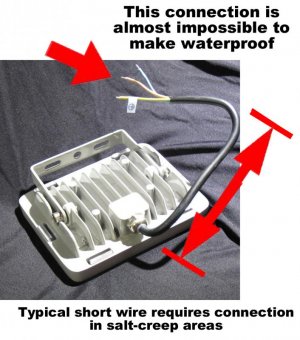
Another problem with most of the metal 240/120 volt lights, is that in order to save more money, they often make the 240/120 volt cord very short, usually just a few inches (see photo).

This means that the rest of the 240/120 volt wire needs to be connected at this point, and almost any connection made by anyone is not going to be hermetically sealed. This connection is going to be placed directly over open areas of sump water, and therefore it's going to get a lot of salt creep and even direct splashing. There is no fix for this; the wire should be replaced entirely.

If you are going to DIY and already have a set of these metal-case lights, you are best advised to not use them and just get a safer light instead. At the very least, use a GFCI protector, available at any hardware store. A safer option would be a low voltage DC version of the same light, with a remote power supply that either comes with it, or that you get and connect yourself (just make sure to get a UL certified supply if it's for the USA). With a really long 2-meter DC cord, the 240/120 volts can at least be placed far away from the sump. However, this does not solve everything for these metal case lights.

Splashes from the sump, and from the top of all-in-one nano tanks, can easily reach the power supply box especially if the box is kept in the sump cabinet or behind the cabinet on the floor. A splash (or even very thick wet carpet) can short the 240/120 volt AC side of the box to the low voltage DC side, effectively electrifying the "safe" side to 240/120 volts.

These low voltage DC lights typically are not grounded on their DC side, so when the 240/120 volts hits the LED diodes inside, the diodes are either going to fail open, or fail closed. If you are having a bad day, they will fail closed. The lights typically use Chip-On-Board (COB) designs which put the diodes within one millimeter of the ground plane, and a 240/120 volt shorted diode will easily arc to the nearest piece of metal which is probably now going to be the metal case. So you once again have a 240/120 electrified case waiting to be touched in your sump area, and you will no doubt be touching and grabbing the light to inspect why it is no longer turning on. Thus even low-voltage metal case lights can be electrocution hazards.

The metal case of these lights is a major problem for safety. Metal obviously conducts electricity, and any 240/120 volt wire that touches the inside of the case is going to electrify the case and cause an electrocution hazard. Especially when you remember that the floor where you are standing is often, and predictably, wet. Unfortunately since the metal case is also the enclosure for the electrical parts, there is no DIY or pre-made solution for this. All you can do is disassemble each light and inspect for visible problems, and test for electrical safety. And if you don't know how to test, get an electrician to do it for you; the metal case must be grounded to earth.
 
Another problem with most of the metal 240/120 volt lights, is that in order to save more money, they often make the 240/120 volt cord very short, usually just a few inches; see attached photo.

This means that the rest of the 240/120 volt wire needs to be connected at this point, and almost any connection made by anyone is not going to be hermetically sealed. This connection is going to be placed directly over open areas of sump water, and therefore it's going to get a lot of salt creep and even direct splashing. There is no fix for this; the wire should be replaced entirely all the way into the case.

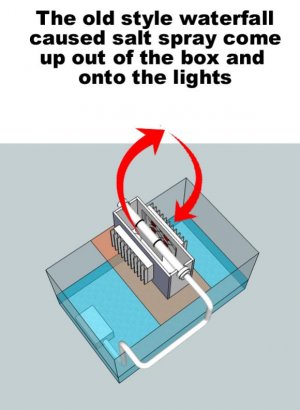
Some scrubbers, both DIY and pre-made, have an open top. We created the first open-top scrubber box, but decided even in 2008 to put a cover over it because of the large amount of spray and salt creep coming out of the top. Here is one of our forum posts in 2008 showing the design:

http://www.reefcentral.com/forums/showthread.php?t=1424843

Before this design in 2008, scrubbers were either dumping buckets or horizontal rivers. But even with our waterfall, the screen sometimes would fill with growth and would clog the water slot, causing water to spray up and out of the box, onto the lights. Back then we watched for this, and DIY people even expected it. But using metal-case lights on a open-top box could have water spraying directly onto the lights, which as shown above, could leak right into the case through a seal that is no longer sealed. See photo.

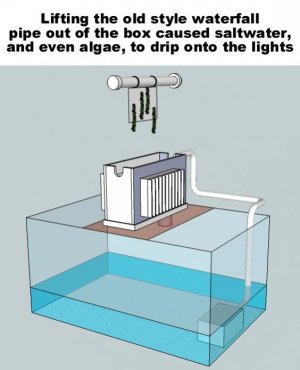
The DIY and the pre-made solution is to close the top of the scrubber box. However this does nothing during cleaning/harvest time, because the pipe and screen need to be lifted up and out of the box, and this causes lots of saltwater to drip down directly onto the lights. Even pieces of algae will fall onto the lights, seeping into the seal. See photo.

Another hazard of our previous waterfall design, especially when there is no top "œshelf" covering the light, is that in order to lift the screen out of the box (for cleaning) you need to place your other hand onto the box to hold it down; the proximity of the lights (to the top) causes your hand to touch the metal case when doing this. This is the worst case scenario for electrocution because as you learn when repairing televisions, it creates the most direct and shortest path of electricity from one arm to the other, directly through your heart. The DIY solution for this is to make a large top shelf over the lights that will absolutely not allow your hand to touch the lights. The pre-made solution can be similar, but the real solution is to change the power supply to a remote low-voltage, AC/DC isolated, UL certified power supply.

A safer solution that all DIY and commercial scrubber makers can use is a remote "œswitching" power supply with at least 3000 volts isolation from the mains, with a long 2 meter DC cable so the 240/120 volt box can be far away from any splashing, wet carpet, interested children, pets, etc. The power supply needs to be UL certified with the "œeXXXXXX" number on its label, so you can cross-check its manufacturer yourself on the UL website. We have had more than one Chinese supplier say they had UL certification, but upon checking, they were actually using the number from another company and thus providing an inferior untested product, even though the price was increased! Lastly, the enclosure for the lights should not be metal, even if they are low voltage. This will protect the customer even if the power supply box itself is splashed because the 240/120 volts will not have a metal case to conduct to, and injure, the customer.

Speaking of injury, when a personal injury attorney contacts a commercial scrubber maker because of an injury claim, it might go something like: "œSo, you are saying that your 240/120 volt device, being sold in the U.S., has no UL certification. And it places 240/120 volts within a single hand's distance from saltwater. And the pink light, known to attract children, is visible from outside the aquarium cabinet, and the floor in front of the cabinet is often, and predictably, wet. And your device has no GFCI or RCD circuit or other means of breaking an electrical short. And, these waterfall scrubbers are known to spray water upwards and outwards, onto surrounding surfaces, such as the surface that my client's child touched?" This will be indefensible.

240/120 volts simply has no business being inside of a non-hermetically sealed metal enclosure that is subjected to hand placement, salt creep, and direct splashing by saltwater. The commercial pre-made scrubbers using these lights are the only aquarium equipment I know of that does this, and they need to be made more safely. So I challenge all pre-made commercial scrubber makers to replace their metal case lights with safer options. Yes these options will cost more, and you will lose a lot of your profit. But I bet you can do it.

Further, all customers that already purchased metal-case lights should be offered to have the lights replaced with safer alternatives. Each month that goes by allows corrosion and salt creep to penetrate into the seals further, and so the sooner these hazardous lights can be replaced, the better. Eventually, all the seals will leak.

Commercial scrubber makers have the final say in obtaining professional electrical safety design advice; specifying safe components; assembling the components properly, marketing them accurately, and standing behind them with personal injury liability insurance coverage. Here is a checklist that you can send to anyone you want to buy a pre-made scrubber from (you can also use it for buying just the lights, although some of the questions will not apply). The fewer answers you get from these questions, the more concerned you should be:


- Is their overall scrubber design certified by an electrical engineer, electronics engineer, electrician, or safety technician who can testify as an expert witness in a personal injury court if required to?

- Do they have personal injury liability insurance for their customers?

- Are they a licensed business in their city?

- Do they have a DBA (Doing Business As) license in their county?

- Do they have a reseller's permit in their state?

- Is the enclosure for the 240/120 volts certified (in the USA) by Underwriters Laboratory, with an "eXXXXXX" certificate number printed on it?

- For metal enclosures, has every enclosure had it's ground path tested to the ground pin of the power plug before shipping?

- If the lights are dropped into saltwater, will they continue to function?

- If a remote power supply, and if the power supply box gets wet, is the metal case insulated from the 240/120 volts?

- If the 240/120 volt cord goes into the enclosure for the lights, does it have a non spliced length all the way to the plug?


Thank you for reading, and for wanting improved safety in your home!

Note: The above is one person's professional opinion on the safety of algae scrubber lights. You should consult your own professional advice and opinion from an independent electrical engineer, electronics engineer, electrician, or safety technician.

 

Attachments

  • 240-120 led light short wire.jpg
    240-120 led light short wire.jpg
    88.7 KB · Views: 9
  • 2008 wf spray up and out.jpg
    2008 wf spray up and out.jpg
    45 KB · Views: 7
  • 2008 wf pipe up.jpg
    2008 wf pipe up.jpg
    39.8 KB · Views: 7
Do you have an actual case that these "œinferior" lights that actually failed in an algae scrubber, that you can share please?


Sent from my iPhone using Tapatalk
 
Do you have an actual case that these “inferior” lights that actually failed in an algae scrubber, that you can share please?


Sent from my iPhone using Tapatalk

I have seen more than a few cases posted in various reef related facebook groups about issues with those types of lights being used on a well known scrubber builder who recently dropped off the face of the earth/shut down. The one thing that always had me scratching my head was the high wattage those lights use which to me seemed like a very inefficient choice of lighting for a small scrubber. I can definitely see how the humidity and potential of spray or slashing would be a potential issue with those lights though and like I said, there have been plenty of failures posted in the groups I follow. Whether that is the result of the moisture, water or just the fact they are cheap Chinese lights I can’t say but personally, I’d never run those on a scrubber not only because they are inefficient but I wouldn’t feel comfortable having those lights so close to water on a device that is prone to overflowing due to clogs. Seems like a recipe for disaster and I’d feel much better have DC powered lights there that don’t require a direct AC connection into them.
 
I saved one photo from someone here, whose light is about to burn out, and it will be part of a what not to do. But like above, I'm trying to prevent it from happening, which should be easy enough. I'm not trying to make people feel bad after it's already occurred.
 
I wonder if one of these Amazon "Waterproof" LED lights could be opened and have the power supply removed so that only the DC lines would be run back to the housing keeping the AC side remote and in an area not subject to the possibility of moisture/accidental submersion. Just a thought. If there is a PCB that integrates everything... s.o.l. However, if the PS and PCB are separate, it could be a possibility.
 
That style is already available, with a remote power supply box. It's much safer, unless the power supply box gets splashed, which can put the 120V into the case of the light.

This is why we don't use any metal at all in our lights; even if the power is shorted and 120V gets into the light, the power cannot get to the water, or your hand, at all.

I think non-metal non-120V lights should be required on all scrubber lights.
 
I actually have 2 of those fixtures on my scrubber and one day my ATO overfilled my sump... ended up submerging the lights halfway in. No issues came up, lights still work. But with that being said, Im open for alternative lights if safer. Can you recommend alternative lights that you know are safe for waterfall scrubbers?
 
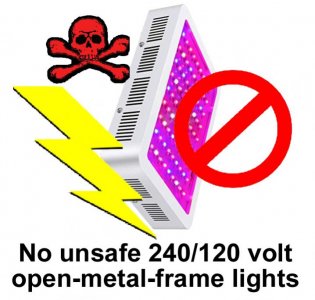
Now I would like to point out an even more dangerous light: the open-metal-frame indoor plant grow light. The "waterproof" lights I covered above are bad enough, but now people are starting to actually use indoor non-waterproof lights that not only have an open-air frame for water and algae to get into, but also have open 240/120 volt connections in the direct path of water (see photo).

Not only are these lights not going to last in the salt air humid environment of a sump, but out-of-the-box they create an extreme electrical hazard:

- Salt spray is going to get pulled through the unit, via the fans, which will corrode and/or short internal components.
- The open high voltage connections are in the direct path of splashing, dripping, and even simple accidental dropping into the sump.
- Internal condensation, which already happens with the "sealed" type of lights when moisture eventually gets inside, is going to happen on the first day with these open-frame lights.
- Placing these lights into enclosed scrubber boxes reduces the circulation of cooling air, which further stresses the internal components.

Since these lights are clearly labeled (or should be labeled) as indoor-only, any usage of them in a worse-than-outdoor situation (such as a wet saltwater sump) puts a manufacturer or distributor in a very bad situation of negligence and possibly willful negligence. Please do not use these lights, ever.
 

Attachments

  • open-frame-led.jpg
    open-frame-led.jpg
    57.3 KB · Views: 10
Back
Top