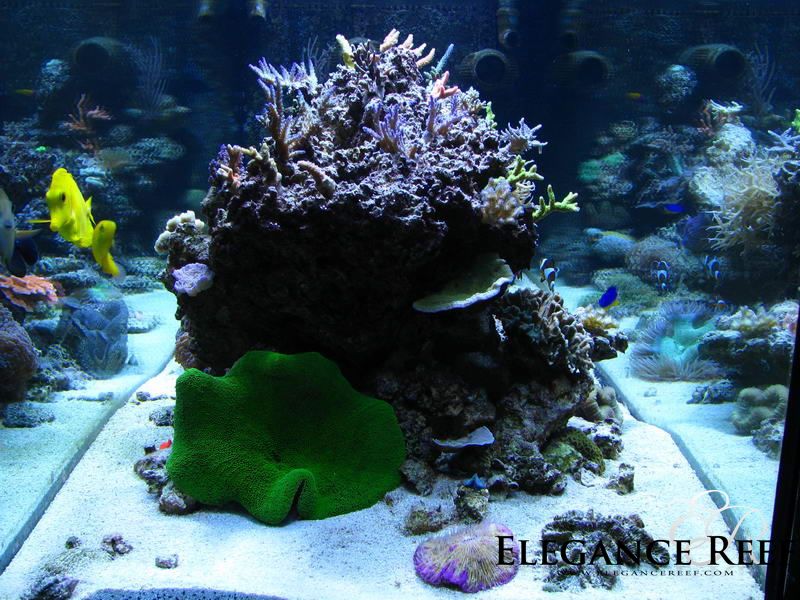
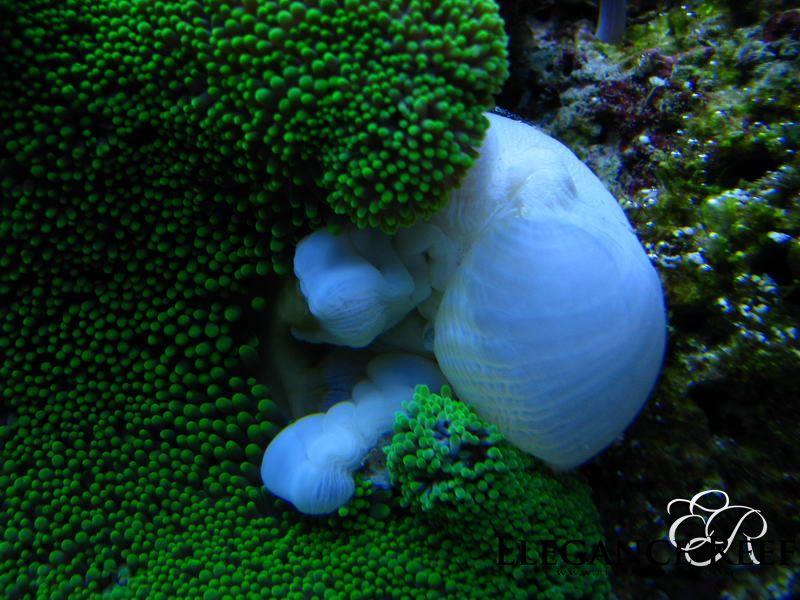
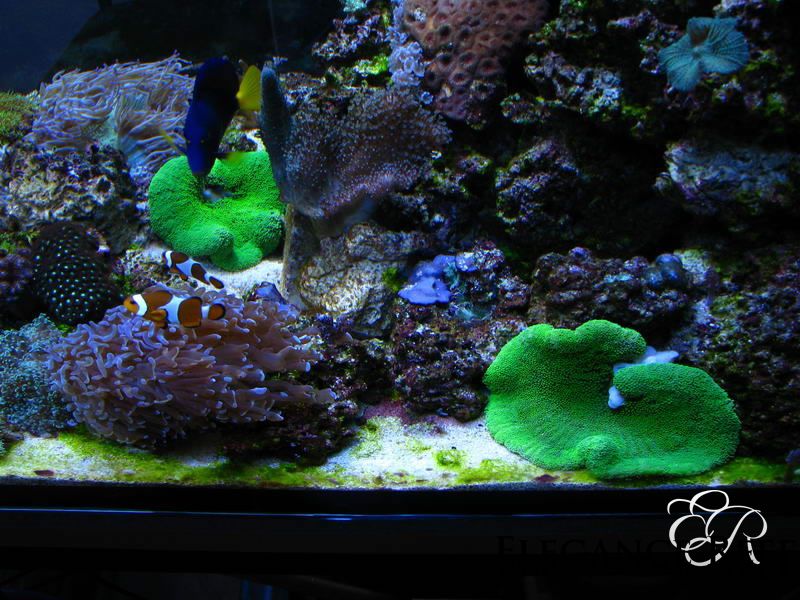
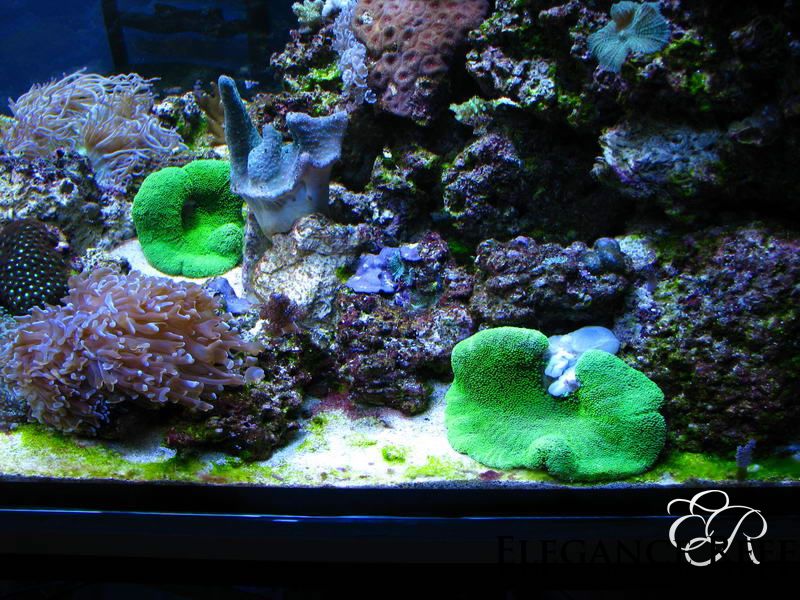
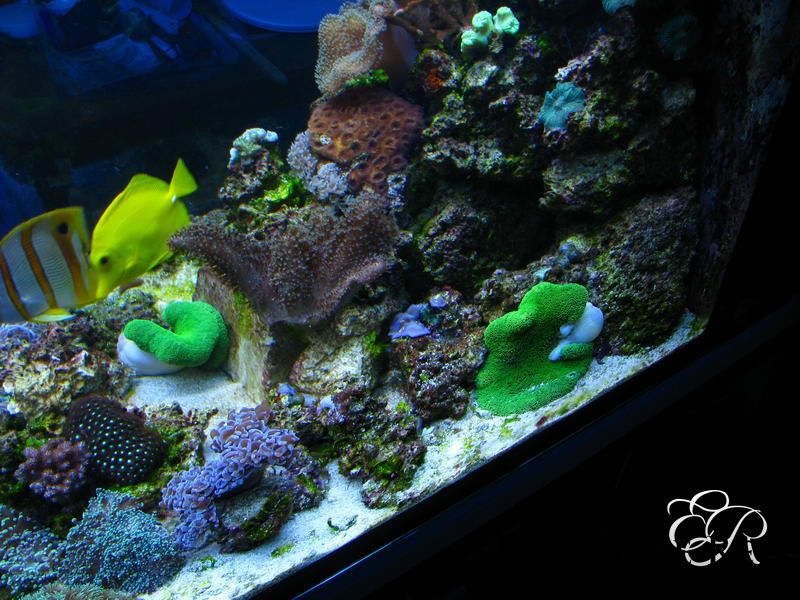
multiple haddoni carpets dedicated aquarium

Can anyone post proof that an anemone can live happily ever after, after being cut in half? Other than those that are known to split naturally. The only two host species I know of that are able to survive such damage are BTA and magnifica. Which also happen to be the only two known to split naturally. The others don't split naturally and its never been shown that they will survive such damage. Anyone can cut an anemone if half. That doesn't mean that it will survive. There have been some very experienced hobbyists with very healthy anemone try this and fail. IMHO, if you cut an anemone that doesn't split naturally, you'll just end up with two pieces of one dead anemone.

That is one thing that has always bothered me about the cutting links on Marine Depot's forum --- there doesn't seem to be any follow up. If it was so easy and successful as claimed, there should be some success stories. Then again, I don't agree with a lot that was said over there.
 
Can anyone post proof that an anemone can live happily ever after, after being cut in half? Other than those that are known to split naturally. ............. IMHO, if you cut an anemone that doesn't split naturally, you'll just end up with two pieces of one dead anemone.

hmm.. I cant prove any of these things i mentioned like proving it with documented process, dates and pictures. I said it more as a matter of chit-chat. I just know that green haddoni well from my local scene, it changed several hands in last three years, grew to big for its owner so he fragged it roughly three months ago and gave one clone to another fellow aquarist.. both clones are still alive and doing well..anyhow, thats the one I'm getting in few weeks
 
I don't think you are lying to us. I just think you've been misled like many others on this subject.


When you get it, can you post pic's and keep us posted? A fragged haddoni won't be healed in three months, so there will still be obvious scars form being cut. It's not uncommon for an anemone thats been cut to survive for several months. If I'm not mistaken Phendor kept his mertensii alive for about 6 months after he cut it in half. Unfortunately, these anemones lack the powers of regeneration strong enough to heal from such a wound. If they had this ability, they would be using it to their advantage. That's how evolution works. Haddoni's don't split naturally, so they have no need to posses powers of regeneration that strong. If an animal doesn't use an ability, they lose it. Like a fish that lives in the darkness of a cave. With no need for eyesight, they go blind and eventually lose their eyes. An anemone with no need to heal form being torn in half, won't have the ability.

While I'm curious to see how long this anemone will survive after being cut, I wouldn't spend money on it if I were you. I'd hate for the first haddoni in your project to die in the first month.
 
yes I am familiar with Phil's thread here on RC and over at Marinedepot. we'll see how it goes with it and in all fairness I'm still optimistic about it. :) Not that I advocate it or that I'm in the mood for endless debate but still I think its doable. IMHO just because some nems haven't split in captivity jet that doesn't mean don't-cant do it in nature. Same can be applied for those famous ritteri anemones.. I remember when we first saw some of their splits here on rc, like Paul's one. Before it it was also debated and all.. Back then it was more like : in nature yes but in aquarium no way! Then I think if it can be applied to it and entacmea why cant be for lets say macrodactyla? Because you cant see em in large cloned colonies in nature so they don't split at all? I think if we put aside some obvious care requirements and their habits these animals altogether are not very different. anyhow I'll get it shortly and post up some shots here, hope and Im right for animal's sake, not debate,, we'll see how it goes
 
Talked with a LFS store that has multiple carpets in a "titan bin" it is a tub

Those are all gig I think maybe a hadoni but I am not sure.

Any way, if I pay for half of one of the green ones (he wont let me touch the 3 blue or Purple ones) we will cut it in half.

Before I pony up the cash, I want more info.

I will document it here on RC. With weekly photos.

The only thing I can think is grab a big sharp knife cut it in half and put it back in the tank? If there is more to it please let me know.
 
Dude,

based on your statement i dont think you should keep that animal. spare the living thing and save your money.

YOU DONT JUST CUT THE THING UP WITH A NIFE AND THROW IT IN THE TANK AND EXPECT IT TO LIVE DO YOU?

I am just speechless.


The only thing I can think is grab a big sharp knife cut it in half and put it back in the tank? If there is more to it please let me know.
 
YOU DONT JUST CUT THE THING UP WITH A NIFE AND THROW IT IN THE TANK AND EXPECT IT TO LIVE DO YOU?

I am just speechless.

Well, based on what I read in the thread it is that easy.

But I doubt you are speechless.
:lol2::lol2::lol2::lol2::lol2::lol2::lol2::
 
The odds are pretty good that you would end up killing your whole tank.


Not my tank the stores. We would separate it from the source tank and watch what happens. I dont see how this would be more toxic than when one dies after shipment and turns to mush. Do a water change and check the parameters.

In regards to the ethics of this proposal - Yes it can be viewed as cruel no need to point that out. It is also cruel to continually deplete the ocean for consumer demands. If cutting 1 results in 2 this will satisfy more of the demand, decrease the cost and hopefully make it less appealing for collectors.

I am guessing odds are we would not be successful since there seems to be a lack of information.
 
There is a difference between an ammonia spike (( an anemone dying )) and cutting one. The stinging cells (( the spelling of the proper name escapes me right now )) of the cut anemone are going to be released along the cut. Those have a very good chance of killing anything (( fish wise )) that is in the tank.

I have seen something similar when one of my Haddonis found an uncovered powerhead. Some of its tentacles were ripped off and released into the tank. There was no ammonia spike, but 2 fish died from it. I am not the only one that this has happened too.

If you guys do go ahead with this, I would make sure to put it into its own tank, that is completely separate from any other tanks. I would feel better about this if the attitude wasn't to caviler.
 
There is a difference between an ammonia spike (( an anemone dying )) and cutting one. The stinging cells (( the spelling of the proper name escapes me right now )) of the cut anemone are going to be released along the cut. Those have a very good chance of killing anything (( fish wise )) that is in the tank.

If you guys do go ahead with this, I would make sure to put it into its own tank, that is completely separate from any other tanks. I would feel better about this if the attitude wasn't to caviler.

+1, especially about the attitude.
 
I don't think they were even talking at all about cruelty.

For instance, I have seen a leather propagation thread that discussed how you want to use smooth motions and not saw.
Also be sure to rinse the blade and everything that will touch the nem.
He suggested a utility knife.

There is just a lot to consider to try and make the best chances for survival.
 
Txchewy,
U r right on bro. The aquaculture of nems needs to be done for our hobby and to take the pressure off the oceans. Our hobby needs this and people are doing it,successfully. I will not tell anyone it is easy (because reef keeping is easy after u learned for many years of trial and error)but if u r really good then aquaculture can be just as easy, after learning from experiences,trial and error.

Something like this (especially since u know from EXPERIENCE) u just have to not even pay attention to the skeptics and pessimists. our hobby needs u.
AC has it all documented right there for u to learn from.

One thing I definetely recommend is too keep them in there own tank (monospecific culture)so they heal better,faster and don't have to fight off other poisons from other nems,coral etc.
Especially carpets they r very toxic.

PS. There cetainly is not a lack of information on nem culturing. marinedepot.com anthony calfo has been doing i for many years and is constantly preaching nem culturing @ clubs around the world......Read up on his works...

PSS. If anybody want to sell me a red haddoni carpet i will cut it and document it. i cant find one anywhere. The ones who do say they ccan provide them get them fro mthe wild. So these anemone's need our help.
Best of luckto you
 
Last edited:
If anemone cutting is as easy as what is preached there should be more than a few anemones farm popping up everywhere in the US and supplying the wholesalers with more than enough anemones. The original recommendation is to cut every 2 weeks on BTA. That is 2^25 number of anemones in a year, take a 90% survival rate, one farm could easily have 33 554 432 x90% crops a year. Let's say only cutting once a month, 2^12 still get you 4000 crops a year, and most 'farm's will start with more than one crop .. that is already enough to flood a few local markets (and make a name for themselves).

That topic has been in discussion for at least 4 years and there had been alot of anemones farm build plans and even complete business proposals out there on the MD forums. Where are those farms now?

Hearing it 4 years ago was fascinating, after hearing it again in a 2009 conference makes question the validity, knowledge and motives. I know at least more than a handful of reefers tried.
 
Reefbox - thanks for the help and sugestion on information. Anthony Calfo did a speech and how to on propagation here in Houston. I was blown away how he simply grabed a ricordea and sliced it with a razor. He stated "when cuting nems it is important to split the foot." I am in no way sugesting after seeing him cut a ric I am an expert our that a carpet will heal the same way.

If I am succesful - a big IF - then I will atempt it on my red carpet. But at $450 dollars I much rather attempt on a less expensive carpet.

Vaporize - you are 100% correct. I hear the same story all the time and when I draw back to the first time I read about it or heard about it, it was never from a first hand source. If it is so simple why is there no mention of a farm or company doing this exact thing?

Thruth be told - I want to know what the outcome will be. I dont plan to start a company but if valid information is tested and proof is provided - then the oceans and our wallets will thank us.
 
just few shots to visualize my words, here it is few days before the cutting

clones are cut and after 24 hours nursing in other aquarium washed out and placed back to the main tank

prije.jpg


24 hours healing fine

24hours2.jpg


both clones good and on the move

24hours.jpg


72 hours

72hours2.jpg


72hours.jpg


so much about being misled, its been 3 months and as i said both are alive and well, I'm not promoting it, or parading it here as a "success story" just backing up my chit-chat that it can be done provided that anemone being cut is healthy aquarium accustomed specimen and that you know what are you doing and how to do it right.
 
This thread has really, really had me concerned, so I e-mailed Dr. Daphne Fautin and she was actually kind enough to respond. Here's what she had to say.

" To prevent taking animals from the wild, some well-intentioned people propose cutting sea anemones in pieces to propagate them artificially. I am astonished how often I receive such proposals! It appears that only (or nearly only) anemones that naturally divide will predictably survive this treatment. Despite a persistent belief otherwise, anemones of most species do not reproduce asexually: only two of the 10 species that are natural hosts to anemonefishes do, and that may be a pretty good estimate of the prevalence of that ability among all anemones - 20% of species.

Perhaps the myth that division is how anemones reproduce is due in part to the feeling that anemones are "primitive" and division is a "primitive" attribute (in fact, anemones have been on earth far longer than humans, so can be argued to be more evolved!), and in part because pests such as *Aiptasia* are many peoples' ideas of a "typical" anemone. In fact, they are so prevalent and common precisely because they have that unusual ability - most of the 1000 or so species of anemones are less conspicuous because they do not occur in such densities at least in part because they lack that ability.

Another possible source of the misconception about anemone division is the practice of fragging corals. Clearly anemones and scleractinian corals are closely related. But that does not mean they can be treated identically. All anemones are solitary (even those that divide separate entirely once they have formed separate bodies, whereas polyps of corals in a colony remain physically attached to one another after they have arisen asexually). So fragging is dividing colonies (groups of polyps) into smaller colonies (fewer polyps per piece). By contrast, cutting an anemone into pieces is analogous to cutting you into two or more pieces; and for anemones of most species, the result would be precisely the same -- we would not have numerous identical yous, we would have no you.

Associated with an ability in some anemones to divide (into two or many pieces, depending on the species) is an ability to heal; obviously healing is necessary for regeneration. And although the reverse is not necessarily the case, it seems that animals that do not normally divide also have poor healing ability. So the prospects are dim for propagating anemones of species that do not naturally divide by cutting them into two or more pieces. One person who wrote to me rather triumphantly with a proposal to reduce collection from nature by cutting anemones in pieces as a means of artificial propagation was so pleased because he had cut in half two anemones of a species that does not reproduce asexually (as I recall, it was a species of *Stichodactyla*), and although both halves of one had died, both of the other had survived. So he started with two and ended with two, each half as large as the originals. I failed to see promise in this approach.

And even for the two species of anemonefish host anemones that seem to divide in nature, differences from place to place make me think there may be more than one species of what we think is a single species of each or there may be differences among individuals. Thus, even an anemone that is thought to be able to propagate asexually (*Entacmaea quadricolor*, the bubble-tip, and *Heteractis magnifica*, the "Ritteri" anemone) may die from being cut up.


Daphne Fautin


Daphne G. Fautin
Professor, Ecology and Evolutionary Biology
Curator, Natural History Museum and Biodiversity Research Center
Haworth Hall
University of Kansas"

 
"elegance coral"

Thank you very much for taking the time to send that email, and then to post it. Very interesting.
 
Back
Top