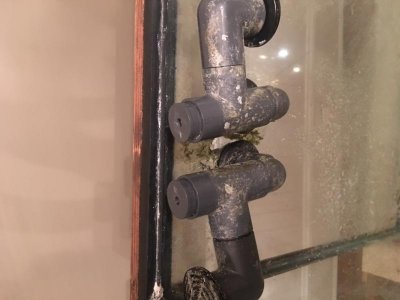
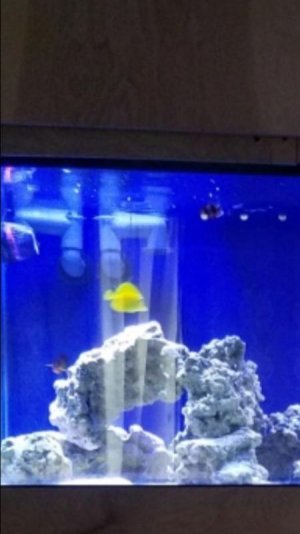
I'm in the process of beginning to do the plumbing on my 180 (after I clean the tank hehe). The previous owner had the back panel drilled with two holes and in the pic I've attatched is how he was running the system. I'm not familiar with this so if anyone could tell me how it works that would be great. Also I'm pretty sure the left one was used as a emergency. I need to use both as drains so I can get as close to 1500 GPH as I can. Do you guys recommend getting a overflow box? I've watched all kinds of YouTube videos and I'm pretty lost. None show how it's piped inside the overflow box mounted to the back. I need help figuring out how to plumb this so that it's efficient and quiet. I have a controllable D.C. Return pump so I'm pretty sure I can obtain the water level I need and I also plan on using gate valves on the drain lines in case I need to slow them. Please help!

You are using an out of date browser. It may not display this or other websites correctly.
You should upgrade or use an alternative browser.
You should upgrade or use an alternative browser.
Need help identifying this overflow design
- Thread starter Trevnc1
- Start date

Mysticalknight
New member
I'm not sure how he was running it, but if I were you I would just drill a third hole next to them and then silicone in an after market overflow box and do a bean, it will get you your 1500 gph silently and still have a dry emergency drain
Sent from my iPhone using Tapatalk
Sent from my iPhone using Tapatalk
Mysticalknight
New member
It kinda looks like he was just running two dursos
Sent from my iPhone using Tapatalk
Sent from my iPhone using Tapatalk
Mysticalknight
New member
One full siphon, one barely skimming the top probably, it wasn't completely dry. Can tell by how dirty the screen is
Sent from my iPhone using Tapatalk
Sent from my iPhone using Tapatalk
Do I even really need a overflow box? Can I just come through the tank and 90 straight up to desired height and put the strainer caps on the pipe and on the backside on the glass bullhead a Tee with a pipe coming up higher than the strainer on the inside, and put a cap on it with a hole in it? Wouldn't this continue draining if the power went out and then started back as long as the pipe doesn't jump back up?
Mysticalknight
New member
Need help identifying this overflow design
Well you don't have to do a beananimal, what size is the pvc? You may be able to get the flow you want out of just one of the pipes. And you could have both of them wet, but to be safe I would make sure just one of them could handle the full flow you want in the case of a clog. You don't have to use a box, but I would strongly recommend it. Without one there is a really good chance that a snail could mess with your flow. It will work without one, but the way I think about it is this: I get more than just an incidental amount of saltwater on my floor and it will almost certainly destroy it, and that's ignoring the potential damage to equipment and loss of livestock that a clog could potentially cause. It's up to you, the way it was setup you can continue and you will more than likely be just fine, but even if there is only a 1% chance of an issue then the consequences could be pretty huge. Personally, I would be willing to run it as a herbie overflow with a box, but I wouldn't do it without the overflow box if it were me. And if you can get someone to help you put it on it's side, then drilling even 1/2" glass isn't too terrible, just really slow. Sorry for all the Runon sentences lol
Sent from my iPhone using Tapatalk
Do I even really need a overflow box? Can I just come through the tank and 90 straight up to desired height and put the strainer caps on the pipe and on the backside on the glass bullhead a Tee with a pipe coming up higher than the strainer on the inside, and put a cap on it with a hole in it? Wouldn't this continue draining if the power went out and then started back as long as the pipe doesn't jump back up?
Well you don't have to do a beananimal, what size is the pvc? You may be able to get the flow you want out of just one of the pipes. And you could have both of them wet, but to be safe I would make sure just one of them could handle the full flow you want in the case of a clog. You don't have to use a box, but I would strongly recommend it. Without one there is a really good chance that a snail could mess with your flow. It will work without one, but the way I think about it is this: I get more than just an incidental amount of saltwater on my floor and it will almost certainly destroy it, and that's ignoring the potential damage to equipment and loss of livestock that a clog could potentially cause. It's up to you, the way it was setup you can continue and you will more than likely be just fine, but even if there is only a 1% chance of an issue then the consequences could be pretty huge. Personally, I would be willing to run it as a herbie overflow with a box, but I wouldn't do it without the overflow box if it were me. And if you can get someone to help you put it on it's side, then drilling even 1/2" glass isn't too terrible, just really slow. Sorry for all the Runon sentences lol
Sent from my iPhone using Tapatalk
Well you don't have to do a beananimal, what size is the pvc? You may be able to get the flow you want out of just one of the pipes. And you could have both of them wet, but to be safe I would make sure just one of them could handle the full flow you want in the case of a clog. You don't have to use a box, but I would strongly recommend it. Without one there is a really good chance that a snail could mess with your flow. It will work without one, but the way I think about it is this: I get more than just an incidental amount of saltwater on my floor and it will almost certainly destroy it, and that's ignoring the potential damage to equipment and loss of livestock that a clog could potentially cause. It's up to you, the way it was setup you can continue and you will more than likely be just fine, but even if there is only a 1% chance of an issue then the consequences could be pretty huge. Personally, I would be willing to run it as a herbie overflow with a box, but I wouldn't do it without the overflow box if it were me. And if you can get someone to help you put it on it's side, then drilling even 1/2" glass isn't too terrible, just really slow. Sorry for all the Runon sentences lol
Sent from my iPhone using Tapatalk
I havent ran any piping yet, it currently has 1" bulkheads but maybe I could fit 1 1/4", can you explain to me how I would pipe this up the "herbie" way and would it be quiet?
Mysticalknight
New member
A herbie is just two standpipes, one with a gate valve running at a full siphon, and the other a dry emergency line. You can look to get around 900 gph (roughly) through a 1" standpipe at full siphon. It should be dead silent at a full siphon. It is used mostly in predrilled tanks since they temper the bottom after drilling usually and no more holes can be added
Sent from my iPhone using Tapatalk
Sent from my iPhone using Tapatalk
Mysticalknight
New member
http://gmacreef.com/herbie-overflow-reef-tank-plumbing-method-basics/
Sent from my iPhone using Tapatalk
Sent from my iPhone using Tapatalk
Similar threads
- Replies
- 0
- Views
- 181

- Replies
- 9
- Views
- 371
