New RANDY's 2 part

<a href=showthread.php?s=&postid=11893468#post11893468 target=_blank>Originally posted</a> by jdieck
Seachem's marine buffer is an alkalinity supplemet including borates but is more suitable for fish only systems. If you will buffer your top off why not use Limewater? cheaper and will add both calcium and alkalinity not only alkalinity while still maintaining good PH?

Thanks Again jdieck & Randy.
" Only Mom Treated Me Better " :lol: :lol:

I use a 5 gal. for T/O . 1~tsp / 1~tbsp per gal of the 5
with the kalk. to start ?

Thanks for a reply

Steve

:smokin:
 
I use a 5 gal. for T/O . 1~tsp / 1~tbsp per gal of the 5
with the kalk. to start ?


That sounds like a fine plan, assuming you add it very slowly. :)
 
Three questions:

1) In your opinion, what are the latest and greatest levels you should try and attian for the following: (SPS tank)

Calcium 400 - 450
Alkalinity 8
PH ?
Magnesium 1300-1500

Was going to start using 2 part but since I've seen this, I put on hold. Am going to start dosing Kalk.

2) If my parameters are out of wack, what is the best way to raise or lower each of these parameters:
raise lower
Calcium
Alkalinity
PH

3) Can I raise these all at once or should I do it over a period of time?

I think Randy wrote and article on how these components interact with each other, but I can't seem to put my hands on it.
 
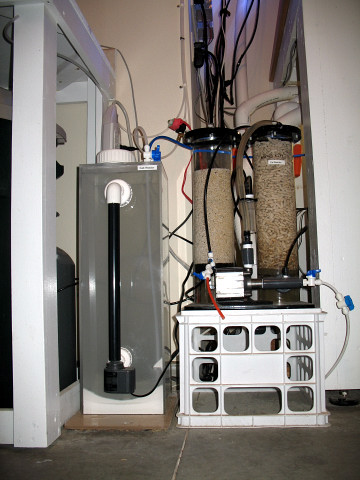
Hey Randy... Speaking of Kalk, can raw pickling lime go stagnant or non productive if left to sit in a Kalk Reactor for a long period of time? We added almost a full jar of Mrs. Wages to our ~8.5g Kalk reactor initially, but I seem to more more pop in our pH when I add fresh lime even though there is a significant amount still in the bottom of the reactor. The reactor stirs ever 4.25 hours for 2 minutes and settles a minimum of 30 minutes before a top-off can resume. The chamber becomes a thick cloud during a stir so I know it's getting mixed.

kalk_ca.JPG


Thanks,

Doug
 
Doug:
My experience has been that water feeding the reactor has some dissolved CO2 in it and given enough time eventually a good portion of the Kalk turns into calcium carbonate flaky precipitate.
This is why I no longer just keep on adding new Kalk to the reactor but instead I use smaller quantities and empty and rinse the reactor of any left over at least every two to four weeks.
You will notice that newly added Kalk is very white and fine, as it eventually turns into carbonate together with impurities it turns snowy, greyish and kind of floating puffy snow.
 
I agree that seems like a likely explanation. You can check the potency of the effluent by conductivity, if you have an appropriate meter (reading around 10 mS/cm). Other methods, such as pH, can be used but are cruder and more of an estimate.

If the water is clear, then calcium or alkalinity testing can be performed, but not if it is cloudy at all.
 
I may be stupid or comp. lost but from what I understand there is no test kit that is really good in reading bromide correct? if so how can salt mix compan'y measure how much bromide is in NSW to know how much to add in thir batches?

if their is a test kit to measure bromide where would we get it? i'm kinda interested in doing a test on the effects.
 
I do not know if salt mix companies routinely or even ever measure concentrations after formulation, but if they chose to, it is not hard to test for bromide with appropriate test equipment or by using commercial testing services. They would not use a test kit. If you want to measure bromide at home, I think the best way is to get a bromide selective electrode, and make some artificial seawater standards with appropriate standard concentrations of bromide.

That said, for a salt mix I expect that they have a recipe that they believe gives appropriate concentrations. After adding whatever amount of potassium or sodium bromide, then they likely assume they know what is there.

I show a recipe for seawater in this article:

What is seawater
http://reefkeeping.com/issues/2005-11/rhf/index.php

from it:

http://reefkeeping.com/issues/2005-11/rhf/index.php#21

An Artificial Seawater Recipe

--------------------------------------------------------------------------------

For those who are interested, the following artificial seawater recipe is taken from "Chemical Oceanography" by Frank Millero. It makes a recipe that matches 35 ppt seawater in terms of major ions, but does not try to match all minor and trace elements, most of which will be present as impurities in the major elements.

23.98 g sodium chloride
5.029 g magnesium chloride
4.01 g sodium sulfate
1.14 g calcium chloride
0.699 g potassium chloride
0.172 g sodium bicarbonate
0.100 g potassium bromide
0.0254 g boric acid
0.0143 g strontium chloride
0.0029 g sodium fluoride
Water to 1 kg total weight.

 
After thinking about this bromide issue for a while, I still do not know if there is a concern, but since so many reefers are using new batches of Dowflake and have not observed (or at least reported) a problem, I think the concerns may not be particularly significant. :)
 
<a href=showthread.php?s=&postid=11955973#post11955973 target=_blank>Originally posted</a> by Randy Holmes-Farley
After thinking about this bromide issue for a while, I still do not know if there is a concern, but since so many reefers are using new batches of Dowflake and have not observed (or at least reported) a problem, I think the concerns may not be particularly significant. :)
I heard from the LFS that our local coral farmer got hold of a new batch and had some issues. He was using it in large quantties though, something like 1-2 cups a day. Sorry, I don't know all the details.
You could try sending him a PM if you want details. http://reefcentral.com/forums/private.php?s=&action=newmessage&userid=41221
 
Randy, I wanted to PM you but it is blocked for you. Would you be able to post/e-mail me any available information on lanthanum chloride? I believe it is the active ingredient in Blue Life Phosphate Control. Have you had experience with this product?
 
I'm sure this has been asked before, but I can't find anything...

In the homemade 2 part solution guide, there is a disclaimer in red saying Mag Flake may not be safe to use. Then right below that it says Randy only recommends Mag Flake that is manufactured by the dead sea company (which is the kind I have).

I'm a bit confused. Is it still safe to use the Mag Flake from the dead sea company?
 
There is no reason that I know of to believe it is unsafe. I put that in at the request of the manufacturer since they do not guarantee it is suitable (either do I). They sell a much pricier grade that they do guarantee for salt mix preparation, so you can interpret their motives how you wish.

Many people use it and continue to use it just fine. There have been no process changes that I am aware of.
 
Back
Top