New Sebae Anemone - Need HELP

Jeremy.XIII

New member
Okay, I made the title a little dramatic but I'm trying to get y'all's attention!

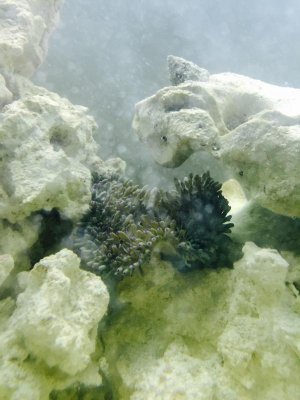
I bought a new sebae after doing extensive research on different 'nems and I already have a curlique that's been happy for a while now at the top of my rock "overhang" where he finally found a small crevice to creep into. So I went and checked out my LFS's shipment they got in a few days ago of anemones and they had two sebaes and after truly extensive checking and rechecking, I picked the one I figured was the healthiest choice (read: inexperienced newb picks anemone) and brought 'em home. He isn't bleached, beautiful tan color with a white foot and purple tips. Problem is.. I can't get him to settle in. I know it's only been like eight hours but it's freaking me out because the curlique didn't float around the tank like this. It's literally like he's dead.. His tentacles aren't shrived but he made them way short but he also flared out. Like way out, almost looking like a carpet or something. And he just floats around the tank wherever the current takes him. I guess I'm fretting so much because I don't want him to slosh around everywhere and get hurt when I'm not looking. I've tried high and low on the rock structures and I even tried placing him in a crater my clown pair dug out in the sandbed in the calmer portion of the tank and he just floated away. Before everybody attacks me about waiting and blah blah blah I just wanted to know if there's anything I can do to help the little guy out and help him settle in?
Also, is he safe to touch barehanded?
Should I go ahead and feed him and turn the lights back on as well? They've been off most of the day.

Tank specs:
55 gal tank
100-110 lbs live and seeding rock
60 lbs aragonite sand
Host of snails
Courting pair of oscellaris clowns
Pair of domino damsels (Yes, pair. They paired like the clowns.. Weirdest thing)
Curlique anemone
1300 gph powerhead (I know I need two and a wavemaker.. Working on it)
Glass top with two long LED strips.. Probably 25 or so 3W white LED's per strip with seven or eight blue 3W LED modules built in about a half inch above the glass on feet.
Tank's been up for over a year, water parameters all read great. Salinity may have been a little high, I forgot to top off before I added him.. Should I top it off now and lower the salinity?


Sorry for so many questions for all of you that made it this far!! I'm just new to this anemone thing (no coral experience) so I'm a little freaked out and don't have any friends into this stuff. Thanks again for all of your help. Any other tips on keeping nems would be extremely helpful as well. :p
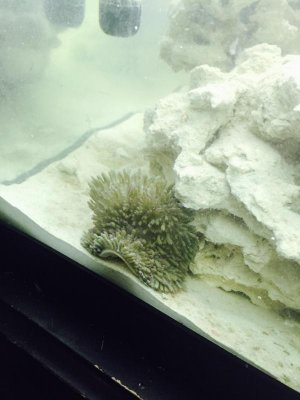
 
An added update.. I tried to set the nem on the deepest part of the sandbed, nestled between some rock and it just climbed out and allowed itself to roll away. He's currently between the glass and live rock with his foot facing the glass. His foot looks amazing and healthy but over the past.. Thirty minutes or so, the strangest thing happened. The anemone's foot seemed to.. Swell? I guess with water I'm assuming. The anemone didn't envelope its tentacles in itself like I've seen but they did get shorter. Then all of a sudden I looked up and the tentacles had spread back out and the foot looked like it had a sunken in spot. In fact, as I was typing this the nem once again is swelling up except this time the left side underneath the tentacles (looks like a table) has a slight swell. And once again.. As I type this it's changing again. The entire anemone seems to be swelling up on the top under the tentacles. This is the most activity I've seen from the anemone since I added him to the tank.. So should I leave him on his side between the glass and rock even though he's not attached?

P.S. I turned the lights back on and then all of this activity started.
 
First, we need more specific information about your tank, including: age, temp, salinity, ph, alk, ammonia, nitrite, nitrate and phosphate. Also, do you have a sump and skimmer?

Second, I doubt those LED strips will provide enough light for the nem, especially with the glass top.

Third, did you shut the powerhead(s) when adding the nem?
 
Age is probably 14 months or so. Over a year. Temp has been steady lately between 80 and 82. The SG is hovering at 1.026 but when I get off I'll be topping it off so that should drop some. As far as my levels I'll have to check the test results when I get home, I know they were all good though. Just had a water change two days ago. And no, the tank is sumpless and skimless. I haven't really had any problems with much algae so I've gotten with it so far but it's definitely on my tank bucket list. Lol.

I was honestly concerned about the lighting myself but I thought since the curly thrived the way it did that perhaps the sebae would too. But after the research I did last night I'm starting to doubt it. I'd take the glass tops off except for the amount of evaporation I have without them.

And no, not at first. I turned it down and turned the lights off. But I turned them completely off for a good hour or so and the nem refused to anchor. This morning right before I left he had tumbled to a quiet spot in the tank but then he proceeded to scoot to the one spot in the tank that isn't completely lit so now he's in the "shade". I didn't know if I should mess with him anymore so I just let him be. I'm so scared I'll be coming home to a dead nem though.
 
SG of 1.026 is fine. I would maintain it there.

You will likely need to either remove the top or add a HOB skimmer (or both), primarily for oxygen exchange. Most anemones and corals require oxygen rich environments to thrive and a closed top tank with canister filer usually won't cut it. Also, although you usually should shut powerheads until a new nem settles, do not do so in your case until you remove the top or add an airstone. Your tank is probably on the brink of oxygen deprivation and any loss of water disturbance may kill of existing inhabitants.

Regarding top off, it is a necessary evil for a healthy reef. With an open tank, you are probably looking at about 3/4 of a gallon per day in evap. Do you have an RO unit to keep up with this?

Your sebae is a sand dwelling anemone and will need much more light than the curlycue. I would invest in better lighting ASAP.
 
Yeah, I have a home kit coming this week and in the meantime I'm paying $1.85 for 5 gal of RODI right up the road. I didn't know the glass was doing that.. I'll remove it. And I'll have to switch lighting then anyways since the LED's now sit right above the water. I checked all my levels just now and my salinity is still 1.026, nitrites and ammonia 0, nitrates <5ppm, pH 8.4, alkalinity 200 ppm.

Oh and this is what I found when I came home for lunch just now. Maybe he settled in? Scratch that his foot is still out. So he's on his side. Really stressed now. I don't want to lose this guy. For now do you think he'd stay towards the top of the reef for the better light if I put him there?

UPDATE: He also just moved enough to where I can see the mouth. It's not gaping open but it is slightly ajar. Should I try to feed him? I don't want to make the wrong move and make it worse.
 

Attachments

  • image.jpg
    image.jpg
    46.3 KB · Views: 15
I have glass tops on all my tanks - good at keeping fish in and evaporation down, and while they can cut down a bit on light transmission, just keep them clean (a little "Swiffer" duster is great for that). They tend to get a rather underserved bad rap honestly.

I do also run sumps with overflows, and have skimmers and significant flow, but oxygen deprivation really only becomes a problem at high temps with little surface turnover (oxygen is exchanged only at the air/ water interface). Throw another powerhead in there and point it at the surface a bit and you should be fine.

Light and water chemistry should be your primary concerns at this point (S.G. of 1.026 is fine), and whether the nem is a H. crispa or H. malu - hard to tell from your lone pic. Crispa can be found in the rocks or rock/ sand interface, whereas malus prefer a deeper sand substrate.
 
I have glass tops on all my tanks - good at keeping fish in and evaporation down, and while they can cut down a bit on light transmission, just keep them clean (a little "Swiffer" duster is great for that). They tend to get a rather underserved bad rap honestly.

I do also run sumps with overflows, and have skimmers and significant flow, but oxygen deprivation really only becomes a problem at high temps with little surface turnover (oxygen is exchanged only at the air/ water interface). Throw another powerhead in there and point it at the surface a bit and you should be fine.

Light and water chemistry should be your primary concerns at this point (S.G. of 1.026 is fine), and whether the nem is a H. crispa or H. malu - hard to tell from your lone pic. Crispa can be found in the rocks or rock/ sand interface, whereas malus prefer a deeper sand substrate.

Key distinction in your case is presence of a sump and skimmer, which are the most efficient for gas exchange. OP has neither so, IMO opening the top or adding a HOB skimmer is a must. Just adding more flow won't solve the problem - no matter how much more you disturb the surface water, if glass isn't letting in fresh air, it will have minimal effect.
 
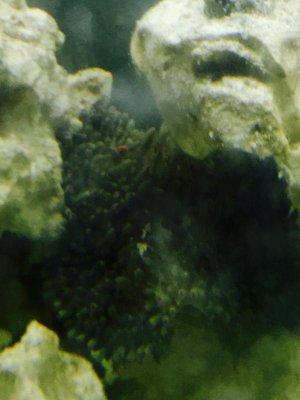
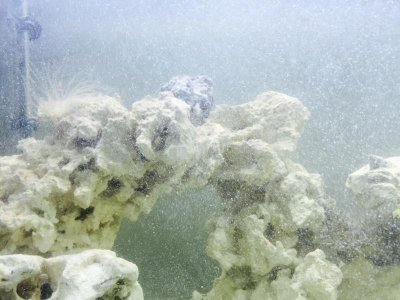
I honestly wanted a sump but the tank didn't come drilled and I didn't want to risk it myself. I've heard there's other ways to run a sump without drilling so I might look into that. Anyways, before I left I placed the nem in a "cranny" of sorts on the rock and fully expected it to move away. But I came back to the following.. Seemed okay, maybe even finally anchored. But it's not an intense light area so I wonder if he's just stuck. Then on closer inspection I noticed his mouth was noticeably open. He hasn't ate since who knows when but I doubt that would cause it. He's not bleached or shriveled or anything.. Even inflated a minute ago. But I can't really see his foot to see if he actually set it. Oh and I thought about putting him on the highest point (3rd pic) in the tank but the curly currently dominates that area and it's the first area to really feel the powerhead. Would he actually stay up there because of the light? And what do y'all think about his current behavior? After posting I'm going to try and target feed some frozen mysis. If no luck, I'll go buy something fresh to try. I'm gonna do everything possible to save this guy. Lol.

P.S. I don't know how these phone pics will turn out so the nem is a greenish tan color with radiantly purple tips.
 

Attachments

  • image.jpg
    image.jpg
    57.9 KB · Views: 18
Second picture of nem showing his mouth. Hard to see, I know. It's to the right sorta. It's not gaping but it's noticeable. And I still haven't noticed an expulsions of fluids or innards.
 

Attachments

  • image.jpg
    image.jpg
    43.6 KB · Views: 10
that pic doesn't look like a tank that's 14 months old. you don't have enough flow and you don't have enough light. You picked one of the hardest nems to keep
 
Final picture of the high spot. In the upper third of the tank. To the right side of the arch there is a "hole" of sorts that he could settle into I think very nicely. Oh and I must say that the anemone seems the most spread out and open in the current spot since he arrived.

Oh and sorry about the salt particles or whatever that is. The powerhead stirs them up and I haven't figured them out yet.
 

Attachments

  • image.jpg
    image.jpg
    71.6 KB · Views: 13
that pic doesn't look like a tank that's 14 months old. you don't have enough flow and you don't have enough light. You picked one of the hardest nems to keep

I recently added a bunch of Marco white rock in February and the glass needs to be wiped down. Yeah, I could have more flow but I haven't really needed it and the lighting has worked wonders until now. Thanks for your opinion though.
 
the old rule of thumb is 6w per gallon at least so you need over 300w fixture your turn over rate from power heads should be about 30x. I have a 55g with two Hydor Koralia 4's 1400gph each and a Mag drive 3 350gph and a 102 3w LED's and my Rose Bubble Tip is doing great. I am also finding I still don't have enough flow and getting ready to upgrade to 2 Jaebo RW8's. If you added some rocks in Feb you started another cycle. Have you checked you NO2, NO3 and PO4 levels?
 
the old rule of thumb is 6w per gallon at least so you need over 300w fixture your turn over rate from power heads should be about 30x. I have a 55g with two Hydor Koralia 4's 1400gph each and a Mag drive 3 350gph and a 102 3w LED's and my Rose Bubble Tip is doing great. I am also finding I still don't have enough flow and getting ready to upgrade to 2 Jaebo RW8's. If you added some rocks in Feb you started another cycle. Have you checked you NO2, NO3 and PO4 levels?

+1. Tank looks very immature and adding new dry rock will throw you into another cycle.
 
Key distinction in your case is presence of a sump and skimmer, which are the most efficient for gas exchange. OP has neither so, IMO opening the top or adding a HOB skimmer is a must. Just adding more flow won't solve the problem - no matter how much more you disturb the surface water, if glass isn't letting in fresh air, it will have minimal effect.

I did note the difference for a reason, but I also highly doubt that the top is fully sealed. Without an oxygen probe (not commonly employed by most hobbyists), making an assumption that an aquarium is running an oxygen deficit is just that - an assumption. Most would be surprised how influential surface agitation and water column turnover is to oxygen saturation. I do think the OP would be better served to add another opposing powerhead, and also think the use of a skimmer is probably warranted, but primarily for nutrient removal though - oxygen saturation is a bonus.

the old rule of thumb is 6w per gallon at least so you need over 300w fixture your turn over rate from power heads should be about 30x. I have a 55g with two Hydor Koralia 4's 1400gph each and a Mag drive 3 350gph and a 102 3w LED's and my Rose Bubble Tip is doing great. I am also finding I still don't have enough flow and getting ready to upgrade to 2 Jaebo RW8's. If you added some rocks in Feb you started another cycle. Have you checked you NO2, NO3 and PO4 levels?

The old watts per gallon rule will not apply with LED usage, where PAR is a better indication of overall useful illumination.

Also, if that nem is indeed a H. malu, then that turnover rate is unnecessary - mine have never "appreciated" intense flow. The OP would be best served to either leave it alone (and do not contemplate feeding it at this point) and let it "settle in", or take it back to the LFS and work on improving the aquarium conditions for the "next time".

+1. Tank looks very immature and adding new dry rock will throw you into another cycle.

That would only apply if the rock was contaminated with a significant load of nutrients. Nutrient-free dry rock will contribute nothing but additional surface area.
 
I did note the difference for a reason, but I also highly doubt that the top is fully sealed. Without an oxygen probe (not commonly employed by most hobbyists), making an assumption that an aquarium is running an oxygen deficit is just that - an assumption. Most would be surprised how influential surface agitation and water column turnover is to oxygen saturation. I do think the OP would be better served to add another opposing powerhead, and also think the use of a skimmer is probably warranted, but primarily for nutrient removal though - oxygen saturation is a bonus.


The old watts per gallon rule will not apply with LED usage, where PAR is a better indication of overall useful illumination.

Also, if that nem is indeed a H. malu, then that turnover rate is unnecessary - mine have never "appreciated" intense flow. The OP would be best served to either leave it alone (and do not contemplate feeding it at this point) and let it "settle in", or take it back to the LFS and work on improving the aquarium conditions for the "next time".


That would only apply if the rock was contaminated with a significant load of nutrients. Nutrient-free dry rock will contribute nothing but additional surface area.

All dry rock will have detritus unless it was somehow sterilized beforehand through acid bath or similar. Indeed, OP said he used Marco rock which is uncured and it is common knowledge that Marco rocks take several weeks to months to cure. Large assumption to say it is "nutrient free." Essentially, OP is dealing with a <1 month old tank.
 
All dry rock will have detritus unless it was somehow sterilized beforehand through acid bath or similar. Indeed, OP said he used Marco rock which is uncured and it is common knowledge that Marco rocks take several weeks to months to cure. Large assumption to say it is "nutrient free." Essentially, OP is dealing with a <1 month old tank.

Yes, dry rock often has detritus, but it doesn't need "sterilized" - acid baths strip away the surface layer that may contain phosphate - not a given, but dependent on the rock itself, and acid baths are often commonly done to "renew" previously used rock. I have never come across dry rock that needs "cured" - a term used to process die-off from fresh live rock. I recently restarted my 9g with dry rock, and had zero nutrients leaching from the rock - I know because I checked with proper equipment.

I made no assumption with the term "nutrient-free", but simply stating that adding dry rock will result in a new cycle is false - a cycled tank can process nutrients much more efficiently than a new sterile tank. It is also dependent on the amount of potentially "nutrient-laden" rock that was added, and whether it had been rinsed/ soaked prior to introduction to the tank.

I am also not aware of the "common knowledge" with regards to Marco rocks, and I doubt most aquarists using it have to wait "several weeks to months to cure" it. I have seen many threads here and elsewhere where it is used with minimal prep. While it is indeed possible the OP now has a "<1 month old tank", it is an assumption to state such without proper testing...
 
Last edited:
Not to mention additional impurities that naturally leach off of new dry rock . . .

What "impurities"? Dry rock is most often fossilized reef that is terrestrially mined, so once rinsed or soaked what is leaching off of it?


I feel like we are getting off track - the OP has chosen an animal that may require more experience that they have currently, and the general layout of the tank leads me to believe they would be better served to return the animal, study a bit , and "return to the arena" once they are better prepared both intellectually and materially...
 
Back
Top