Newish tank, good parameters, algae killing zoos?

gimmea250swb

New member
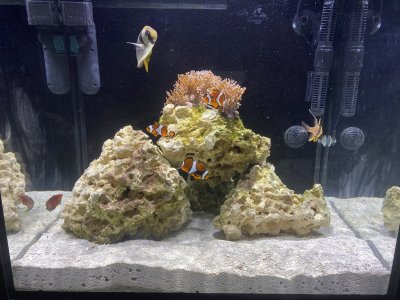
I’m new to the hobby after 20 years away. Roughly 75 gal waterbox. Bought established, but moved here roughly 8 weeks ago.

Ammonia: 0
Nitrite:0
Nitrate:2
Phosphate: 0
pH: 7.6 (4 hours after lights out)

Vectra return pump: 42%
Orbit 1: 59% random
Orbit 2: 59% random
Nero 5: 50% random
2x Radion XR15w G6pro: 80%, 8 hours

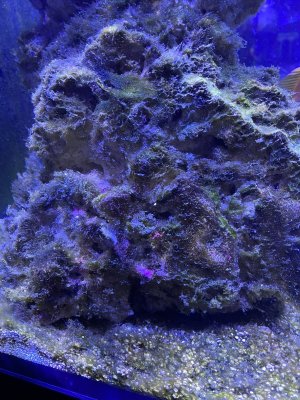
red/green hairish algae is mostly on top facing rock, but it looks like there is some cyano here and there.

Reddish algae on sand

Algae is on all my zoo/clove plugs and one set of zoos stopped opening after I tried to remove algae.

Less than 10 snails and added a lawnmower last night but he’s still spooked.

Toadstool, purple tang, clown came with purchase. Still alive. Feeding once per day nori and a small pinch of pellet food.

Ro/di reads 1ppm

Photos taken after 4hrs lights off.

Zoos in left photo haven’t opened in 3 days

Is it safe to dip zoo/polyps in hydrogen peroxide to kill the algae or too stressful for zoos/cloves?

Suggestions on how to fix this mess?


IMG_0441.jpeg
IMG_0440.jpeg
IMG_0438.jpeg


IMG_1458.jpeg
 
What filtration do you have? Is the water box and all in one?

You moved the tank 8 weeks ago so, you’re probably in the process of a mini cycle.

Parameters are decent but phosphate is a tiny bit low. It’s likely because the algae is taking up all the nitrate and phosphate. What is your Alkalinity and Magnesium?

Slow and steady will win the game. You’re not gonna to fix this overnight. Manual removal of the algae, regular water changes, and the addition of some additional clean up crew couldn’t hurt.
 
Pretty much what @griss said. It looks like your in the middle of an ugly stage as the tank re-stabilizes. I would try to boost the nitrate and phosphate as we no longer shoot for 0 numbers. I’d also boost your clean up crew.

As to the hydrogen peroxide dip, it should be perfectly safe as long as you follow the recommended guidelines. Most people in my experience use these:

 
Pretty much what @griss said. It looks like your in the middle of an ugly stage as the tank re-stabilizes. I would try to boost the nitrate and phosphate as we no longer shoot for 0 numbers. I’d also boost your clean up crew.

As to the hydrogen peroxide dip, it should be perfectly safe as long as you follow the recommended guidelines. Most people in my experience use these:

Thank you both. I’ll stop buy on the way home and grab some snails
 
Your lighting is the sole cause. It's too bright with too much white spectrum

Prediction: if you continue hands off mode on the tank, adding snails isn't hands on, you will still be dealing with this in September.

But if you rip clean your tank and fix the lighting in response to your system feedback you can have a clean tank by Saturday. Not one reefer on the planet nowadays will choose the hands on fix, 100% of them will continue hands off mode and accept the tank as it is. They will start with snails, then try parameter adjustment, then get dinos.

Refusing hands on mode is about to delay your tank enjoyment years. This isn't being bleak, you have a way to get off this train but we're trained not to do that. Your challenge is one of choice not biology. If you want to see a thread that shows several tanks like yours fixed, let me know

Adding in snails and assorted indirect controls from a pet store is a massive disease risk for your fish.
 

There's a thread showing complete resistance to any hands on mode at all

What's the time frame he's dealing with there (coming up two years full resistance=wrecked tank bad for animals doesn't care)

If you want results opposite from that, and by Saturday, what would you choose?

See how invaded reef tanks are a choice vs a chemistry challenge?

We will get outside and manually clean up a filthy dog pen that's rotting the backyard, but a reef tank/ nope/ we will refuse to clean it out of sheer digging in heels, it's the strangest pattern among pet hobbies.

Your tank needs manually cleaned so that it's algae free. By you, not an animal. If you want to see how it's done, there's threads with ten reefs like yours fixed available to copy.

Here's one
before:

Algae Problem.jpg

after
done by hand, not snails, this was a reefer with no hesitation attitude (.001%)

Finished Tank.jpg

The lighting is white there to show pic details. It now runs heavy blue and less power than the before pic.


Notice the sand. In the prior picture even the sand is covered in waste. In the after pic, the sand is clean. Your entire tank needs cleaning, not a dip for the corals.

Hardly any reefers will choose the fixed by Saturday option, it's fascinating reef psychology. The reef gets to stay bad for years but the cats and dog get the top level care, that's what we do.

It's true that all new reefers didn't know that algae battles don't have to be a 36 month work in progress. The strange part is even after showing them, just about 100% will still choose to make it that way.

Invaded reef tanks are a choice matter, we choose to keep them invaded after seeing such progression pics available

We're taught that chemistry causes this, no it doesn't. We didn't use chemistry to get that 24 hour turn around, we only needed a willing reefer, all rip cleans come out looking the same way. So will yours

algae grows in perfectly good water, it takes physicality to target algae and remove it.

The way we would work your tank is in sections since it's a larger system than a small nano. We'd have you do all the rocks first one at a time, cleaned off outside the tank in a special way over the course of a few days. No deep cleaning at the start, just detailing the rocks to get them back into compliance

then at the end you'd clean the sand a special way (special meaning there's real work involved/ hands off mode ends)

As soon as work is involved that's where we lose the 99.999999% of willing reefers. The ones who have resolve made those progression pics.

We're responsible for the way our reef looks day to day. It's not a parameter or lack of an animal we can blame.

Having an internal locus of reef control fixes your tank by Saturday

an external locus of control means you'll be dealing with this still in 2028 = simple choice

Some find that statement angering; some don't, it's simply a reflection of responsibility in reefing.

Standards wanted can be attained, by Saturday in fact.

How serious are you about wanting a fixed reef tank
 
Last edited:
Just one more of the 2000 jobs logged on websites for manual cleaning by Saturday in case we get lucky here

Before

ap1-1.jpeg


During: this is how rocks are cleaned of algae. Using a knife and detail scraping it off and rinsing with saltwater then a little peroxide on the cleaned part of the rock but not a dip and no peroxide is applied to corals where algae wasn't growing. Your toadstool doesn't have algae growing on it, so you wouldn't dip the toadstool. You'd surgically detail that rock outside the tank then set it back in fully detail cleaned

ap5.jpeg


After
Not a dip, an entire tank cleaned the right way with no 36 month delay, another .001% 'er

ap7-1.jpeg


See the lighting change between the two progression pics


Which reefing choice option is great quality for the fish, and looks sharp? Chemistry didn't get us that turnaround. Willingness to work did

This is tough love truth, it's not being reef mean :)

A non wrecked tank by Saturday is a real option. I won't be mad if you don't take it, nobody does nowadays.

Those pics were from 2020. Standards are slippin' in the hobby nowadays. Old school will it into shape is a forgotten (resisted) option.

Look up anyone's current dinos or algae help thread on any reef forum. You'll see the 36 month/ never getting fixed option in place. Whatever is the least work is what's chosen in 2026.

Then we just throw everything out and start over. Attitude is why today's reef tanks last 3-5 yrs max, it isn't a biome or chemistry issue at all.

We choose this, that's fascinating reef psychology.

The choice you make shapes how you will approach reefing for the rest of your time in the hobby. If someone told me this with pics in 2002 it would have saved me about six reefs to arrive at 2026 this way.

You'll either reef as a constant work in progress, or you won't. It's a choice.

Snails do have a 4% chance of helping, pics exist for that. But if snails worked more than 4% of the time nobody would be a 36 month work in progress.

Snails don't help with dinos, manual control fixes all reef invasions so start with the guaranteed approach for best habit training

I forgive you for not taking the option :)
 
Last edited:
Here's my two cents nickel's worth; Patience. Get some urchins, research clearly show herbivores are essential for healthy reefs (1) (2) (3). (My favorite are rock urchins, Echinometra sp., they scrap rock really clean and don't carry around frags.) Another technique that has worked well for me for several decades now has been using straws to scrape and siphon algae mimicking teh scraping action of parrot fish and urchins (I use [/URL]steel straws now). FWIW, I don't do more than 10% water change per week using steel straws to remove algae I also do not siphon algae into a filter sock to reuse the water as that only adds to the detrimental DOC in a system [1] [2]. For sand I'll use straws to just siphon off the surface layer, then do one of two things, first rinse off in saltwater then return to the system or I'll rinse in H2O2 then fresh water then return to the system, sometimes one works and the other doesn't and sometimes niether works but it's reduced the algae. Did I mention patience? I will occasionally remove rock to scrub it but from what I've seen in your system I wouldn't bother if it was my tank. I would be doing weekly 5% - 10% water changes for awhile.

Oh yeah, patience is real important. You're not fixing your reef's ecosystem, you're helping it fix itself and trying to rush it invariably ends up in frustration.

Unless you have the settings or PAR levels your coral grew under I'd be inclined to just leave them. All the corals you shown are fairly hardy and able to adapt to different light levels and changing light settings is just throwing another variable into the mix and your corals are already adjusting to current settings. I don't see any need to make them start adjusting to different settings, wait until your system is past teh "uglies" to mess with lighting to bring out better colors. You can dip the frags in H2O2, I'd use 6 parts aquarium water to 1 part H2O2 and just leave them in it for 2 miutes then rinse in clean aquarium water and return to the system. Keep in mind it is impossible to set up a system where every coral is happy, even if all the parameters we can test for are the same there's a lot going on we can't test for and there's some pretty complex biological warfare going on*.


If you can find a copy of Forest Rohwer's book "Coral Reefs in the Microbial Seas" ch 5 has a good description of how the equilibrium of a reef ecosystem can shift between different states, either promoting algae or promoting corals. It cover's DOC like his video linked above does, but it also covers details not mentioned in his video, The book and video complement each other and I'd encourage you to examine both.


*These two papers hint at some of the complexity we're dealing with:


That was my birthday in April :)

Not a car guy in fact I have a video of my engine shaking I need a car guy to diagnose


Thank you for not letting my algae soapbox off put you!

=got grizzled after 23 years of reefing online

Here's the thread the pics came from.


*there's decent argument at the start from naysayers so ignore that and just consider the links and pics from the actual jobs ran.

Notice nothing died, nobody crashed, they were willing to be thorough and not customize the approach so that consistency keeps all reefs safe.

There is an order of ops used in every tank to prevent a crash/recycle upon setting back up.

If we work your tank in sections since it's larger volume that is opposite so we'll need to plan carefully

I think it'll be practical once prepared for you to lift out rocks and detail them and set them back in without having to take down the whole tank, depends on what your full tank pics show

post a full tank picture here so we can see the sandbed details. This is just brainstorm stage for preps, no action required other than lighting adjust that'll help you without any risk. You can get the light reduced and more blue without harm to corals, they like the setting.

Quick summary: I think your tank is larger than these nanos your job is on the high end of effort. It's easy when the tank is only twenty gallons for example so we're just brainstorming here so far.

But the principle still holds: light is your cause most likely and physical controls work best. And you can still remove one or more rocks and detail them and set them back onto not clean sand. Perhaps your sand isn't so bad with waste being new, but it's possible. The key will be not stirring up waste in the tank when lifting out rocks, that clouding can kill sometimes so before any action is taken we should see full tank picture first and plan carefully.

These jobs above were completely safe because the tanks were taken down and the rocks and sand were cleaned externally, then the whole tank was put back together with fully rinsed sand + surgically detailed rocks.

No ammonia testing was done and no bottle bac was used in any job, even though this seems extreme the filter bacteria on rocks are preserved so that's why nobody's tank crashes. It's because we cleaned fully all at once; when you work in sections that upwells waste and casts it around the tank, that's unsafe.

This next thread is important to study patterns in skip cycle reef handling.


This thread above are the *exact* same steps, without variance, but it's used to skip cycle reefs into new homes or new tanks.

That thread does include rip cleaned systems up to 250 gallons, because they were moving homes and had no choice, they had to disassemble. am showing that in both threads we had different reasons to deep dive the tank but the order of takedown and assembly doesn't change and that's why no reefs died. As soon as we start kicking up bad sand in the presence of fish/ something will likely die.

Rip cleans are how to move reefs and never crash. Rip cleans are how we fixed those wrecked nanos in the first thread; the order of ops doesn't change regardless of reason to put a reef tank into surgery. I'm wanting you to see that regardless of tank size the handling steps and rules for how to handle sand don't change.

You could easily fix lights today and remove one rock off the very top, work it, and set it back for practice. That won't hurt anything.

We shouldn't do more than that without planning.

So an interesting reef rule is under scrutiny there: we've been told sandbed bacteria are crucial for reef balance and we can't live without them

Is that true based on the patterns shown?

Sandbed bacteria aren't your algae cause, but the rules formerly stated about sandbed bacteria set the cleaning boundaries. Due to perceived tight cleaning boundaries, thousands of old school reefs allowed algae to build up because they thought the system would die if deep cleaned. Not so, we see in ten years of work logged above.

Final summary:

partial cleaning kills tanks because of upwelling waste in the sandbed, rot, this kills things

It wasn't the lack of bacteria that kills, it's the cloudy waste kicked up. Hesitant and scared handling kills reefs.

Deliberate, planned and confident handling using a safe order of operations + total sandbed cleaning saves reefs. There's no middle ground. Practicing on a few top rocks in your scape and setting them back in is easy and safe.

And now you see why many large tank owners go without sand: it creates a giant headache in our reefs 9/10 times. If it weren't for sand we'd have just been lifting out rocks and setting them back in without all the fanfare.

 
Last edited:
@gimmea250swb You're getting a valuable lesson here. In this hobby, there is not a single correct way to do things. People tend to develop their methods and are either a success or a failure. Unfortunately, way more people have a single failure and quit the hobby (from what I've seen over the years) than those the resolve the issues and remain in the hobby a long time.

As you can see, Brandon429 and Timfish have almost polar opposite methods of dealing with problem algae and both have been in the hobby and on the message boards for a long time. I've seen Timfish's tanks over the years and can attest he is a very successful reefer. I just realized, I don't recall ever seeing pictures of Brandon's tanks...if I did it was probably years ago and I just don't remember.

That said, experiment, take your time and find what works for you.
 
Back
Top