
Pairing Potters Angels (Centropyge potteri)

solitude127

Proud user of IO Salt!
I have a pair of Potters angels in QT right now. One is visibly larger than the other. I currently have the smaller in a acclimation box inside the QT tank with the larger one. How long should I leave the smaller one in the acclimation box?
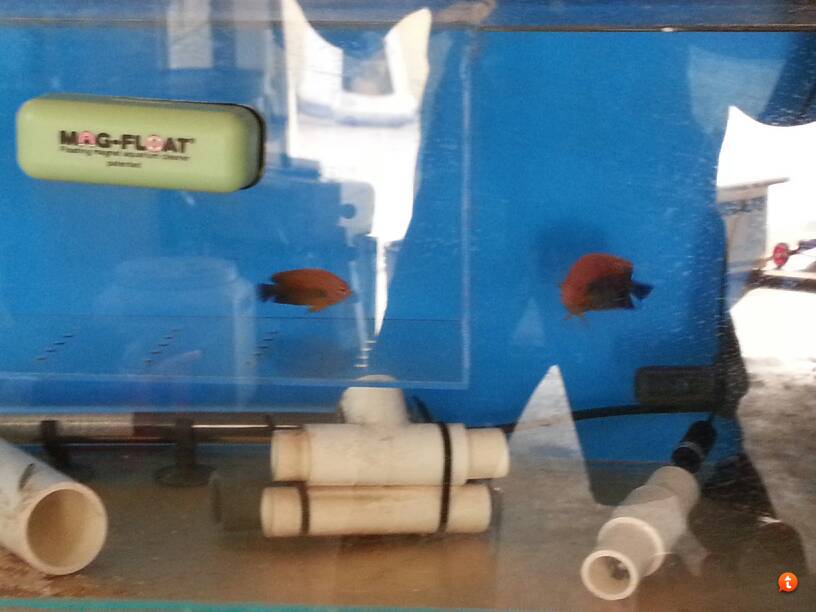
 
3uva3yhe.jpg
 
Are you noticing any indications of aggression from the larger specimen? If not, then I would say let the smaller one go and keep an eye on them to see how they interact.
 
This may help...
Is from 4/04 'Hawaiian Fishes" when the Potter's was their fotm...

POTTER'S ANGELFISH
Centropyge potteri (Jordan & Metz, 1912)
The only truly common angelfish species in Hawai`i, Potter's Angel is rusty orange overall with many irregular, vertical gray-blue lines. The orange darkens to bluish black on much of the lower side and this dark area is larger in males than in females, making them easy to distinguish in the field (i.e. females show more orange). The edges of the rear fins are striped horizontally with bright blue and black. Males have more blue on the fins than females and their bodies are slightly more elongate. Some individuals are much darker than others and a rare all blue-and-black specimen has been photographed by Hiroyuki Tanaka.
Potter's Angels live in pairs or in small groups of a male and several females....

Male- O'hau 25ft

female- O'hau 100ft

male- O'hau 100ft
 
might consider putting the smaller one in the tank and the larger in the box for a few days...

Thanks for the suggestion. I thought about that when I put them in there but put them in there that way for some reason. This evening I changed them around.

If I read correctly, these fish are hermaphrodites, correct? So assuming these 2 specimens I have are still juveniles, they'll change to appropriate sexes correct?
 
Is the larger one from you display that I saw listed in your TOTM article? The amount of blue/black I see on it makes me think it is already a male. The smaller looks like a juvie/female, in this case it should become a female, if not already, with the male being present.
 
Sorry for the confusion, Centropyge are protogynous hermaphrodites. They start out as females and turn male as environmental conditions allow.
 
Is the larger one from you display that I saw listed in your TOTM article? The amount of blue/black I see on it makes me think it is already a male. The smaller looks like a juvie/female, in this case it should become a female, if not already, with the male being present.

No, unfortunately, my friend was holding that one for me and he had a mini crash. These are 2 new specimens.

When these fish become mature and are solitary, do they always become males?
 
No, unfortunately, my friend was holding that one for me and he had a mini crash. These are 2 new specimens.

When these fish become mature and are solitary, do they always become males?

I hate to say something "always" happens in this hobby since there are many variables with most everything. The factors that cause a female to turn male aren't completely understood, but I would only advise adding a smaller specimen to an existing one since the probability of a mature, solitary specimen being male is quite likely with Centropyge.
 
Since I saw no aggression when the larger was in the acclimation box and when the smaller was in the acclimation box, I decided to let them out. So far, so good, no aggression towards each other. They were swimming together when I first released them.

Now that they're in the QT together, what's the best way to get them to eat? The smaller one was eating misys but was spitting them out. The larger one hid when I came close to feed. Any suggestions on food?
 
Are you treating for anything? If not, I would move a piece of live rock or two into there. It will give them something to pick at until they are eating for you.
 
Are you treating for anything? If not, I would move a piece of live rock or two into there. It will give them something to pick at until they are eating for you.

No, not treating for anything yet. I wanted to get them eating first. Thank you for the suggestion. I'll give it a try.
 
Good luck, one of my favorite angels but have yet to find one available thats eating.

IME, even if they are eating, there is still a good chance that the fish will suddenly die in the first few months!
 
The good news is that I saw the smaller one eating Nutramar Ova but the larger one hid when I came close to feed. I'm hoping the larger one is just settling in. More updated to come.
 
Not sure how close Potters and Flame Angels are in the pairing department but my Flames took about 3 months to pair up before the male stop trying to kill the juvy female. My female used the many birdsnest I had in the tank at the time. After a month I knew it was going to work out when the female would shoot out of the coral grab food from the male and run like heck. Good luck with your pairing, for me it has been rewarding.
 
Back
Top