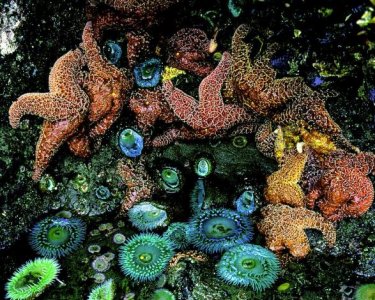
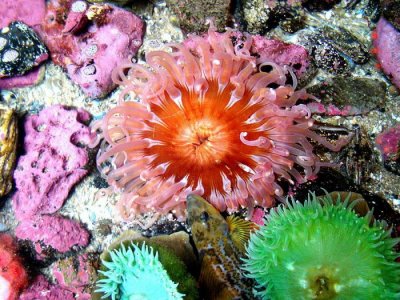
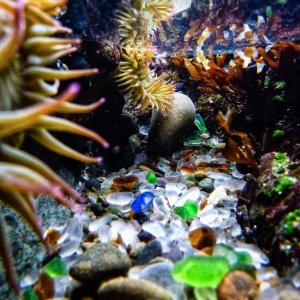
Hello everyone, so after doing quite a bit of research on outdoor saltwater ponds it seems like either everyone gave up or tried and failed to maintain an outdoor saltwater pond. But, I noticed one thing... all the ponds i saw were saltwater tropical based and that got me thinking. Could there be a more suitable biotope for an outdoor saltwater pond? I believe there is a great alternative that provides hardy, colorful creatures that can survive swings in salinity, temperature and whatever else may come they're way. These creatures are widely known as rockpool or tidepool inhabitants and are not only beautiful but very tough as well. In their natural habitat they are constantly battling the elements. Now more specifically Coldwater or temperate fish and invertebrates is what I'm talking about. Relatively new to the private aquarium world not many stores sell cold water creatures. but to name a few that I believe would be great for a saltwater pond: (Anthopleura xanthogrammica, or the giant green anemone, The beadlet anemone, Actinia equine, The strawberry anemone (Actinia fragacea), Pisaster ochraceus, generally known as the purple sea star, Treefish (Sebastes serriceps), purple or green sea urchins. Also various macroalgae. They're temperature range is from 55F- 70F. which leaves a lot of wiggle room. Feeding is minimal if the pond is set up right. Although its not a conventional "Reef" I believe it brings its own beauty and hands on personality. Now Filtering and Pump would be expensive, but I cant see it being much more than a conventional pond. Also a chiller would be needed for a short time during each year depending on where you live or even a heater if you live in a Very cold place. ANY feedback would be greatly appreciated. I really think this type of saltwater/touchtank style pond can work. I DO NOT OWN THESE IMAGES. they are natural photos of coldwater tidepools off of google.-Jacob

You are using an out of date browser. It may not display this or other websites correctly.
You should upgrade or use an alternative browser.
You should upgrade or use an alternative browser.
Possible outdoor Saltwater pond theory (NEW)
- Thread starter Saberjnl
- Start date

Whiterabbitrage
New member
If I hadthe money, yes I would try to set this up. I would probably set up the tidepooling in an Unheated greenhouse to give it a bit of stability in temperature and protecting from salinity swings and random junk falling in the water. But yes, I'd set this up. Cold water specimens are so colorful.
Without greenhouse
Without greenhouse
Do you think this could be setup outside of a greenhouse? I think it could.
Even with just a covering like an arbor or something like that. a sort of roof.
Without greenhouse
If I hadthe money, yes I would try to set this up. I would probably set up the tidepooling in an Unheated greenhouse to give it a bit of stability in temperature and protecting from salinity swings and random junk falling in the water. But yes, I'd set this up. Cold water specimens are so colorful.
Do you think this could be setup outside of a greenhouse? I think it could.
Even with just a covering like an arbor or something like that. a sort of roof.

bundybear1981
New member
IMO outside a greenhouse would be very difficult. Things such as wildlife, pets ect could get easy access to it and contaminate it. Not saying it couldn't be done thou, just be much more difficult then if its confined.

A little input from a pond owner (freshwater): I run a 5000 gallon koi pond (in addition to my saltwater and freshwater tanks) and it can lose 30 gallons a day easily, up to 300 in very dry warm weather. I use aeration from a waterfall, and of course surface exchange. You also have problems with infall from the environment. When we had smoke in the air from the forest fires, the pond chemistry went from cinch to running battle. You are never isolated from what's going on with the environment, be it excessive heat, or two weeks of daily rain, or whatever, not even mentioning a neighbor's lawn crew deciding to spray. It's a balancing act with freshwater. Maintaining aeration and clarity with saltwater would be more than a tick harder.

AquaticEngineer
New member
I've gone through this idea almost fully to completion many times 
Its easier for me though since I run a temperate/coldwater livestock supply business
A few things to key in on though if you decide to push forward.
1) Evaporation will be minimal despite what people may say. I actually have more evaporation on my large holding systems in the winter than I do in the summer because that is the only time of year that the air around the tanks gets below the water temperature. Water will only evaporate into the surrounding air when the water temperature is above the air temperature.
2) Rain. Biggest issue for me (I live in Oregon) to overcome an outdoor coldwater marine pond is the amount of rain I get. You would very likely have to have it either under a covered patio, or with some sort glass roof/arbor, etc to prevent massive decreases in salinity when it rains.
3) Check out an old hot tub. You may laugh at first, but thing about it. My eventual plan is to use an old hot tub that someone is giving away because the heating element went out on it. They are already insulated, water tight, plumbed with jets for returns, you just need to spray foam or faux rock the inside with texture and loop a chiller into the plumbing where the heating element use to be. I'm planning to put mine next recessed into deck and build a covering with sky lights above it for light.
Its easier for me though since I run a temperate/coldwater livestock supply business
A few things to key in on though if you decide to push forward.
1) Evaporation will be minimal despite what people may say. I actually have more evaporation on my large holding systems in the winter than I do in the summer because that is the only time of year that the air around the tanks gets below the water temperature. Water will only evaporate into the surrounding air when the water temperature is above the air temperature.
2) Rain. Biggest issue for me (I live in Oregon) to overcome an outdoor coldwater marine pond is the amount of rain I get. You would very likely have to have it either under a covered patio, or with some sort glass roof/arbor, etc to prevent massive decreases in salinity when it rains.
3) Check out an old hot tub. You may laugh at first, but thing about it. My eventual plan is to use an old hot tub that someone is giving away because the heating element went out on it. They are already insulated, water tight, plumbed with jets for returns, you just need to spray foam or faux rock the inside with texture and loop a chiller into the plumbing where the heating element use to be. I'm planning to put mine next recessed into deck and build a covering with sky lights above it for light.

karimwassef
Active member
why wouldn't you want to put it in a greenhouse?
it's the cheapest and easiest method to gain a large degree of control, reduce risk and control cost.
You're basically setting up a garden. Unless you're in the exact same environment as the plants you're cultivating, you would use a greenhouse.
it's the cheapest and easiest method to gain a large degree of control, reduce risk and control cost.
You're basically setting up a garden. Unless you're in the exact same environment as the plants you're cultivating, you would use a greenhouse.

I would love to do a big saltwater pond. Keeping many of the fish, corals and inverts would be impossible but there are species that do see annual temps drop into the 60's which makes heating it a bit more manegable here in central Texas. Leaf debri would certainly be a serious design issue. But the biggest issue I see is we can see a foot of rain in a day and 6" in an hour happens around here somewhere every year. Covering the pond would be an option but using a really big reverse osmosis system to remove the fresh water and dump the saltwater back into the system would have to be part of the design in my opinion.
I can definitely see debris as a problem in an outdoor design.
Rain water I feel can be managed either from a system that recycles the water or more simply a covering over the pond and a setup which doesn't allow run off water to get in.
And from the input from AquaticEngineer that makes sense regarding evaporation. You would know more about that considering your business. Also that old hot tub would definitely work as a piped shell. Great idea. :strooper:
Have you seen first hand in your holding and breeding tanks that if any debris fell in it could adversely affect the animals?
My whole idea was to have this outside of a greenhouse to have a more open feel so that's the design ill be brainstorming.
Rain water I feel can be managed either from a system that recycles the water or more simply a covering over the pond and a setup which doesn't allow run off water to get in.
And from the input from AquaticEngineer that makes sense regarding evaporation. You would know more about that considering your business. Also that old hot tub would definitely work as a piped shell. Great idea. :strooper:
Have you seen first hand in your holding and breeding tanks that if any debris fell in it could adversely affect the animals?
My whole idea was to have this outside of a greenhouse to have a more open feel so that's the design ill be brainstorming.
karimwassef
Active member
Don't forget predation depending on what fish you have and where you live.
I put an external reef in my backyard and I just happen to live on a lake in TX that occasionally sees pelicans and seagulls... I quickly put up a greenhouse covering.
I put an external reef in my backyard and I just happen to live on a lake in TX that occasionally sees pelicans and seagulls... I quickly put up a greenhouse covering.
I've gone through this idea almost fully to completion many times
Its easier for me though since I run a temperate/coldwater livestock supply business
A few things to key in on though if you decide to push forward.
1) Evaporation will be minimal despite what people may say. I actually have more evaporation on my large holding systems in the winter than I do in the summer because that is the only time of year that the air around the tanks gets below the water temperature. Water will only evaporate into the surrounding air when the water temperature is above the air temperature.
2) Rain. Biggest issue for me (I live in Oregon) to overcome an outdoor coldwater marine pond is the amount of rain I get. You would very likely have to have it either under a covered patio, or with some sort glass roof/arbor, etc to prevent massive decreases in salinity when it rains.
3) Check out an old hot tub. You may laugh at first, but thing about it. My eventual plan is to use an old hot tub that someone is giving away because the heating element went out on it. They are already insulated, water tight, plumbed with jets for returns, you just need to spray foam or faux rock the inside with texture and loop a chiller into the plumbing where the heating element use to be. I'm planning to put mine next recessed into deck and build a covering with sky lights above it for light.
I think you are completely wrong about evaporation and water temperature.
So evaporation stops in the winter?
"Evaporation can take place at any temperature. However, increasing the temperature of a body of water also often increases evaporation. This is because as the temperature rises, the water molecules begin moving about more rapidly. This increases the odds that molecules will escape."
http://www.kidsgeo.com/geography-for-kids/0103-evaporation-and-temperature.php
http://www.kidsgeo.com/geography-for-kids/0103-evaporation-and-temperature.php
I think you are completely wrong about evaporation and water temperature.
So evaporation stops in the winter?
To be fair he did say that its minimal not that it stops.
AquaticEngineer
New member
I have evaporation on my systems that are in the garage when the air temp drops below the water temp (like right now at night it drops into the low 50's and the water is at 57F)
But the plus side to that is my chiller isn't running
However, my inside tanks that always run below my homes temperature don't evaporate a drop
But the plus side to that is my chiller isn't running
However, my inside tanks that always run below my homes temperature don't evaporate a drop
Last edited:
AquaticEngineer
New member
I think you are completely wrong about evaporation and water temperature.
So evaporation stops in the winter?
During the winter is when you'd see increased evaporation on a temperate/coldwater tank. More so if its exposed to outdoor temps and maintained at a constant temperature. Ideally on a chilled system exposed to the outdoors I would simply let it drop to a lower temperature, at least where I live in Oregon. When we go diving out here you'll see the water temps can easily be in the mid 40's in the winter, so I'd just let the system naturally drop in temperature during cooler months and run the chiller during warmer months. For extremely cool climates with an outdoor system you may have to set a heater at like 45F or 50F to make sure it didn't go too low.

nogascans
Member
This might or might not be common knowledge or relevant, but we visited the Discovery Cove in Orlando a few years back (on wife's bucket list to swim with dolphins). That part was OK for me, but they had a large open water Grand Reef with all sorts of S/W fish (lots of tangs and butterfly fish) that is exposed to the elements (thinking of rain and heat). This may have some relevance with modeling how they keep the water parameters in check.
https://discoverycove.com/en/signature-experiences/grand-reef/
Sincerely,
David
https://discoverycove.com/en/signature-experiences/grand-reef/
Sincerely,
David
karimwassef
Active member
The volume vs. surface area matters. If you had a million gallon underground sump, it wouldn't matter if a thunderstorm passed over your tank.
I had a similar problem with clownfish mating, so what I did was put them both in a 5 gallon in critter cages clear so that they (female and male) would get used to being together without fighting and now I hve 5 clownfish instead she laid 20 eggs only 5 survived *( so yeah it shoould work for you remember to trie to have 30 g or more tank and the right temp etc. So good luck also trie to remove bottom crabs etc
Similar threads
- Replies
- 10
- Views
- 3K

- Replies
- 378
- Views
- 105K
