Prophylactic Treatment in QT

Hi guys. Somehow getting back to this thread eluded me but I wanted to come back to the issue of the possibility of dormant Crypt.

Put me down as someone else who doesn't trust the info on saltaquarium.com. I'm not sure what their source of this information was but I have never seen anything like that documented in a scientific journal or any other trustworthy source.

However, I have documented at least one source (I think I have a couple others in my links here...) that mention the parasite being inactive/dormant for periods of months in some observed cases. Here's one such document from the Univ. of Florida.

IMO this is something that is rarely if ever discussed or considered when it comes to treatment of Crypt. and could be one of the culprits to blame when these reports of "ich appearing out of nowhere" (or whatever along those lines) are posted. Yes, there are few more likely ways that Crypt. "suddenly" finds it's way into a tank but I think this is at least worth mentioning for anyone who is attempting an ich-free tank and/or prophylactically treating for ich.
 
I think its safe to say that a long 6 week QT period with just observation is better than buying a fish and putting it directly in your tank. My past history with copper has my scared to use it in fear of killing the fish. I think I will be moving my Achilles Hybrid over this weekend. I started to use Paraguard on Sunday and noticed an increase in Ammonia yesterday. My luck I will kill the fish with ammonia. Granted the ammonia reading is slight but still it aggrevates me. Almost like whatever I try to treat with always back fires in some way shape or form. The fish is looking healthy, eating good and shows no signs of rapid breathing at all..............
 
I think its safe to say that a long 6 week QT period with just observation is better than buying a fish and putting it directly in your tank...

No doubt about it, even a couple of weeks in a QT is better than nothing. IME if by 6 weeks you haven't seen any indicators of parasites or disease you've probably got as healthy a fish as you're going to find. Personally I would still run Prazi (if you haven't already) since it's a relatively easy on fish and can eliminate a handful of common parasites.

After experimenting with Copper, Chloroquine, and Hypo... I think I prefer Hypo, then Chloroquine, then Copper. I have had bad luck with copper even when ramping up slowly. I don't run any of these 3 unless I see signs of Crypt. or something else that would require treatment.
 
However, I have documented at least one source (I think I have a couple others in my links here...) that mention the parasite being inactive/dormant for periods of months in some observed cases. Here's one such document from the Univ. of Florida.

IMO this is something that is rarely if ever discussed or considered when it comes to treatment of Crypt. and could be one of the culprits to blame when these reports of "ich appearing out of nowhere" (or whatever along those lines) are posted. Yes, there are few more likely ways that Crypt. "suddenly" finds it's way into a tank but I think this is at least worth mentioning for anyone who is attempting an ich-free tank and/or prophylactically treating for ich.

It is a good article, but I do not see where it discusses "dormant" or inactive stages of the parasite. I do see the portion that discusses variations in time which occur between various stages of the lifecycle (which appear to be weeks and not months), but I do not interpret that as a dormantcy. Rather, the variation between stages of the lifecycle seems to be caused from everything I have read by variety of variables, such as temperature, etc. This nothing different than, for example, gestation periods varying as to when a chicken's egg may hatch based on conditions and other variables. That is not the same thing as a stage of the lifecycle going dormant or inactive. Maybe I just missed something. Could you direct me to where in the article you are refering to? I think this dormantcy issue you are describing is not talked about because at least I am not aware of any source for such information. I would also be most interested in these other links you describe which discuss this dormantcy because that would change things dramaticly and make pretty much every treatment currently believed effective to be ineffective.


</p></p></p></p>
 
Last edited:
Ok, now I think I understand. I guess the terminology is what threw me. I have no disagreement with the notion that extremely low temperatures like the 53 degree F temperature may greatly slow down the life cycle and have read other information which states that this is true. However, I do not think that is in anyway an issue for us because such a low temperature would kill pretty much most fish and corals in most systems anyway. No one other than those who maintain cold water systems are going to be keeping temperatures so low so as to extend the lifecycle.
 
No doubt about it, even a couple of weeks in a QT is better than nothing. IME if by 6 weeks you haven't seen any indicators of parasites or disease you've probably got as healthy a fish as you're going to find. Personally I would still run Prazi (if you haven't already) since it's a relatively easy on fish and can eliminate a handful of common parasites.

After experimenting with Copper, Chloroquine, and Hypo... I think I prefer Hypo, then Chloroquine, then Copper. I have had bad luck with copper even when ramping up slowly. I don't run any of these 3 unless I see signs of Crypt. or something else that would require treatment.

The only thing I have seen on the fish is a scratch on his eye. It appears to be clearing up now. I did 2 courses of prazi....and about 4 days of that Paraguard stuff. I think I am going to do a large water change tonight and give him one more week in QT. Next weekend will be the main tank ceremony.....LOL....Then I have to start thinking about what fish to get next....
 
So do you think the 72 day encystment period that the paper refers to is also at lower temperatures?

In my opinion yes. However. To play it safe when people ask my opionion on tank fallow times I will suggest 10-12 weeks.
 
In my opinion yes. However. To play it safe when people ask my opionion on tank fallow times I will suggest 10-12 weeks.


+1. I would add that if you keep your temperature up near or about 82F then you could easily get by with a fallow period as little as 6-8 weeks. But 10-12 weeks combined with temperatures remaining constant at near or about 80F is a very reliable fallow period.
 
I just finished adding new livestock (non-fish) to my tank three weeks ago. Should I really wait the full 10 weeks? It seems a bit excessive but...

If you want to be safe yes. 10 weeks from the last thing you add....
 
I am not sure the shortest time, you may luck out with no fallow time. But here are some statistics.


"I found that 6 weeks would give you the odds of about 99% success. That is, 1 in a 100 would still have a living Marine Ich parasite in the fishless tank.

At about 8 weeks, the odds are above 99.9% or less than 1 in a 1000 that there would be any living parasite in the fishless tank.

As far as research has found, the odds are about 100% or very close to that number, that there would be no living parasite in the fishless tank, when the tank is fishless for no less than 12 weeks.

I have heard of tanks still having parasites at or below 6 weeks, but so far have not heard of anyone having identified and confirmed living parasites in fishless tanks at 8 weeks, though there is a very small chance.

The assumptions with all this 'data' is that the tank remains active -- normal tropical temperatures, being fed, biological filter running, lighting as usual, etc." -- (Lee Birch)
 
Ok, now I think I understand. I guess the terminology is what threw me. I have no disagreement with the notion that extremely low temperatures like the 53 degree F temperature may greatly slow down the life cycle and have read other information which states that this is true. However, I do not think that is in anyway an issue for us because such a low temperature would kill pretty much most fish and corals in most systems anyway. No one other than those who maintain cold water systems are going to be keeping temperatures so low so as to extend the lifecycle.

That may be true, then again if the incubation period can be extended by several months by a ~25 degree temp drop (using 78F as a ref) how long could it be extended by a less drastic temp drop? I don't know to the extent it has been studied, if at all. I run my tanks at 70F including my QT.
 
Ill put my 2 cent in this one...
I personally used both,
but with copper; i have had very few that survive and lived longer than 2 months...

but good luck :D
 
I can tell you I have not had good luck with treating fish with copper....I lost about 4 fish that were all doing great till I got to full strengh. This has me gun shy with doing further copper treatments. I currently have an achilles hybrid in qt. It is 4 weeks today and he is eating and acting great. I have not seen a spot on him and I check him every morning with a flashlight......

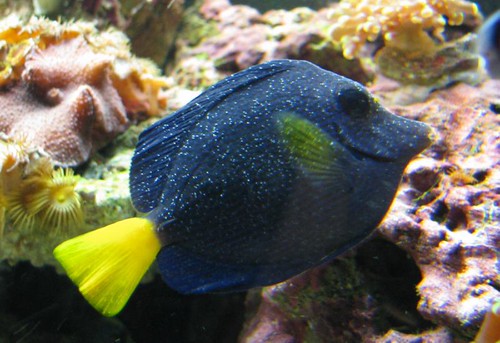
This is my Purple Tang...2 years ago. I never treated him. He is still alive. I have added 17 other fish (including 3 more Tangs) since this pic was taken, never qt'd a single one. Ich has never returned to my tank despite 2 tank upgrades and a fair amount of stress on all my fish. You have killed at least 4 times as many fish as I have with your supposed prophylactic treatment. You once posted that I was playing russian roulette. I think I'll stick with my method. IMO it is cruel to treat a fish that shows no signs of anything. And as you have killed at least 4 fish with your qt and treatment I think this is a fair statement.

 
Back
Top