Purcula clownfish favorit anemone

Clownfish don't host anemones.

The natural host for A. percula are H. magnifica and S. gigantea. Maybe others but those are the most common.


Sent from my iPhone using Tapatalk
 
H. malu or H. crispa most likely to host A.percula in captivity. A lot more likely than E. quadricolor or S. haddoni.
 
My percula chose, in order, a group of feather dusters, a long tentacle anemone and some mushrooms. She was in the tank without picking a host for four or five months before she chose the feather duster.
 
Ok, thanks. But I've read that those are all really hard to keep?

Which anemones?
Gigantea and Magnifica are difficult
A little easier are H. crispa, M. doreensis and S. haddoni
Easiest are E. quadricolor and H. malu.

Of all of these. i would recommend an H. malu. They don't get to big. Max out at about 8 inches. I do need to have a sand bed to be happy.
 
My percula chose, in order, a group of feather dusters, a long tentacle anemone and some mushrooms. She was in the tank without picking a host for four or five months before she chose the feather duster.

Cool! I've heard they can be hosted by some pretty odd things, lol.

Thanks
 
Which anemones?
Gigantea and Magnifica are difficult
A little easier are H. crispa, M. doreensis and S. haddoni
Easiest are E. quadricolor and H. malu.

Of all of these. i would recommend an H. malu. They don't get to big. Max out at about 8 inches. I do need to have a sand bed to be happy.

Ok, thanks. I'll probably try an H. malu if I start this new tank.
 
Favorite anemones of percula are:
1. S. gigantea
2. H. magnifica
Some will refuse all others.
Some will also readily accept H. crispa and H. malu.
And some are not picky at all and take pretty much all host anemones.

A ceramic flowerpot works sometimes better than the wrong anemone. I have not had a single clownfish reject those. At least that's my experience. And these flowerpots are as hardly as it gets...

Sent from my XT1254 using Tapatalk
 
Favorite anemones of percula are:
1. S. gigantea
2. H. magnifica
Some will refuse all others.
Some will also readily accept H. crispa and H. malu.
And some are not picky at all and take pretty much all host anemones.

A ceramic flowerpot works sometimes better than the wrong anemone. I have not had a single clownfish reject those. At least that's my experience. And these flowerpots are as hardly as it gets...

Sent from my XT1254 using Tapatalk

Thanks. I wish there was a cross between a flower pot and an anemone :sad2:. It sounds like BTA's are the easiest, but I would have to get maroon clowns and I'm not a fan of them lol.
 
Last edited:


The lta as host, the anemone chose to be up in the rockwork at this time, it later moved to rock/sand interface like a proper lta.


No anemone in the tank at this point.
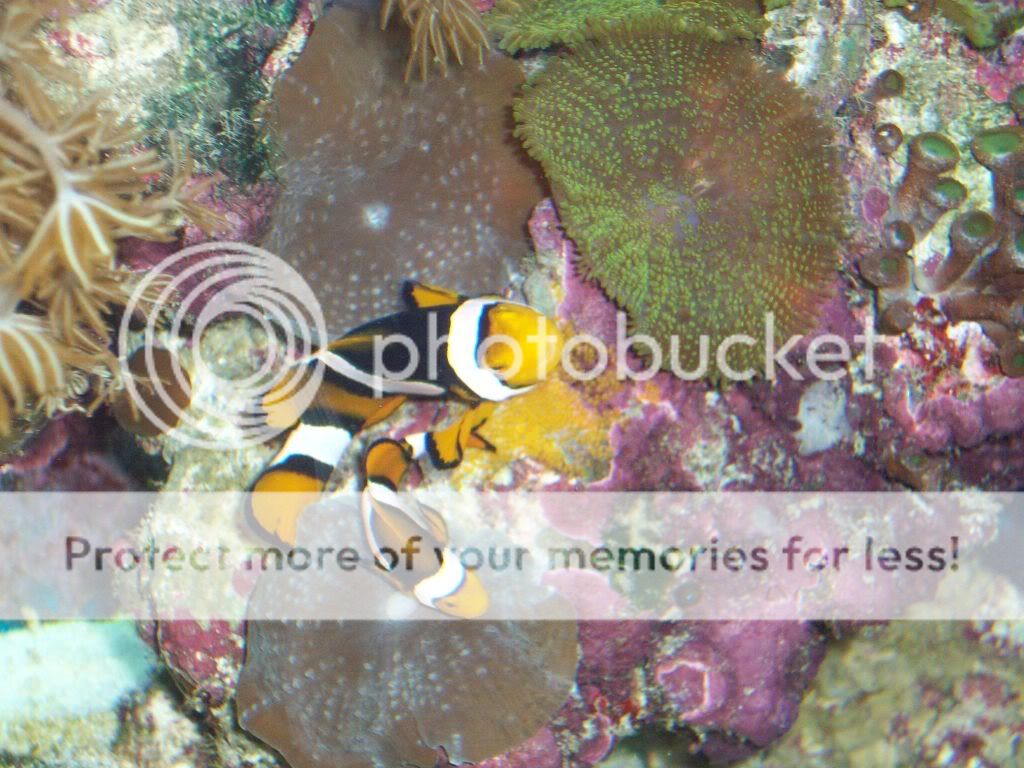

Thanks for sharing! My female ocellaris clown that I have now was in a BTA at night but isn't anymore. Did those eggs ever hatch?
 
Last edited:
You could let the flowerpot overgrow with green star polyps...
To go a step further, you could make your own ceramic carpet anemone with a big enough recess in the middle and let that overgrow. Local ceramics studio should be more than willing to help.

Sent from my XT1254 using Tapatalk
 
You could let the flowerpot overgrow with green star polyps...
To go a step further, you could make your own ceramic carpet anemone with a big enough recess in the middle and let that overgrow. Local ceramics studio should be more than willing to help.

Sent from my XT1254 using Tapatalk

Ok, thanks for the ideas.
 
In two different tanks, I have an ocellaris being hosted by a bta and another hosted by a lta. Both tanks are less than three months old, but were established tanks. Both hostings happened within three days of placing anemones in tanks.
 
Individual results may vary largely. I have a pair of percula that refused every anemone I tried: malu, crispa, BTA. Only when I put a gigantea into their tank they jumped right in.
Other of my percula were less picky and accepted a crispa without much hesitation.
 
Individual results may vary largely. I have a pair of percula that refused every anemone I tried: malu, crispa, BTA. Only when I put a gigantea into their tank they jumped right in.
Other of my percula were less picky and accepted a crispa without much hesitation.

So far it's been almost the same story with me, I had two percula clownfish that didn't like the BTA and now have 2 ocellaris clownfish that also don't like it.

Still deciding if I should get ride of my tank or not so I can get a smaller 30 gallon custom rimless that isn't so much work.
 
These are the ones that insisted on a gigantea:

<iframe width="560" height="315" src="https://www.youtube.com/embed/v4Asw2fYTDo" frameborder="0" allowfullscreen></iframe>

I'm not sure if these are wild or tank bred (which is why I added the little Bali Aquarich percula to them). They are also the ones who grow the slowest despite being in my largest tank.

My 3 other pairs which are for sure wild caught Solomon percula would go for crispas without too much hesitation.

Which anemone a clownfish prefers is not just a species specific thing but actually imprinted during the embryonic phase inside the egg. The little baby clownfish pick up the scent/chemical signature of their parents anemone species while still in the egg - and that is the type of anemone they will later look for to settle down in.

Most tank bred clowns don't get that imprint or, probably more importantly, the experience of being in an anemone from their early life stages on.
When I was breeding clownfish I made once a test and added a magnifica to a tank of 2 week old ocellaris. Their parents were living in a flowerpot so no imprint. Yet it took only a moment until all baby clowns were in the anemone.
So the key issue seems to be that they never saw an anemone in their early youth.
 
I'm not sure if these are wild or tank bred (which is why I added the little Bali Aquarich percula to them). They are also the ones who grow the slowest despite being in my largest tank.

I don't think any of the three clowns are tank raised. The adult pair is almost certainly wild caught. Having seen dozens of clowns from SI and PNG, I've noticed they have a frog like appearance on their face. Your pair has that too. I'm yet to see that frog like resemblance on CB clowns.
As far as the little one goes, he too is wild caught. His shape is too good for a CB clowns, even for a Bali Aquarich clown. If not from SI, he's probably one of those onyx clowns that come from Biak region
 
Back
Top
