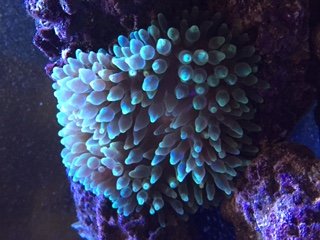
Questions about multiple clownfish and anemones

SeaweedSam

New member
Hi,

I'm pretty new around here ... both to RC as well as marine tanks.

I have a ~90 gallon tank (4x1.5x2 ft^3) that I set up last October. Co-incidentally, about the time that I started my tank, someone else was tearing down theirs, so for practical purposes I ended up with their LR, which I think helped my tank get established sooner than where it would be. I understand that it will still be quite a while for the tank to be truly established. But FWIW, I'm seeing a healthy population of copepods/amphipods and coralline algae.

I picked up a few anemones along the way - a bleached bta (newbie mistake!), a gbta, a magnifica and just this last week a gigantea. I also added a pair of B&W ocellaris clowns (two weeks ago) that have taken to the mag right away. They're pretty small, the larger one is about an inch and a quarter at best. Curiously, the larger of the two displays a kind of seizing to the smaller one. (Upon reading up, it seems that that might be the male attempting courtship displays, but in other cases where people describe this, the female has always been larger, and in this case, the smaller one is presumably not yet female...?)

When I added the gigantea, they took a brief interest (and I mean that they allowed the gig to host them) in it as soon as I added the anemone to the tank, and pretty much have ignored it since.

The mag sits pretty much way up top, at the center of the tank, and the gig sits on the sand/rockwork almost right below it about a foot and half away.

That brings me to the question: Is it advisable to add other juvenile/adult clownfish to this system when there are ample anemones (discounting the bleached bta, there is still the gig and the gbta that can potentially host compatible clowns) in such a small volume of tank, when the second pair/juveniles will be in line of sight of the first?

Reading up on anecdotes littered around the internet, I suspect that it is unadvisable, but I wasn't sure if some of the aggression might be mitigated by providing adequate hosting opportunities?

Cheers,
Harshad
 

Attachments

  • IMG_5744 (1).JPG
    IMG_5744 (1).JPG
    45.5 KB · Views: 5
  • IMG_5743.JPG
    IMG_5743.JPG
    43.3 KB · Views: 3
  • IMG_5496.JPG
    IMG_5496.JPG
    45.9 KB · Views: 4
I have a pair of Maroon Lightnings in a bta in 1 corner of the tank and a pair of Picassos in another, a Magnifica will be ready soon for it. No aggression so far.
 
I have a pair of Maroon Lightnings in a bta in 1 corner of the tank and a pair of Picassos in another, a Magnifica will be ready soon for it. No aggression so far.

i will guarentee you will be down to the pair of maroons only especally if they are in your 40 gal.

as for the OP, it isn't really advisiable to have more than 1 pair per tank unless the tank is very large or they all come from the same batch of eggs (still may wither down but your chances are much better IME)
 
i will guarentee you will be down to the pair of maroons only especally if they are in your 40 gal.


as for the OP, it isn't really advisiable to have more than 1 pair per tank unless the tank is very large or they all come from the same batch of eggs (still may wither down but your chances are much better IME)


Everything will be moved to a 190g soon. Tank is here n the rest of the equipment are trickling in! Can't wait!
 
You can have multiple Ocellaris in a 90 gal tank, but I would not recommend more aggressive clowns. Don't try to have more than one pair and Juvi. I have a 320 gals and have 2 pairs (lots of Magnifica and Gigantea, plus Haddoni)
Ocellaris can live as pair and juvi and it is OK.
 
@OrionN, if you want to have 3 do you need to add them together or is it possible to add a juvenile to an already established pair?
 
You just need to add the the Juveniles last. More than two mature clown fish in that tank will not work.
 
Thanks for the replies guys.

When people say the tank needs to be very large - what do they mean? A minimum of 8 feet? I read that ocellaris pair territories will extend up to a 4 ft radius and so in an 8 foot tank for instance, one can imagine that two pairs can potentially coexist.

In these cases where there's a mature pair, and other juveniles - do the juveniles take up residence in the same anemone? Or will they find other hosts?

How about the possibility of adding clowns that are anemone specific? Does that work better? I guess the maroon/picasso example is a good example - it's long term feasibility remains to be seen.

In the end I may not add any more. I find that clowns can be vicious if they don't get along. I'm still curious to see what has potentially worked.
 
I only have experiences with smaller, less aggressive clown fish like Ocellaris, Percula, Pink Skunk. Never keep Tomatoes, Clarkei or mature Maroon, Black foot....
Even with more docile clowns the female/and resident male can be brutal to a second male. They will chase the un-sexed juveniles but not to the point of killing, especially in larger tanks. They often attack on sight. Out of sight out of mind with these clowns. I have a bunch of natural hosts for these clowns and the weaker pairs often just move to the far side of the tank. I have a huge T. gigas in the middle of the tank that basically separate my tank into two. One pair cannot see the other. I bred clowns and run out of room for babies, ended up put about 12 of my best babies in my 320 gal tank above. After about 1 years, I ended up with two pairs. The rest slowly was removed, a few died. Two stable pair at opposite side of the tank.
I had 450 gal tank in the past with multiple large Magnifica, and keep three Pink Skunk on one end and three Ocellaris on the other end. The juveniles never get to go into the anemone, unless it is night, or when I work on the tank. Even as the light intensity go down, the pairs would chase the juvenile around and around the anemone until the light is completely out. Fortunately my Magnifica are huge (2 feet across) the juvenile just get lost in the tentacles and thus get away from the punishment of the pair. Seeing how the third clown get abuse, I never try to keep trio of clowns again.
 
You can have multiple Ocellaris in a 90 gal tank, but I would not recommend more aggressive clowns. Don't try to have more than one pair and Juvi. I have a 320 gals and have 2 pairs (lots of Magnifica and Gigantea, plus Haddoni)
Ocellaris can live as pair and juvi and it is OK.

Interesting thread and I have been meaning to ask, I recently had our male percula die leaving its mate to care for 3 nems after a split. She tends to hang out with only one (the original BTA that split)and gives the other two just a tiny bit of attention. If I get another perc will they get along ok? Does it have to be a perc or could it be a different type of clown fish?
 
My experience has been that any new clown must be larger than existing clowns. I have had three pairs in the same tank for years without incident. Others have had different experiences.
 
Interesting thread and I have been meaning to ask, I recently had our male percula die leaving its mate to care for 3 nems after a split. She tends to hang out with only one (the original BTA that split)and gives the other two just a tiny bit of attention. If I get another perc will they get along ok? Does it have to be a perc or could it be a different type of clown fish?
When you try to pair cross species the smaller one tend to suffer more. All my Ocellaris/Percula pair, the beating lasted a lot longer, even when the smaller clown capitulate early. IMO, this is the cue does not match. What Ocellaris does to show dominate/capitulate is just not completely the same for Percula. Because of this reason, the beating last longer. Several time I almost separate the two because I did not think the smaller male would survive. Fortunately, I never lost a male in cross species pairing.
In the olden days, I tried to get the white of snowflakes into my Percula line, so I tried to pair Onyx Percula to Snowflakes Ocellaris quite a few times.
I have never try to do any other cross species pairing.
 
I been wanting to add a pair of juveniles tank raise pink skunk clowns (they are tiny... about 1.5") into my tank.

I currently have two anemones and soon adding a third one (Magnifica, H.Malu and RBTA). The Magnifica host a mature pair of misbar clownfish. This pair have never been aggressive towards any other fish I had over five years.

The Magnifica anemone is on the top right side of the tank, if i can get the H. Malu to host the skunks on the bottom left side of the tank. Could I have a small chance of temporary no aggression success? or no chances at all?
 
My LFS have a nice purple LTA that came in today. Maybe that will be a better choice... taking in consideration that LTA are natural host to skunks.

Any thoughts?
 
Last edited:
My A. Nigripes (Blackfoot) are insanely aggressive. To everything and I don't even have any other types of damsel. They left my gobie alone because he stayed low but anything else in the water column they fed to my haddoni. Suckers are brutal. Really thinking of setting up a tank just for them.
 
Ok, so I when ahead with it...

Stage one: Got the Purple LTA fully acclimated and buried in the far right side of my tank.

D7AFD3E1-9C86-4466-B675-B8692EBA6D57.jpg


And got a pair of sustainable aquatics skunk clowns in my sump on a acclimating box.

10C9E954-22EC-4132-9F2A-A6AD592B8D10.jpg
 
Those look like orange skunks (A. sandaracinos) n not pink skunks (A. perideraion). If they are A. Sandaracinos, a doreensis is not a natural host.
 
Back
Top