
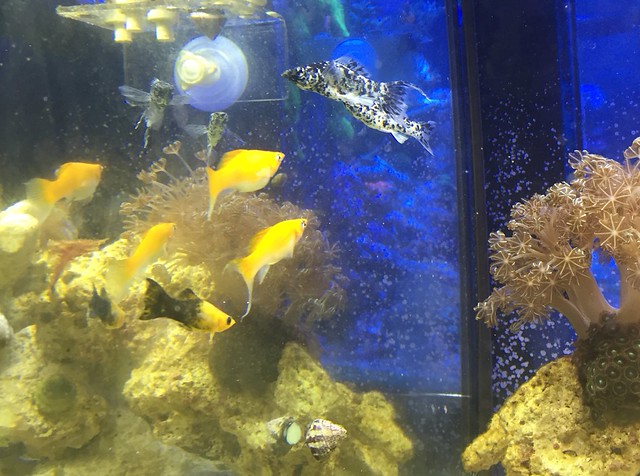
Saltwater mollies!

Coelli

New member
24406917285_6440dd180b_z_d.jpg


I set up a 30g display fuge a few weeks ago and have really been struggling to decide what fish to put in it. I added a red scooter blenny, but almost everything else would be territorial or get too large or be otherwise problematic (or I already had one in my display). Then it hit me - mollies! So I stopped by Petsmart today and picked out a male panda, two cremesicle females (one lyretail) and two female lyretail dalmations. One of the dalmations gave birth shortly before they were ready to go into the tank; I added some to my DT as a snack for my other fish, a couple to the fuge in the sump, and the rest into the display fuge with the adults.

The scooter blenny has been going NUTS trying to catch the babies but they're too fast for him, lol.

Anyway hopefully they all make it - so far they seem to be doing okay except for the one who just gave birth, but I don't think any of us feel good after that. I transitioned them over about 4 hours.

Total cost: $10. Cheapest saltwater fish I've ever bought and it's cool to see a bunch of free-swimming fish in the refugium. :)
 
Well, the male suddenly started to decline and is on his way out. :( The female who gave birth is still hanging in there and could go either way. I'm still seeing her babies now and then so they will probably be okay. The other 3 females seem fine so far. We'll see how it goes!
 
Did you acclimate them over a long enough period? If not that may explain the decline you observe.

I was planning to get some mollies myself one day - as reef fish disease research guinea pigs

BTW: don't you think a scooter blenny (well, actually it's a dragonet) is a bit counter productive in a refugium - it's like keeping a fox in a henhouse.
 
Did you acclimate them over a long enough period? If not that may explain the decline you observe.

I was planning to get some mollies myself one day - as reef fish disease research guinea pigs

BTW: don't you think a scooter blenny (well, actually it's a dragonet) is a bit counter productive in a refugium - it's like keeping a fox in a henhouse.

Ha, yes he is - but I didn't want to put him into the display. I have a second in-sump fuge as well. The display fuge is more for growing various types of macros and xenia than for pod production.

I acclimated them over about 4 hours. So far the others are doing fine. I'm not entirely sure it wasn't a powerhead - it was pretty sudden and he didn't look dehydrated. I spent a couple of hours reading last night and there seemed to be no consensus on acclimation time. Some people dump them straight in with no mortality. Some people acclimate over days and still lose some. I compromised and dripped them for a few hours.
 
Last edited:
4 hours is way to fast to bring a fish from full freshwater to full saltwater. No wonder they are dying.

Especially for the first leg, from 1.000 to 1.016 you need to go slow - days! - so their metabolism can switch over to saltwater. From 1.016 to full ocean salinity you can then just drip them over an hour.
 
Actually the long or short acclimation is hit or miss anyway. I've read a lot on this and it seems that they're actually best just temp acclimated and dropped in. I did this with a pair of black sailfin mollies and did a 1/2 cup of tank water every 4 minutes for 30 minutes and then dropped them in my DT. Well my Cherub Angel basically was trying to kill them, so I caught them both and dropped into my sump. The male was in the worst shape from the Cherub's attacks and he didn't make it. The female is doing great and eats algae or pods. I will go get another female and another male in the near future.

Just do a Google search on acclimating mollies to saltwater and you will see what I'm saying.
 
I'm going to do this same thing to some mollies and put them in the 625g after its cycled to make sure it's disease free.
 
Just do a Google search on acclimating mollies to saltwater and you will see what I'm saying.

You're absolutely right. I wasn't kidding that I spent a couple of hours reading up on it! Many things in this hobby have at least some consensus but on this one, there is none. Success doesn't seem dependent on acclimation time. I haven't seen the tank yet this morning so they could have all died overnight, but they looked good when I went to bed. The female that gave birth looked wobbly but better.
 
4 hours is way to fast to bring a fish from full freshwater to full saltwater. No wonder they are dying.

Especially for the first leg, from 1.000 to 1.016 you need to go slow - days! - so their metabolism can switch over to saltwater. From 1.016 to full ocean salinity you can then just drip them over an hour.

I agree. At the very least a quick rise will damage kidney function.
 
All four females are alive and well this morning. They ate some flake food last night as well and are beginning to pick at the rocks. Several of the babies are still alive and I've been catching them and putting them into the sump fuge for now, where the only predator is a hermit crab who won't be able to catch them. There's also a little hair algae in there for them. None of the females are showing signs of dehydration. The one who gave birth is still wobbly but active.

I forgot to mention that I totally forgot to temp acclimate them after dripping them. It wasn't until I was putting them in that I realized the acclimation water was cooler than the tank water. That might be what did the male in too (I euthanized him last night, he looked pretty bad).
 
I'm going to do this same thing to some mollies and put them in the 625g after its cycled to make sure it's disease free.

Doesn't that increase the possibility of introducing disease to your DT or are 100% of diseases found in freshwater nontransferable in salt water?
 
ilikefish that would be correct, no transfers from fresh to salt. So if the mollies get anything it's in the saltwater tank.
 
I've considered keeping a pair as a food source (i.e. feeding the fry to the tank) - but I'm scared if a fry didn't get eaten, I'd end up with one in the display tank... and if god forbid two didn't get eaten, I'd have a tank full of mollies within 6 months.
 
I've considered keeping a pair as a food source (i.e. feeding the fry to the tank) - but I'm scared if a fry didn't get eaten, I'd end up with one in the display tank... and if god forbid two didn't get eaten, I'd have a tank full of mollies within 6 months.

I put some fry in the display yesterday and believe me, they didn't last long. :D I've been catching the ones I can today in the display fuge (sucking them into a cup when they're up by the top rim) and putting them in the sump fuge for now. I guess that's the drawback of being soft-hearted and keeping livebearers. If any of them survive and get bigger I'll give them away. In theory they'll be dalmations if the mother was always kept with other dalmations like she was at the store.

I bought a male sailfin today and one more female; they've been dripping for about 4 hours so far and I'll keep dripping overnight and release them in the morning. The other 4 females are still alive in the display fuge.

Depending on what you have in your display I doubt the fry would last long. I have a lyretail anthias, a royal gramma, gold assessor, starry blenny, and two clowns that will eat any in mine, not counting anemones and LPS. I don't think they stand a chance.
 
I'm going to do this same thing to some mollies and put them in the 625g after its cycled to make sure it's disease free.

For that I would breed my own reduce the chances of introducing something nasty - some bacterial and viral diseases are transferable between fresh and saltwater.

Better would probably be to put them in a connected test tank where the water that is returned to the main system is going through a UV unit.
 
For that I would breed my own reduce the chances of introducing something nasty - some bacterial and viral diseases are transferable between fresh and saltwater.

Better would probably be to put them in a connected test tank where the water that is returned to the main system is going through a UV unit.

I have been reading about things that can transfer between fresh and saltwater and not be eliminated... I have a few PJ cardinals that's are 100% disease free and have been for 4 months now in a tank at a buddy's house keeping the QT cycled. I will just use one of them to check the 625g. Didn't really want mollies in the 625g anyway, they were just cheap and seemed to be the easiest choice until I read some more! :reading:
 
Just a little update. :) All 4 females are alive and well and eating. The one who birthed is looking better and stronger today. So far, so good. Most of the babies I keep catching and putting in the sump fuge have disappeared (not sure if they're dead or hiding) but the ones in the display fuge I haven't managed to catch are okay. So I guess being born into saltwater didn't phase them.

The male and female I bought yesterday are actually both male. :| Oh well... now I have to decide whether to put both in the display fuge and if not, which one to put where. They're still being dripped and were up to 1.022 tonight at bedtime so they're spending another night in the Dip & Pour in the sump, poor things. Tomorrow they gain their freedom. :D So far, though, they are holding up quite well.
 
Doesn't that increase the possibility of introducing disease to your DT or are 100% of diseases found in freshwater nontransferable in salt water?

It shouldn't but the more you read the more conflicting info comes along with it! Have to make sure the sources are reputable that the info is coming from
 
"FUNNY" thing is, i never see mollies when i dive the reefs!!!!!!:blown:


Didn't really want mollies in the 625g anyway

i agree, if you want mollies set up freshwater!!!!
 
Back
Top