
You are using an out of date browser. It may not display this or other websites correctly.
You should upgrade or use an alternative browser.
You should upgrade or use an alternative browser.
Show off your S. gigantea
- Thread starter OrionN
- Start date
zzlonewolf
New member
Updating condtion

BonsaiNut
Premium Member
If he died now it is all my fault not due to stress and injury from before I got him
Don't you mean "she"? I'm pretty sure I see eggs... Take a close look and tell me if you can see them as individual spheres.
Mine is now under a 15k Bulb and looks like it has lightened up in color. He is expanded more but under new bulb so was just wondering if a new bulb could cause the apperance of being lighter in color, he is stretchin more to the light where i can see column but then settles down but looks more expanded.
BonsaiNut
Premium Member
Yes, this anemone have a lot of what you and Gary called eggs. I am still not sure if they are indeed eggs. I hope they are but when I first got her there was none but there are a lot of these shadow clusters on the column now.
Check out the paper "Gametogenic and reproductive cycles of the sea anemone, Entacmaea quadricolor" by Dr. Scott (I am pretty sure you have this because I have posted copies several times). Granted, the photos aren't of S. gigantea, but I have seen the same thing in E. quadricolor.
The sex of E. quadricolor individuals could generally be
determined by examination of the mesenteries prior to
histological sectioning. Female anemones were usually
distinguishable from male and non-reproductive anemones
by the presence of prominent green oocytes. During
the early stages of development, the oocytes were visible
through a thick layer of endodermal tissue that contained
highly concentrated brown speckled zooxanthellae in
the region above the maturing gametes (Fig. 4a). As
development proceeded, the oocytes increased in size
and became more prominent (Fig. 4b, c). The mesenteries
of recently spawned anemones appeared to have
empty sacs where the oocytes were previously located
(Fig. 4d).

ponokareefer
New member


Week 5. Gigantea walked to the base of my main rockwork. Hope the anemone doesn't get any ideas of climbing up to the sps level.
One of my anthias dissapeared. I have a nagging suspicion that the gigantea may have made a meal of the fish.
The smaller brown carpet is on the bottom left of the picture. The bigger blue anemone walked right on top of the brown carpet.
Minh, I didn't try cutting the tentacles off the brown carpet. Very small anemone and I didn't want to traumatize the anemone.
I am still feeding fairly regularly with frozen rods, krill, and mysis.

One of my anthias dissapeared. I have a nagging suspicion that the gigantea may have made a meal of the fish.
The smaller brown carpet is on the bottom left of the picture. The bigger blue anemone walked right on top of the brown carpet.
Minh, I didn't try cutting the tentacles off the brown carpet. Very small anemone and I didn't want to traumatize the anemone.
I am still feeding fairly regularly with frozen rods, krill, and mysis.
My Blue Gigantea at week 9

Video from Waikiki Aquarium taken last week. This blue gigantea is about 3' across. Link to the video below - surprisingly lack of flow. There is a surge device(Carlson?), but even with the surge the anemone does not receive a lot of flow. Anemone seems to do well under this condition.
http://www.youtube.com/watch?feature=player_detailpage&v=kzF_3XaLnfs
Video from Waikiki Aquarium taken last week. This blue gigantea is about 3' across. Link to the video below - surprisingly lack of flow. There is a surge device(Carlson?), but even with the surge the anemone does not receive a lot of flow. Anemone seems to do well under this condition.
http://www.youtube.com/watch?feature=player_detailpage&v=kzF_3XaLnfs

OrionN
Moved on
schprock,
You are sure that it was a Gigantea? Certainly not a lot of flow for him. From the video, it could be a Haddoni. Not likely but possible.
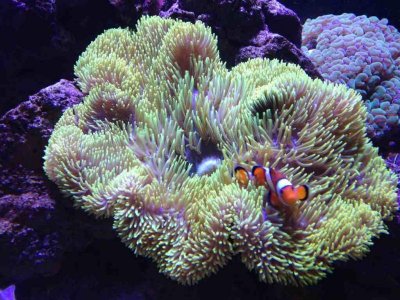
Here is my other Gigantea. It changed from bleached yellow to darker yellow now with green tinted to it. It is a lot greener today than last week when it was kinda mustard yellow.

You are sure that it was a Gigantea? Certainly not a lot of flow for him. From the video, it could be a Haddoni. Not likely but possible.
Here is my other Gigantea. It changed from bleached yellow to darker yellow now with green tinted to it. It is a lot greener today than last week when it was kinda mustard yellow.
Similar threads
- Replies
- 67
- Views
- 2K


- Replies
- 14
- Views
- 239


