Sorry John... But I am calling out COPPS!!!

Chris, thank you for your post. I replied at greater length in the other thread. I agree completely, new fish need to be conditioned. I probably should not have shortened QT, but the fish were looking great and eating everything in sight. I wanted them to have a little stress-free time to get to know the new tank.

After removing the emp for a couple days, then putting it back in the DT, things look okay, so far. The blueface is eating well, and all the new fish still have their fins. Emp is chasing, but not with killer enthusiasm. He seems to be making sure everyone knows who is boss.

Where I made a mistake (per your comment about the necessity of QT) is adding a blue spotted angel directly to the DT, because the emp was in my QT. The blue spot isn't being chased much anymore, but it needs to be isolated for observation, targeted feeding, and possible treatment. If it doesn't show signs of eating soon, I may have to pull out the rock to catch it.

I'll be picking up some egg crate this week, just in case it's needed. So far, it looks as though the time out for the emp helped, and there is peace in the tank. (Didn't mean to hijack, but again, really appreciate the input!)

We'll see if it lasts...
 
<a href=showthread.php?s=&postid=13940800#post13940800 target=_blank>Originally posted</a> by copps
I do 100% water changes about
once a week with new water mixed for at least 24 hours, depending on the conditions...
You change out 100% of the water with fresh salt water in the QT tanks with fish in it? How do you go about this? (without having fish with no water - I know that sounds stupid, but I'm at a loss here...)

Also, do you keep live rock in QT assuming your not using Cupramine?
 
<a href=showthread.php?s=&postid=13942273#post13942273 target=_blank>Originally posted</a> by reidcrandall
I hadn't heard that it was impossible to get them to change at all, just to get them to change completely. I was hoping that I would get a response like that from you. I am at least 6-12 months away from making a purchase, and this answer is all I needed to reinvigorate myself to do all of the proper research before I do.

Thanks!

I would say it depends on the species. I've had a blueface do it many times.
 
<a href=showthread.php?s=&postid=13940863#post13940863 target=_blank>Originally posted</a> by copps


Be aware that it has been years since true Red Sea regals have been exported to the US in any significant numbers... the industry tends to use "Red Sea regal" for any regal originating from the Indian Ocean...


QUOTE]

I do realize it's an Indian Ocean speciman. Most hobbyist's only think of a yellow breasted regal as a red sea variant. But obviously John is know ordinary hobbyist. Your tanks and knowledge is an inspiration to all of us John. Let's see some pics of your larger angels.
 
You must have a conspic?? Let's see some of your unusual collection of the larger angels. Centropyge's are nice but I love the Pomacanthus or Chaetodontoplus better.:D
 
Awesome thread, tons of great info.

Copps, what are your thoughts on Chrysurus angels? I see you have one (what don't you have) and they are my favorite large angel and the #1 angel on my future keeping list. How is it as far as aggression, hardiness, etc? Can't really find a ton of info on them on the net.
 
<a href=showthread.php?s=&postid=13950544#post13950544 target=_blank>Originally posted</a> by Grouperhead
Awesome thread, tons of great info.

Copps, what are your thoughts on Chrysurus angels? I see you have one (what don't you have) and they are my favorite large angel and the #1 angel on my future keeping list. How is it as far as aggression, hardiness, etc? Can't really find a ton of info on them on the net.

I have had the opportunity to keep both an adult and currently a Juvi Chrysurus. They are like any other Pomocanthus, as they are semi aggressive and will eventually be the boss of the tank. However they are not over aggressive. My adult Chrysurus showed its dominance when it needed to, but was not a bully. They are mid level swimmers and are very active. They have awesome personalities. The love to eat nori and just about any other food you drop in the tank. I lost my adult to an aggressive attack of velvet, it almost made it though. They are fairly hardy overall. I got a juvi about a month ago and he is one of my favorites in the tank.

My first Chrysurus, I miss him:

DSC00836.jpg


DSC00857.jpg


DSC00946.jpg


and my new juvi:

DSC01550.jpg
 
I have contrasting experience. I got a sub adult, and he was an aggressive SOB. He ended up killing a male watanabei, my prized male scribbled, and was working on my emperor, before I had to remove him. He was introduced well after all of them, and aside from the watanabei, they were all bigger than he.
 
That adult was gorgeous Jason. Sorry to hear you lost it. That juvie is sweet too.

jmaneypanda, sorry to hear about that. Goes to show every fish is different.

Hoping to set up a 220g by this summer and want to have a large angel (chrysurus) as a show piece and then a lot of small fish like anthias, wrasses, and gobies. They get about the same size as emperors, right?
 
Hey guys... I'm continuing to catch up here... my apologies for the tardy replies...

<a href=showthread.php?s=&postid=13891825#post13891825 target=_blank>Originally posted</a> by LisaD
how do you like your Diana's hogfish? I had an adult years ago, and it was one of my favorites.

Hey Lisa, that fish is actually a close relative of Bodianus diana that has a very limited range and almost never enters the trade... one of my friends in Hawaii received him and it's the only one he's seen in the many large shipments he's received from Christmas Island... he's Bodianus prognathus... with prognathus meaning long honker essentially... identity was confirmed by Rich Pyle...


I've always loved Bodianus... they are exceptionally intelligent and personable fish...

<a href=showthread.php?s=&postid=13894705#post13894705 target=_blank>Originally posted</a> by myerst2
Obviously something we should all try and duplicate. John have you ever considered writing a book, articles, or possibly blog? Your advice has always been very simple but perfect have great success with these animals. I am stunned you have the time to keep your animals and dispay in such immaculate condition, especially with the little one now in your life!!! Hope fatherhood has not overwhelmed you and your child is doing great!!!!

Not sure if you caught my earlier post. Do you think that juvi. Regal will keep that misbar when it matures? Did that Regal come out of Sumatra?

Again great work. Many envious fish dorks sweating your displays. Keep up the great work!!!!!!!!!!!!!!! T

Write a book? :D I can barely keep up with this thread! In all seriousness I'll soon be writing some articles... and of course I do my talks, but a book will be way in the future... probably when my 3 year old and 4 month old are in college... until then I'll be gaining more experience... this hobby will never bore you... there are always things to learn and experience...

The regal I expect to keep the misbar... that specimen came from Majuro in the Marshall Islands... he'll eventually be a blue belly when he grows up... Sumatra puts out some small ones like the one posted earlier, but this collector in Majuro gets some tiny ones like this guy...

<a href=showthread.php?s=&postid=13902729#post13902729 target=_blank>Originally posted</a> by aquaboy620
hey John your tanks look gorgeous. I just was looking to find info about achilles tangs and or powder blues and came across this thread. From the responses i've been reading you know your stuff like nobody else. you really should write a book about how to make a system thrive instead of survive and what methods to use to make all this happen. You obviosly have a bigger fan base than some celebs out there and for good reason. You seem to help out a lot of people with advice they couldn't get anywhere else. Thanks for sharing your experiences with us all. The only question I have for you is, have you ever posted anything about how to keep an achilles or powder blue happy and thriving? it's pretty much the only fish i haven't had any luck/skill in keeping. they all do great for like a month and just break out in some serious ich and wither away. these are the fish that excites me the most and bums me out that i can't have them. Thanks again for all the great info. it's very much appreciated by all.

This complex of tangs within Acanthurus... the goldrim, achilles, and powder blue to name a few, falls victim regularly to that "dump and hope approach" I mention... these fish come in very stressed, usually in a weakened state with little fat reserves left... combine this with their tiny scaled thin skin, and they very often succumb to ich and other maladies... again it comes back to proper QT... people may buy one of these fish with it being seemingly free or free of ich in a store or through the mail... this is because most every fish system in the industry runs copper, ozone, UV, or something else that treats for this parasite... when we dump this fish into our reef tank in this weakened state if there is any ich present on the fish or in our system it attacks the fish in its weakened state... ich itself is not that bad, but to a fish like this in a bad state it will often put it over the edge...

Ich is very easy to treat for in QT with cupramine or other copper products. I only take my fish out of QT not only when they're disease free, but when they're fully adapted with their fat reserves restored... this benefits fish like this tremendously, as they are much more resistant to ich when they are settled in and fat and happy... putting the fish to marinate in this copper treated water in its weakened state allows it to adapt without the threat of ich. By adding the fish after that to the stressful environment that is our reef tanks results in a much higher success rate... with some fish I even place them in a transition tank hooked up to my large system... this introduces them to the water environment of my reef system without the stress of the "herd" in the display... if they take on something from there they go back into QT...

This is not the "easy way"... many people have the attitude that they'll just keep trying until one lives... which is unfortunate... we all have killed fish, but we have the moral obligation to learn from our mistakes and correct accordingly... I have a collection of rare tangs... some one of a kind... that I will share later this week... and again using the methods above you have the MOST control over the life of the fish... the "tang police" jump on so many people for keeping tangs in small tanks, when there are thousands of tangs that die as a result of this for every one that will outgrow a system...

Of the complex talked about above, achilles have additional issues in relation to the others... I believe this may be due to temperature (achilles are essentially a subtropical species) and/or dissolved oxygen issues (achilles are almost always found near the surface in surge zones, whereas goldrims for instance, are documented to hundreds of feet depth... with both species in Hawaii...

Anyway, thanks again guys... I'll continue catching up on responses and get more pics up by the weekend...

John

 
I think I was very lucky with my first "big" tank, which I kept in the early 1990s. I had four fish.

Hey Lisa, that fish is actually a close relative of Bodianus diana that has a very limited range and almost never enters the trade... one of my friends in Hawaii received him and it's the only one he's seen in the many large shipments he's received from Christmas Island... he's Bodianus prognathus... with prognathus meaning long honker essentially... identity was confirmed by Rich Pyle...

I'm pretty sure that what I thought was a Diana's hogfish may have been the same species as your fish. I had never seen a B. diana that looked exactly like mine, especially in the schnoz region, until you posted that picture. :)

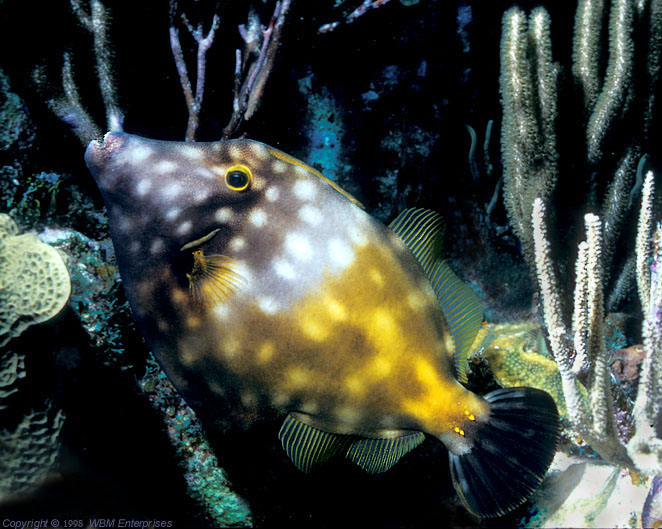
I also had a white spotted filefish, which was another favorite, and which I have not found since. that was an awesome fish.

white spotted filefish
carsrd22.jpg


and last but not least, I had a mated pair of 8 inch Naso tangs, one of which had beautiful tail streamers.

the tank was a 125 I bought used. I ran it bare bottom with some huge pieces of live rock that look like they were elkhorn branches. The tank had a home made wet-dry and skimmer. for whatever reason, the water was clear and pristine, the rock had nice coralline growth, and the fish were very healthy.

I would have had to upgrade within a few years, but then was offered a job across the country. Rather than trying to move the fish from Minnesota to North Carolina, I adopted out the fish to the best homes I could find and sold the tank. I still miss those fish...
 
<a href=showthread.php?s=&postid=13954917#post13954917 target=_blank>Originally posted</a> by copps
Of the complex talked about above, achilles have additional issues in relation to the others... I believe this may be due to temperature (achilles are essentially a subtropical species) and/or dissolved oxygen issues (achilles are almost always found near the surface in surge zones, whereas goldrims for instance, are documented to hundreds of feet depth... with both species in Hawaii...

Wow great thread John, ive learned alot of neat things here and I hope i will be able to attend your speech for FMAS. Just wondering about what you mention with the dissolved oxygen, would it be more beneficial to keep the dissolved oxygen elevated as found in the surf zone for all species or to keep it closer to a specific fish's natural habitat such as the goldrim and merely keep say all deepwater species?
 
John, post pics of the new regal and butterflies. You are better at picture taking!

I can't believe i have had those bodianus prognathus before and didn't know what they were! (2 actually...)

more pics please!
 
Whe John refers to high levels of O2, he means that Achilles live in the surge zone. The crashing of waves against structure, (i.e rock) causes levels of O2 to be elevated. Far higher than in an area where water is not crashing against structure. Our captive reef systems rarely come close to the amount of dissolved O2 that would be found in the Achilles natural environment. Hope this explains it for you and gives John a little less to teach us all!!! Cheers John for all the great information!!!! T
 
John - WOW. B E A U T I F U L.

I see in the photos and text that they are safe with SPS and some LPS. Anyone ever try angels or butterflies with anemones or gorgonia? Just curious which species, if any, might leave them alone too. I see the idol went after SPS. Where do you draw the line, John, or do you like to experiment as I do? Always trying something at the edge.

Dan
 
As being student of John's, J/K John. His belief I believe is that if the fish kept in a display would not eat anemones or gorgonians in the wild then they won't eat them in a captive environment. For this to work the fish needs to be in great health and have adequate amounts of natural food sources. Also the invertebrates, i.e corals, anemones, need to be in great health as well. Not sure if you are familiar with freshwater fish, but it similar to someone saying that my pleco ate my fish when in fact the fish was dying and the pleco hungry and took advantage of the situation. T
 
myerst - fist one looks like a regular flagfin with a black splotch... i have had one similar although not as dramatic (black spot)

2nd looks like a coral beauty variant. Marshall Islands has some of the nicest i have ever seen. Lots of variants and color.

3rd looks like a normal C. flavicauda (white tail pygmy) close relative if not subspecies of the resplendens and fishers. They do really well from Christmas - not so good from Indo (bali, philippines etc)
 
Back
Top