
You are using an out of date browser. It may not display this or other websites correctly.
You should upgrade or use an alternative browser.
You should upgrade or use an alternative browser.
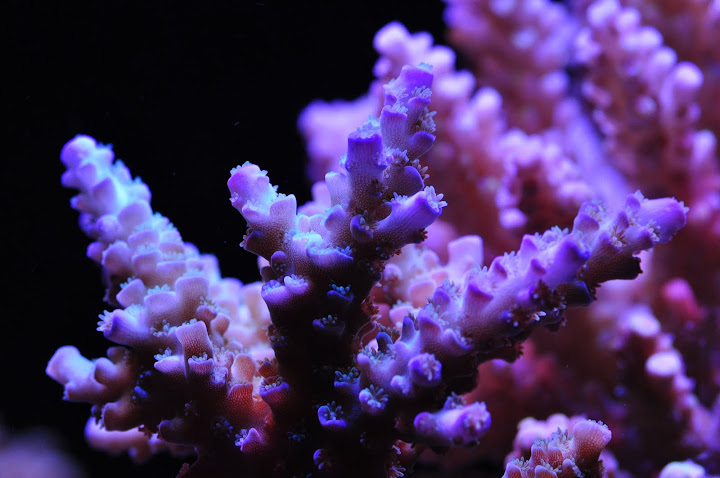
SPS growth with LED's
- Thread starter tmichael
- Start date


Acrotrdco
New member
Acrotrdco awesome pics i want to switch from my mh to a led setup Are you just using led lighting?
Thanks and yep, LED only.
Acrotrdco, awesome post. Looks like you've gotten some great growth!
Thanks, I'm pretty happy with how the A.Nana turns out now, when I first got that frag off my friend I wasn't too thrilled cuz he's got some other better pieces and he gave me that brown stick! :lol:
Wow! Even your silicone purpled up!
Well it does have coraline algae growing all over it :spin2:


Felixc395
Registered Member
My goodness, a couple of the first posts were quite rude. Give the OP a break. But oh well, I'm not going to argue with anyone.
LED's should work well. I still have my doubts, but that's me. It's just to much money to gamble on. Thats why I love T5. So I'm on the fence, but if you were to go AI's, I think that would be your best option. Either that or maxspect, or vertex
LED's should work well. I still have my doubts, but that's me. It's just to much money to gamble on. Thats why I love T5. So I'm on the fence, but if you were to go AI's, I think that would be your best option. Either that or maxspect, or vertex
All I can say is WOW Acotrdco. Those are the progression pictures I was looking for. That was all in a Nano? My good friend has a 29 BioCube and upgraded his hood with LED's from Nanotuners. He added 7 of the Edison Linear Modules, 3 - 50/50, 2 Whites and 2 Blues all switched seperatley. Total of 42 LED's. A couple of weeks ago I gave him a couple of my SPS frags to see how they would do. They have great color I'm just waiting to see some growth. Great pic though and thank you for your post.
Acrotrdco
New member
All I can say is WOW Acotrdco. Those are the progression pictures I was looking for. That was all in a Nano? My good friend has a 29 BioCube and upgraded his hood with LED's from Nanotuners. He added 7 of the Edison Linear Modules, 3 - 50/50, 2 Whites and 2 Blues all switched seperatley. Total of 42 LED's. A couple of weeks ago I gave him a couple of my SPS frags to see how they would do. They have great color I'm just waiting to see some growth. Great pic though and thank you for your post.
Thanks - some of the frags started off in my nano, and made the switch to my current tank that I built last Nov/Dec, and they've been growing pretty fast after moving to the new tank, too.
I think I should give credit to better water flow and light, as well as a much more stablized water condition compared to the nano.
LOL sorry that was NANA not Nano. I just saw the tank dimensions in your signature.
I spent the last hour or so reading your build thread Acotrdco. Nicest build I have seen in a while. What type of LED fixture were you using?
It's also in my signature! :lol:
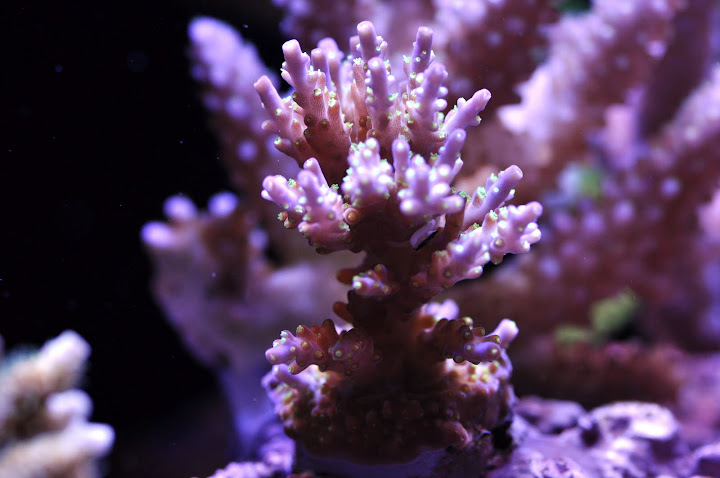
Here's the latest photo of my A.Nana frag, notice a new symbolic pirate crab had just moved in, ha!
Last edited:
Acrotrdco
New member
How do you get such great pics? what type of camera and setting do you use.
Thanks Michael, I've just answered the same question here (scroll down a little):
http://www.reefcentral.com/forums/showthread.php?t=1929512&page=5


Shard
Member
LEDs work, go with them. I use them as well as MH on my various tanks. My 90g tank has 4 x AI modules, and if I could afford to I would go 100% LED over all my tanks, or maybe even use some plasma fixtures.
PAR is PAR just as science is science. There is no voodoo to whether or not LEDs work, and I feel like people who 'have doubts' and 'need to see proven results' just don't understand scientific principles properly. There is no 'magic' component that is missing from LEDs that is there in other lighting options. I trump those doubts up to be as valid as superstitions.
Hope this helps,
Landon
PAR is PAR just as science is science. There is no voodoo to whether or not LEDs work, and I feel like people who 'have doubts' and 'need to see proven results' just don't understand scientific principles properly. There is no 'magic' component that is missing from LEDs that is there in other lighting options. I trump those doubts up to be as valid as superstitions.
Hope this helps,
Landon
Acrotrdco
New member
Another update, the growth rate and improvement of coloration of one of my newly acquired blue/green staghorn acro frag, over a period of 3 weeks:
1.17.2011

7.2.2011

Some more updates, on the same frag:
23.2.2011

14.3.2011

Here's the latest photo of my A.Nana frag, notice a new symbolic pirate crab had just moved in, ha!
1.2.2011
14.3.2011


Acrotrdco
New member
29.1.2011
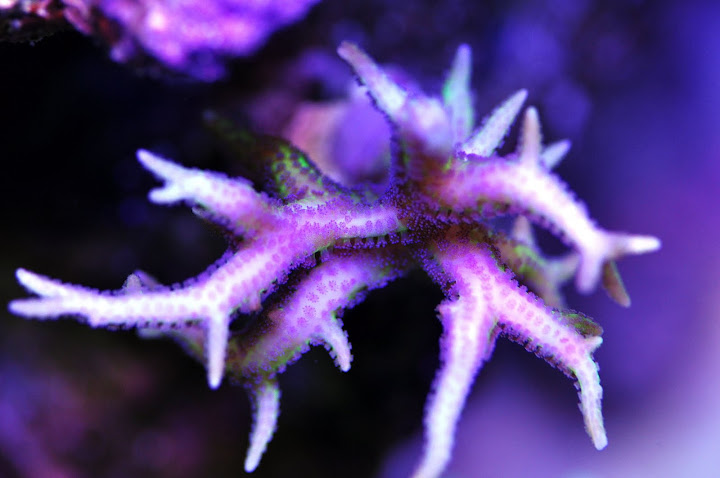
14.3.2011

Pink Cat's Paw:
17.1.2010
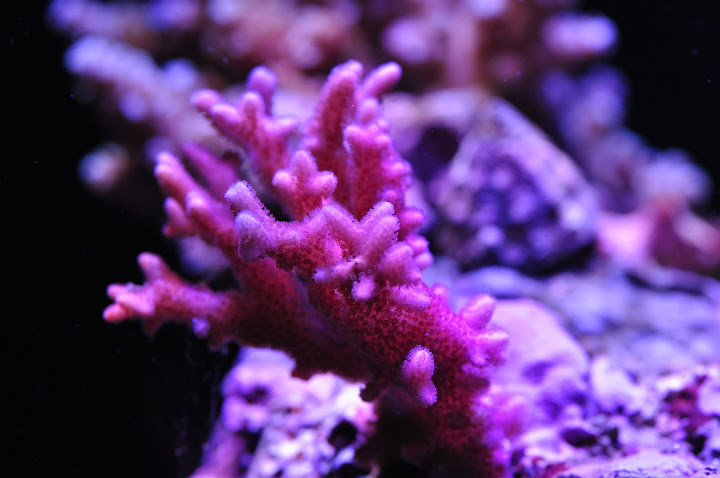
14.3.2011

Last edited:


PAR is PAR just as science is science. There is no voodoo to whether or not LEDs work, and I feel like people who 'have doubts' and 'need to see proven results' just don't understand scientific principles properly. There is no 'magic' component that is missing from LEDs that is there in other lighting options.
Seems like I'm on a crusade lately. I'm an early supporter of LEDs but I'm also an evangelist when it comes to killing urban legends in this hobby. PAR is PAR, as Landon points out, but most people really don't understand what that means.
A PAR meter essentially counts photons that have wavelengths between ~400 and ~700nm. Corals have very specific spectral requirements within that range (which, btw, was developed for terrestrial plants --- not marine animals). You can have two lamps each putting out 700 PAR - one with a broad spectrum and one 100% yellow light. Both putting out the same PAR but destined to give you far different results if placed over your tank.
So, getting high PAR readings is only one part of the equation. Getting high enough PAR readings in the parts of the spectrum that matter is another. This is why reefers are constantly trying different MH lamps and T5 combinations ---- to get just the right intensity of the important spectral regions (that stimulate growth and make for happy corals) and a pleasing aesthetic look.
With LEDs we have far less flexibility and options when it comes to spectral composition. Compare a spectral plot of your typical W/RB/B LED fixture with a popular MH or T5 combo. You'll see the problem right away. LEDs are close and the success people are having indicates that LEDs are apparently getting close enough. But spectrally, we're not quite there yet and it will take LED manufacturers to begin producing high-powered LED's tailored to our needs before that happens.

redfishsc
New member
So, getting high PAR readings is only one part of the equation. Getting high enough PAR readings in the parts of the spectrum that matter is another. This is why reefers are constantly trying different MH lamps and T5 combinations ---- to get just the right intensity of the important spectral regions (that stimulate growth and make for happy corals) and a pleasing aesthetic look.
The vast majority of the bulb swapping I see being done is people trying to get stuff that looks better to their eyes, and then hoping the coral grow fine.
With LEDs we have far less flexibility and options when it comes to spectral composition. Compare a spectral plot of your typical W/RB/B LED fixture with a popular MH or T5 combo. You'll see the problem right away. LEDs are close and the success people are having indicates that LEDs are apparently getting close enough. But spectrally, we're not quite there yet and it will take LED manufacturers to begin producing high-powered LED's tailored to our needs before that happens.
Keep your eyes open, a friend and I are going to be checking this very thing with a radiometer (as well as nominal PAR values for comparison). We will be checking individual LEDS (mostly Cree, Rebel, a few Bridgelux and Satistronics), and then we will be putting a BUNCH of combinations together for both reef and freshwater planted tanks to see what the resultant spectrum will be of, say, 1:1 cool white/royal blue, and 1:2 neutral white/royal blue.
We can compare these with popular halides that are known to produce reasonable growth--- such as Radium.
More news to come at 11 (meaning, 6-8 weeks)
Shard
Member
Hey jtma,
Haha.. true, but I really didn't feel like writing a whole post about what PAR is. I did however want to add a little to what you have said.
True, just a few corrections. Chlorophyll A, the type present in coral, has peaks around ~430nm and ~460nm. The reactive range is actually wider (since they are comprised of peaks), ranging from ~410-440nm and ~650-680nm.
Also, the Photosynthetically Active Radiation (PAR) scale was devised to cover the range of light useful in photosynthesis. Chlorophyll A is the most abundant and most prevalent type of chlorophyll, existing in all oxygenic photosynthetic organisms, including plants and corals. It also has peaks that are farther away from center than those of Chlorophyll B (which is not present in corals), so one could argue that the 400-700nm PAR scale was built around the absorption spectrum of Chlorophyll A, not a specific group of organisms such as plants.
I have seen some new fixtures incorporating a variety of different LEDs with various spectral characteristics lately, so there is a lot more flexibility now. As for comparison, if you compare the plot from an Aqua Illumination module and then one from a MH bulb, you will see they are actually quite similar. LEDs do work, and they are hitting the peaks needed for reactivity and covering the right spectrum, so I would say manufacturers are producing LEDs that meet our needs.
I would be interes
Hope all is well!
Landon
PAR is PAR, as Landon points out, but most people really don't understand what that means.
Haha.. true, but I really didn't feel like writing a whole post about what PAR is.
I did however want to add a little to what you have said.A PAR meter essentially counts photons that have wavelengths between ~400 and ~700nm. Corals have very specific spectral requirements within that range (which, btw, was developed for terrestrial plants --- not marine animals).
True, just a few corrections. Chlorophyll A, the type present in coral, has peaks around ~430nm and ~460nm. The reactive range is actually wider (since they are comprised of peaks), ranging from ~410-440nm and ~650-680nm.
Also, the Photosynthetically Active Radiation (PAR) scale was devised to cover the range of light useful in photosynthesis. Chlorophyll A is the most abundant and most prevalent type of chlorophyll, existing in all oxygenic photosynthetic organisms, including plants and corals. It also has peaks that are farther away from center than those of Chlorophyll B (which is not present in corals), so one could argue that the 400-700nm PAR scale was built around the absorption spectrum of Chlorophyll A, not a specific group of organisms such as plants.
With LEDs we have far less flexibility and options when it comes to spectral composition. Compare a spectral plot of your typical W/RB/B LED fixture with a popular MH or T5 combo. You'll see the problem right away. LEDs are close and the success people are having indicates that LEDs are apparently getting close enough. But spectrally, we're not quite there yet and it will take LED manufacturers to begin producing high-powered LED's tailored to our needs before that happens.
I have seen some new fixtures incorporating a variety of different LEDs with various spectral characteristics lately, so there is a lot more flexibility now. As for comparison, if you compare the plot from an Aqua Illumination module and then one from a MH bulb, you will see they are actually quite similar. LEDs do work, and they are hitting the peaks needed for reactivity and covering the right spectrum, so I would say manufacturers are producing LEDs that meet our needs.
I would be interes
Hope all is well!
Landon
Last edited:

reefkeeps
Active member
Keep your eyes open, a friend and I are going to be checking this very thing with a radiometer (as well as nominal PAR values for comparison). We will be checking individual LEDS (mostly Cree, Rebel, a few Bridgelux and Satistronics), and then we will be putting a BUNCH of combinations together for both reef and freshwater planted tanks to see what the resultant spectrum will be of, say, 1:1 cool white/royal blue, and 1:2 neutral white/royal blue.
We can compare these with popular halides that are known to produce reasonable growth--- such as Radium.
More news to come at 11 (meaning, 6-8 weeks)
Any update?
Similar threads
- Replies
- 2
- Views
- 137
- Replies
- 3
- Views
- 238
- Replies
- 0
- Views
- 113

- Replies
- 39
- Views
- 975


- Replies
- 1
- Views
- 735
