
Stubborn Ich- help please

snake42490

New member
I will keep this short and sweet.

I did hypo for all my fish in 90 gallon tank- dropped salinity to 1.007, kept them there for 9 weeks. Ich came back around the 5th week of hypo. I did everything in the books on this one and think I may have a strain that was reproducing in hypo.

I have now gone to the tank transfer method. I am using 35 gallon garbage cans to do this. I am on day 9 and 2 of the fish are completely covered with VERY large cysts... I have seen my fare share of icy, but these cysts are huge and are not dropping off the fish. The two fish that are showing really bad signs haven't been eating and the stomachs are sunken in. Am I dealing with ich or am I messing with some other disease.

Hypo salinity- dropped down to 1.007 within three days. Maintained throughout the course. Did water changes every 2 days on the tank. The fish were completely ich free by the second week. Then on the fifth week while still in hypo, another break out happened on. scopas tang, yellow tang, blue hippo tang

Tank Transfer Method- 35 gallon buckets- 1.015 , 78 degrees. I have been doing the transfers every 48 hours, I would do the third day, but am a bit nervous because of how many fish are in the 35 gallon buckets. My ammonia is spiking every day. I am using prime, but it still scares me having the ammonia spikes.

When transfering the fish, i surface them with a net then use my hands to pick them up and place them in a clean bucket- I put formalin in the bucket and poor some new water in the bucket to somewhat acclimate them. They stay in there for 5 minutes, then i pick them up with my hands and place them in the new container. Old container is drained, pumps and heater are soaked in a bleach solution then let dry for 24 hours. I have used TTM about 5 other times with success. I am a nazi on no contamination...


What am I dealing with?!?! Could it be any other disease?
 
Are you sure your refractometer is calibrated? If you calibrated it at 1.025... your not gonna get good results at 1.007.. You would need to calibrate using ro/di water since thats closer to the required measurement you need. Test your ro/di water and see what measurement you get from the refractometer.

I had this same problem until i found my readings for ro/di water was like -.06...Yes it was under the 1.0 line by a long shot... because I had my refractometer calibrated at 1.025....


the very large cysts concerns me though... beginning to think it's not ich. Can you show closeup pics?
 
Double checked calibration, it was still on. I used the factory fluid that is pure water. Checked ro di water and it checked out. Can't get pictures up for a while. I'm at school until tonight. What it appears to me are the cysts are forming deep under the skin, but not surfacing. The fish has scars all over it's body. Typical inch should drop off within 24 hours to six days. We are hitting day 10 and the same cysts are still there getting bigger
 
the very large cysts concerns me though... beginning to think it's not ich. Can you show closeup pics?

+1 How big in diameter would you say these "cysts" are? Ich always looks like sprinkled salt or sugar; It doesn't grow in size or get bigger the longer the fish is infected.

What you are describing might be Lymphocystis or something bacterial or even fungus.
 
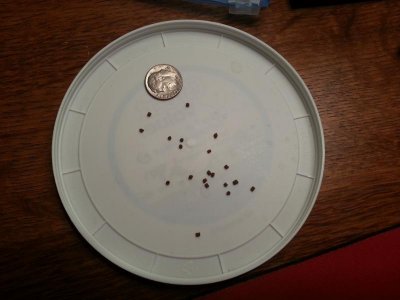
These specs are all across the body and on the tail fin. I have been using melafix in the water to help promote healing. Definitely not Lymphocystis, doesn't appear like that at all. Just think of your salt sprinkles, but bigger.

Roughly 30-40. FYI- None of the other fish have cysts this big, the yellow tang has been dropping off the ich. The blue hippo has around 15 specs that appear to be normal ich. The only fish that has this is the scopas tang. The specs are the size of the food that I am feeding them. I don't know if they are just so big they are having a hard time maturing to the surface to drop and may have encysted on the fish itself?
 

Attachments

  • 2012-11-09 09.00.43.jpg
    2012-11-09 09.00.43.jpg
    40.7 KB · Views: 22
These specs are all across the body and on the tail fin. I have been using melafix in the water to help promote healing. Definitely not Lymphocystis, doesn't appear like that at all. Just think of your salt sprinkles, but bigger.

Roughly 30-40. FYI- None of the other fish have cysts this big, the yellow tang has been dropping off the ich. The blue hippo has around 15 specs that appear to be normal ich. The only fish that has this is the scopas tang. The specs are the size of the food that I am feeding them. I don't know if they are just so big they are having a hard time maturing to the surface to drop and may have encysted on the fish itself?

Ya know, I just remembered a thread that described something like this. Read from Post #51 onward:

http://www.reefcentral.com/forums/showthread.php?t=2085503&page=3

Also, check out this thread:

http://www.reefcentral.com/forums/showthread.php?t=1568912&highlight=pimple

If you're sure the other fish have "normal Ich", then I'd mainly focus on eradicating that for now. At least with that you know what you're dealing with. Sometimes other problems can be a secondary condition and go away on their own once the Ich is gone.

I would only be guessing at what the larger white spots could be. Parasitic isopods of some kind are certainly possible. Look here and do a search for "isopod":

http://www.chucksaddiction.com/disease.html
 
I guess this would explain why the dots aren't going away lol... Any ideas??
I did hypo, will be done with tank transfer in three days. I almost wonder if I'm best to count my loss on the one fish and get the other ones better... Are you thinking parasitic or bacterial?
 
I guess this would explain why the dots aren't going away lol... Any ideas??
I did hypo, will be done with tank transfer in three days. I almost wonder if I'm best to count my loss on the one fish and get the other ones better... Are you thinking parasitic or bacterial?

If you can do it, I would isolate the Scopas away from the other fish. Just as a precaution. Focus on saving your other fish. Btw, I'm not sure how effective TT is if you deviate away from the 3-day rotation. You said you were transferring the fish every 24 hours. But I'm not an expert on TT; Hopefully snorvich will chime in on that aspect.

Continue to treat the Scopas as if he has Ich. Because if all the other fish have it, odds are he has it too. I would just kinda wait & see what happens with the larger white spots.
 
Depending on how he looks when I get home will depend on what I'm going to do. I am pretty sure this is ich. I just don't know what else it could be. I'm going to wait one more day to do the tranfser which will be the 6th one for the 12 day mark. I am going to do a couple extra transfers on the fish minus the scopas and see where that leads me. My only other option for treatment is copper. I would rather not do the copper treatment, but it may be my only option.


Question--- say the fish are in QT and after 24 hours the ammonia spikes to .25, I add prime, then test the next day and it's around .5 ppm... Am I understanding that I add the prime and it instantly detoxifies the ammonia, but the ammonia levels will still show up on a test?
 
Question--- say the fish are in QT and after 24 hours the ammonia spikes to .25, I add prime, then test the next day and it's around .5 ppm... Am I understanding that I add the prime and it instantly detoxifies the ammonia, but the ammonia levels will still show up on a test?

Dechlorinators such as Prime render most, if not all, liquid/powder ammonia test kits useless.

Your best option for keeping tabs on ammonia in QT is one of these:

http://www.seachem.com/Products/product_pages/AmmoniaAlert.html

This FAQ explains why the ammonia badge works in the presence of Prime, while regular test kits do not:

http://www.seachem.com/support/FAQs/AmmoniaAlert.html

Don't take the ammonia badge's reading as gospel (still watch your fish closely), but I've found it to be roughly accurate.
 
Question--- say the fish are in QT and after 24 hours the ammonia spikes to .25, I add prime, then test the next day and it's around .5 ppm... Am I understanding that I add the prime and it instantly detoxifies the ammonia, but the ammonia levels will still show up on a test?

Correct. Prime converts free ammonia (toxic) to ammonium. Most test kits measure total ammonia (free ammonia plus ammonium). If you want to be sure that the water is not harmful, you need a test that measures free ammonia only. As b0bab0ey noted, the Seachem ammonia alert badge measures free ammonia. In addition, Seachem sells an ammonia test kit that measures free ammonia only.
 
Thanks guys, okay... we are going on day 15 now and the ich is still here.... Any ideas guys? I'm doing the transfer every three days now, my salinity is 1.015.

My process- Drum 1 transfer fish, 48 hours catch fish, place into small bucket, acclimate to Drum 2 for the second transfer- place fish into another bucket with the new drum water- wash my hands then transfer fish with my hands to the new drum.

Drum 1- torn down, drained rinsed with water and let dry for 48 hours- equipment is all soaked in bleach solution then let dry after.

I think I am dealing with a resistant strain here... It's just not going away... I have watched the same ich spot for 12 days on this fish without it dropping off? Any ideas?
 
I believe you are dealing with ich. I know exactly what you are talking about. My fish had the same thing, very big spots and then small spots as well. The only difference is the time frame of the drop off. My spots both big and small, drop off the fish every day and reinfect each night. No treatment was working. I ordered quinine sulfate and after a few days the spots went away. But they didn't stay away, so i had to treat again. Low sg did nothing to help. Most of the fish are clean now, but i am still treating. Many people have a hard time believing that this is some supper ich, and personally i hope they never encounter it. It takes a long time to treat and it can do damage to the fish. Once the fish are clean i would avoid putting any other fish with them again. They will forever be carriers.
 
I believe you are dealing with ich. I know exactly what you are talking about. My fish had the same thing, very big spots and then small spots as well. The only difference is the time frame of the drop off. My spots both big and small, drop off the fish every day and reinfect each night. No treatment was working. I ordered quinine sulfate and after a few days the spots went away. But they didn't stay away, so i had to treat again. Low sg did nothing to help. Most of the fish are clean now, but i am still treating. Many people have a hard time believing that this is some supper ich, and personally i hope they never encounter it. It takes a long time to treat and it can do damage to the fish. Once the fish are clean i would avoid putting any other fish with them again. They will forever be carriers.
Many fish will show different color patterns at night. I don't think you are describing ich. Ich doesn't come and go like this and ich spots don't vary that much in size. The spots ''dropping off" does mean anything when it comes to ich being present. Being "clean' is not a reliable indicator of ich either. You are right, low SG does nothing for ich; it must be all the way down to 1.008 to have any effect at all. Fish will not be "forever carriers". I don't know if you have ich or not; but although well-intentioned, I think you are passing along a tremendous amount of mis-information. I'd read the ich stickies above and learn about this parasite If you don't treat it properly, it will forever haunt you; if you treat it properly and quarantine all new fish, it won't be a problem again.
 
I'm definitely dealing with ich. I have done a lot of research on this parasite and what is bothering me is this time around it is not following anything by the books. This is what is bothering me. I was hoping someone could explain what might be going on and why. I'm now on day 14 of TTM and still dealing with the parasite present on the fish. I know what you are going to say you probably cross contaminated and brought a cyst over. The issue that is bothering me is the ich is still on the fish. I have watched these same spots stay on the fish for 14 days. NOW-- some of them are falling off the fish and leaving behind some nasty scars, I will get some pictures for you guys at some point. At this point I am going to continue into a second round of TTM for another 12 days. I am hoping that by this Sunday the fish "look" parasite free. Allowing the last couple of transfers to get the non visible parasite off the fish.

Note- Only three of this fish show symptoms of ich - the only fish that is having this "stubborn" ich is the Scopas Tang. This time around I am doing 72 hour transfers. Also, the fish have gained all appetite back. I have increased feeding to help fatten up my tangs. The scopas looked like it was on death row before it decided eating.


My main Question that I would like answered--- Most trophonts will fall of the fish within 3 to 7 days. Why am I on day 14 still dealing with this parasite?
 
I started the TTM on the 1st- now the 14th. I came straight out of hypo salinity 1.007 to TTM, I slowly raised the salinity to 1.017.
 
I understand what everyone is saying but this is crypt. I did have the salinity down to 1.008. Nothing happened. Also the fish is a scribble angel and is dark blue so it is easy to see the white spots and they do not have night time color changes. I had thought I was seeing things when during the day the fish was clean and at night even before lights out the would be covered. I even started to video tape it so if I could find an exotic vet I could show them. Found out where it came from, my local fish store. Wouldn't have found that out except that they had to kill one of their systems that contained over 1000 gals and when I asked why they told me. My largest female scribble also had a huge scar from it. The biologist at the fish store looked under a microscope and confirmed that what I am dealing with is icy and a very resistant strain. Thankfully the quinine is working. Had to move the fish to a bare bottom and I am killing my 75 gal at tank.
 
I understand what everyone is saying but this is crypt. I did have the salinity down to 1.008. Nothing happened. Also the fish is a scribble angel and is dark blue so it is easy to see the white spots and they do not have night time color changes. I had thought I was seeing things when during the day the fish was clean and at night even before lights out the would be covered. I even started to video tape it so if I could find an exotic vet I could show them. Found out where it came from, my local fish store. Wouldn't have found that out except that they had to kill one of their systems that contained over 1000 gals and when I asked why they told me. My largest female scribble also had a huge scar from it. The biologist at the fish store looked under a microscope and confirmed that what I am dealing with is icy and a very resistant strain. Thankfully the quinine is working. Had to move the fish to a bare bottom and I am killing my 75 gal at tank.

A biologist at a LFS can identify strains of ich????
 
Back
Top