sump design input request

cushms01

New member
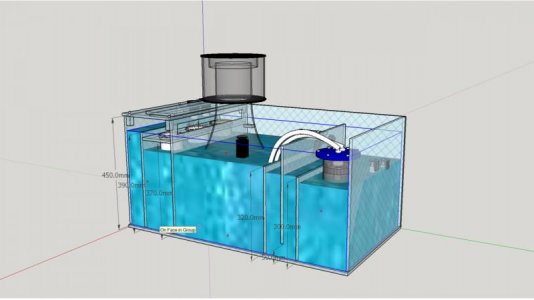
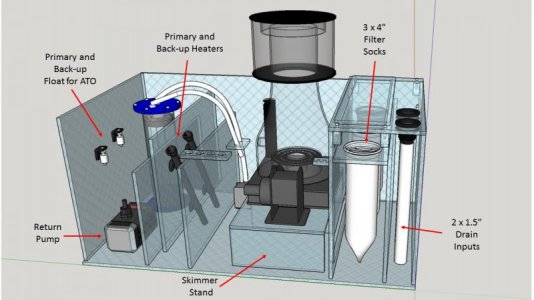
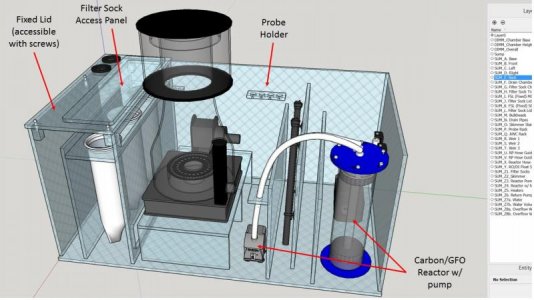
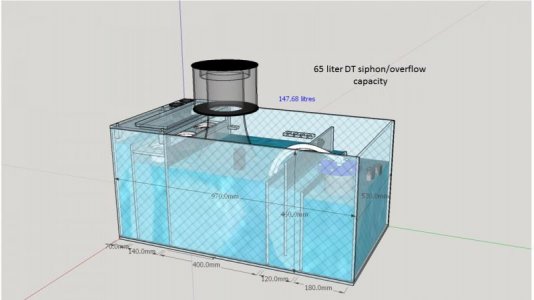
After browsing the forums here, I've drawn up a sump design for my 125g DT. I was hoping that folks could take a look and offer some suggestions. My main concerns are the baffle drop heights. I've got them all at 20mm (a little less than an inch). Looking to keep the noise down.

I'm set on filter socks, so don't try to talk me out of that.

Other than that, looking for any and all constructive criticism and/or advice.

What am I missing? What looks good? What should I modify? What should I subtract?
 

Attachments

  • Slide1.jpg
    Slide1.jpg
    32.7 KB · Views: 6
  • Slide2.jpg
    Slide2.jpg
    28.8 KB · Views: 5
  • Slide3.jpg
    Slide3.jpg
    47.8 KB · Views: 6
  • Slide4.jpg
    Slide4.jpg
    56 KB · Views: 4
Looks like a very well thought out sump design. The only concern I would have is if there will be enough empty space for the extra water from the display for when the power to the return pump is out. That will take some calculation on your part. FWIW.. I use filter socks myself so you won't hear any criticism from me regarding the use of them.
 
+1^^ LOL about socks. Micron socks or pads are excellent mechanical filtration so no argument here as well. What's up, slief?

I haven't looked at the pics yet but yeah, make sure the sump is big enough in case of power outage.
 
Good looking sump. I share slief's concerns about drain down capacity. Also putting the reactor in the return section cuts down on it's capacity. This is really an issue if your ATO has a problem. The return will suck air pretty quickly.
 
But there is a continuous flow of water through the sump. He's not going to be recirculating the same water through the reactor just because the intake and output are in the same chamber.
 
It matters because of the loop. The out needs to go to next section to prevent the loop. Same with a protein skimmer, UV, etc.

As username stated, more water will go right past the reactor than will go through it, it won't recirculate anything. Even the flow rate though the sump is irrelevant to what will actually go through the reactor. Same for the skimmer. This completely debunks the myth that flow through the sump should match the flow through the skimmer, and recirculating skimmers are less efficient than "single" pass skimmers. Much higher flow through the sump, is more efficient in a multipass system, such as the system altogether.
 
Last edited:
I just like low flow in the sump so the crap collects there and I can vac it out easily.

That makes it convenient for you, but it is not what is best for the system as a whole. You want the flow rates high enough that particulates remain suspended in the water column, without falling out, as they are an important food source for many critters. There are also specific species of critters called detrivores, that thrive on the crud. Bio-diversity is another component of a system that works, (often the mythified successful) and a system that works really well.

Also, in a multi-pass system, the higher the flow rate, the more efficient all the various methods are. This includes perhaps on of the most important: gas exchange.
 
Reactor is in the sump, because there was no where else to put it with my old setup. With the new set-up, I can move it out of the sump. I kind of like it being in the sump in case of a leak, but that's rather unlikely. I'll move it out of the sump. Thanks for the great idea. I can also move the output of the reactor to the return pump/ATO chamber. I don't think there is an issue with recirculation, but it's no harder to move the return line to the return pump/ATO chamber.
 
Also, I have a check valve on the return pump line which should stop any siphon events. But I'll check to see how much siphons out as a back-up in the event that the check valve fails. Again, thanks for the suggestions!
 
Also, I have a check valve on the return pump line which should stop any siphon events. But I'll check to see how much siphons out as a back-up in the event that the check valve fails. Again, thanks for the suggestions!

Check valves are, IMHO, a waste of time and money. They are not reliable in a SW tank. Stuff grows on them and prevents them from working at the most critical time.

The only failsafe method is to have enough capacity in the sump to handle drain down.
 
Also, I have a check valve on the return pump line which should stop any siphon events. But I'll check to see how much siphons out as a back-up in the event that the check valve fails. Again, thanks for the suggestions!
Have you used this calculator for sump volume? It will tell you how many gallons of water will go into your sump from tank overflow in case of the event. As for siphon back, it depends on how deep the return outlet is inside the tank water. One or two small holes drilled into the outlet just below the water level in DT is mostly recommended.
 
Last edited:
Back
Top