I may have not made myself clear in that the amount of time the sun is not at full intensity at the equator is insignifigant in reference to our lighting.
Clouds, haze and changing atmospheric conditions have a more profound effect on spectrum than a few insignicant minutes when the sun isn't at full spectrum and intensity.
Some good info here---
http://www.fishchannel.com/saltwater-aquariums/aquarium-frontiers/natural-reef-light.aspx
Exceprts from Harker's article linked above..........
"
From total darkness, it only takes a few minutes for light to reach levels normally found in a reef aquarium. Measuring light over a shallow reef off Sulawesi, Indonesia, I found that intensity reached 200 microEinsteins per square meter per second (μE/m2/sec) by 6:30 a.m. This is a light intensity level that exceeds that found on many reef aquariums. By 8:00 a.m. light intensity exceeded the intensity found over an aquarium lighted by 400-watt metal halide bulbs.
This raises the question of whether slowly "œcycling" lights on gradually is of any value.
On the natural reef, light exceeds that of a typical reef aquarium in less than an hour. If a hobbyist wants to re-create sunrise on a natural reef, a cycling time well less than an hour would be more realistic than the more typical several hour cycling"
More----
"While some of the corals collected for the reef hobby have habitats that extend below 30 feet, virtually all coral species collected are found in shallow depths, often only a few feet below low tide. This means that most corals imported have adapted to living in virtually
full-spectrum light. This is also true of Tridacna clams and anemones collected for reefkeeping.
These organisms are collected from shallow,
full-spectrum light environments. Therefore, the hobby's focus on blue light is more a reflection of current hobby fashion rather than clear evidence that corals need blue light. At the same time, studies have shown that corals can adapt to predominantly blue light (Kinzie et al. 1984, Kinzie and Hunter 1987), so a hobbyist has a great deal of flexibility in choosing lighting, as long as sufficient intensity is provided.
Regarding what you may see when diving---
http://www.reefkeeping.com/issues/2002-09/atj/feature/index.php
Excerpt-----
"Before I discuss these influences, I feel it is important to note that while our vision is sensitive to various intensities and spectra of light,
it is not very good at judging either intensity or color in isolation. Our eyes adjust to a huge range of intensities, over a number of orders of magnitude, but it is not easy for us to estimate the intensity with our eyes alone. Similarly, our brains interpret images we see and may adjust the perceived colors such that we may be unaware of a color shift."
---------------------------
I've always used full on/ off for the past 25 years of keeping corals, Sps dominant over the last 13, and this has always worked well for me.
Regardless of whether people want to use the blue light to mimic some kind of sunrise/sunset is neither harmful or helpful as corals are amazing animals and will adapt.
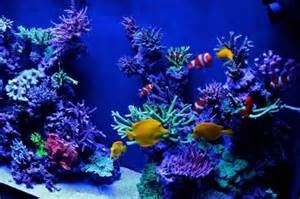
I hate that blue light look that mimics the back room of Spencer Gifts with their corals acting like black panthers, psyhadelic patterns, and the guy smoking a joint from the 70's.
So in the end, I think it's just a matter of prefereence.