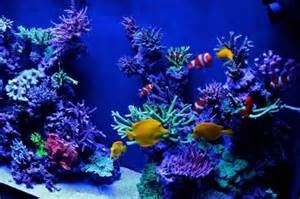
T5 users, please post you bulb combination!

Front----
Blue+
Coral+
Blue+
Coral+
Back---

I don't do dawn/dusk, i go full on full off...........corals at the equator get full sun immediately. Also the spectrum is the same all day. It doesn't turn blue as the sun goes down.

Unless your tank is in a dark basement, ambient light will serve fine as evening and morning light so the fish don't get shocked.
 
So are you saying that the PAR on the ATI Actinic is still 137 and it did NOT increase like was said previously?

This a follow up for the post #61:

Confirmed!
The ATI representative said once more that the ATI actinic wasn't changed at all since the beginning.
The distributor here in the US call the bulb "True Actinic". That's all.
Perhaps that was the reason for such rumor among some aquarists(?).

Grandis.
 
The current bulb setup not at all blue, more yellow. I have sps corals and looking more for a crisp white colour with a bit of blue. Will the tank look better with Special, Special, Blue Plus, Blue Plus?

You can try something similar to mine (please see post #53), with the ATI Coral Plus and Blue plus bulbs then.
Another bulb that could help you, with a good growth, is the Giesemann 6000K.
The 6000K will keep some of the yellow there. You can have a Coral Plus to help balance that out. So, the other option would be a combo of Blue Pluses, The Coral Plus and a Giesemann 6000K.

Grandis.
 
Front----
Blue+
Coral+
Blue+
Coral+
Back---

I don't do dawn/dusk, i go full on full off...........corals at the equator get full sun immediately. Also the spectrum is the same all day. It doesn't turn blue as the sun goes down.

Unless your tank is in a dark basement, ambient light will serve fine as evening and morning light so the fish don't get shocked.

I just want to put my observations here and try to help you understand better.

Well, naturally the sun doesn't come at once on the corals, never. The nights are dark, unless there is moon light, and there is a period of time when the light reaches the skies and the water looks blue, when the sky is blue, yes. That is a reflection of the sun light on the sky. You can se that in very shallow waters, even like 2 or 3 feet deep, when the water is clean, like the Tropics.

Everyone that did some snorkeling/diving during those times know what I'm talking about.
Therefore I just need to bring my suggestion for you to try to do that for your system. It isn't a big deal to accomplish such natural event every day with the available technology today.

The new ATI dimmable fixture does that wonderfully and I just love to be able to control the time for that effect.
My other systems, the ATI PMs are on timers.
It's more natural that way.

Grandis.
 
After debating for a while on the coral+, i got the combo 4Blue+,1 coral+, and1purple+ like some here. I must say it brings a beautilful look. I just switched from 3 blue+ 1 purple+ and two 10ks. Its too early to tell how my acros and sps will react, but i dont see how it wouldnt be ok. Some of my acros had gone from 2" frags to some at about 8" now, so i always thought the lower k was needed for them. What made me switch was tanks of other reefers in the 20k range having not only the growth i had, but also much better color rendition.
I was wondering par on coral+ as well, so will be tagging along if anyone has that info...
If that helps, here is a pic of before and after the switch. The bluer combo, even though looks dark in the pic( its hard to capture the real colors with my camera), in person is much brighter, and the contrast is amazing.


Please tell me what 10000K bulbs you were using.
Thanks,
Grandis.
 
I just want to put my observations here and try to help you understand better.

Well, naturally the sun doesn't come at once on the corals, never. The nights are dark, unless there is moon light, and there is a period of time when the light reaches the skies and the water looks blue, when the sky is blue, yes. That is a reflection of the sun light on the sky. You can se that in very shallow waters, even like 2 or 3 feet deep, when the water is clean, like the Tropics.

Everyone that did some snorkeling/diving during those times know what I'm talking about.
Therefore I just need to bring my suggestion for you to try to do that for your system. It isn't a big deal to accomplish such natural event every day with the available technology today.

The new ATI dimmable fixture does that wonderfully and I just love to be able to control the time for that effect.
My other systems, the ATI PMs are on timers.
It's more natural that way.

Grandis.

I may have not made myself clear in that the amount of time the sun is not at full intensity at the equator is insignifigant in reference to our lighting.

Clouds, haze and changing atmospheric conditions have a more profound effect on spectrum than a few insignicant minutes when the sun isn't at full spectrum and intensity.

Some good info here---

http://www.fishchannel.com/saltwater-aquariums/aquarium-frontiers/natural-reef-light.aspx

Exceprts from Harker's article linked above..........

"From total darkness, it only takes a few minutes for light to reach levels normally found in a reef aquarium. Measuring light over a shallow reef off Sulawesi, Indonesia, I found that intensity reached 200 microEinsteins per square meter per second (μE/m2/sec) by 6:30 a.m. This is a light intensity level that exceeds that found on many reef aquariums. By 8:00 a.m. light intensity exceeded the intensity found over an aquarium lighted by 400-watt metal halide bulbs. This raises the question of whether slowly "œcycling" lights on gradually is of any value.
On the natural reef, light exceeds that of a typical reef aquarium in less than an hour. If a hobbyist wants to re-create sunrise on a natural reef, a cycling time well less than an hour would be more realistic than the more typical several hour cycling"

More----

"While some of the corals collected for the reef hobby have habitats that extend below 30 feet, virtually all coral species collected are found in shallow depths, often only a few feet below low tide. This means that most corals imported have adapted to living in virtually full-spectrum light. This is also true of Tridacna clams and anemones collected for reefkeeping.

These organisms are collected from shallow, full-spectrum light environments. Therefore, the hobby's focus on blue light is more a reflection of current hobby fashion rather than clear evidence that corals need blue light. At the same time, studies have shown that corals can adapt to predominantly blue light (Kinzie et al. 1984, Kinzie and Hunter 1987), so a hobbyist has a great deal of flexibility in choosing lighting, as long as sufficient intensity is provided.

Regarding what you may see when diving---

http://www.reefkeeping.com/issues/2002-09/atj/feature/index.php

Excerpt-----

"Before I discuss these influences, I feel it is important to note that while our vision is sensitive to various intensities and spectra of light, it is not very good at judging either intensity or color in isolation. Our eyes adjust to a huge range of intensities, over a number of orders of magnitude, but it is not easy for us to estimate the intensity with our eyes alone. Similarly, our brains interpret images we see and may adjust the perceived colors such that we may be unaware of a color shift."

---------------------------

I've always used full on/ off for the past 25 years of keeping corals, Sps dominant over the last 13, and this has always worked well for me.

Regardless of whether people want to use the blue light to mimic some kind of sunrise/sunset is neither harmful or helpful as corals are amazing animals and will adapt.

I hate that blue light look that mimics the back room of Spencer Gifts with their corals acting like black panthers, psyhadelic patterns, and the guy smoking a joint from the 70's.

So in the end, I think it's just a matter of prefereence.

 
Please tell me what 10000K bulbs you were using.
Thanks,
Grandis.

Grandis,

I know it sounds silly, but believe it or not i have used successfuly Deep Blue 10K bulbs and did get lots of improvement with them.
Reason i switched (in my new 80 gal tank)was i felt in my shallow tank (16" deep)it was way too much light. The 10ks gave my tank a nice look but i noticed some $ plate corals' colors fading a bit. I switched and with the coral + seem to have lowered it to what they like better. Their colors now about 3 weeks after the switch have come back.

The only reason i would ever have tried those bulbs is because i got a Dee Blue fixture(4 bulb 24") in a 20 gal long i had for a year and the results i had with 1blue+/2x10ks/1 actinic were very impressive IMo. Since that little tank was shallow(12"), i figured these bulbs would have enough to get corals growing. Boy i was right on!

I had some people come see my little tank and spend hours trying to figure how i got so much color and growth. Im posting a pic again of it, and def recommend the Deep Blue(10k is the one i tried) bulbs, since ive seen in practice what theyve done to my tank and corals.... Here is a pic. Note: this tank was always kept w these bulbs from day one...


Last edited:
I may have not made myself clear in that the amount of time the sun is not at full intensity at the equator is insignifigant in reference to our lighting.

Clouds, haze and changing atmospheric conditions have a more profound effect on spectrum than a few insignicant minutes when the sun isn't at full spectrum and intensity.

Some good info here---

http://www.fishchannel.com/saltwater-aquariums/aquarium-frontiers/natural-reef-light.aspx

Exceprts from Harker's article linked above..........

"From total darkness, it only takes a few minutes for light to reach levels normally found in a reef aquarium. Measuring light over a shallow reef off Sulawesi, Indonesia, I found that intensity reached 200 microEinsteins per square meter per second (μE/m2/sec) by 6:30 a.m. This is a light intensity level that exceeds that found on many reef aquariums. By 8:00 a.m. light intensity exceeded the intensity found over an aquarium lighted by 400-watt metal halide bulbs. This raises the question of whether slowly "œcycling" lights on gradually is of any value.
On the natural reef, light exceeds that of a typical reef aquarium in less than an hour. If a hobbyist wants to re-create sunrise on a natural reef, a cycling time well less than an hour would be more realistic than the more typical several hour cycling"

More----

"While some of the corals collected for the reef hobby have habitats that extend below 30 feet, virtually all coral species collected are found in shallow depths, often only a few feet below low tide. This means that most corals imported have adapted to living in virtually full-spectrum light. This is also true of Tridacna clams and anemones collected for reefkeeping.

These organisms are collected from shallow, full-spectrum light environments. Therefore, the hobby's focus on blue light is more a reflection of current hobby fashion rather than clear evidence that corals need blue light. At the same time, studies have shown that corals can adapt to predominantly blue light (Kinzie et al. 1984, Kinzie and Hunter 1987), so a hobbyist has a great deal of flexibility in choosing lighting, as long as sufficient intensity is provided.

Regarding what you may see when diving---

http://www.reefkeeping.com/issues/2002-09/atj/feature/index.php

Excerpt-----

"Before I discuss these influences, I feel it is important to note that while our vision is sensitive to various intensities and spectra of light, it is not very good at judging either intensity or color in isolation. Our eyes adjust to a huge range of intensities, over a number of orders of magnitude, but it is not easy for us to estimate the intensity with our eyes alone. Similarly, our brains interpret images we see and may adjust the perceived colors such that we may be unaware of a color shift."

---------------------------

I've always used full on/ off for the past 25 years of keeping corals, Sps dominant over the last 13, and this has always worked well for me.

Regardless of whether people want to use the blue light to mimic some kind of sunrise/sunset is neither harmful or helpful as corals are amazing animals and will adapt.

I hate that blue light look that mimics the back room of Spencer Gifts with their corals acting like black panthers, psyhadelic patterns, and the guy smoking a joint from the 70's.

So in the end, I think it's just a matter of prefereence.

Hello Big E:

Now I got your point of view...

When you've said, and I quote once more, "corals at the equator get full sun immediately. Also the spectrum is the same all day. It doesn't turn blue as the sun goes down." I thought that statement was a bit empty, with all the respect. I thank you very much for the clarification. Actually the "blue time" would be more important to the fish than the corals...

I agree with you, and the article, that there is no really need for the corals to have that blue light for any sunrise/sunset effect. Even disregarding all the great info from the two articles one should know that the dimmer effects of sunrise/sunset won't change much the metabolic functions and/or healthy/growth of the organisms we keep. As you've said, the corals are great creatures and with an amazing adaptation capability toward artificial lighting. Fishes and other invertebrates do have a great influence from that time range thought. If you do some snorkeling/diving that is tremendously noticeable. The behavior of the fishes, specially is amazing and different from species to species, specially during the mating season. In the aquarium we can also notice that. Not a big deal, as they can also adapt really well after a while, but we can see some of the same behavior when the blue light is there. And that is not only if you have a dark room, I should add.

As you've said, a matter of preference too.

By the way, the articles are great and I was looking for the first one for years!!! That article is old!!! I remember reading it long time ago. Thanks very much! I'm reefing only for 18 years and use the 1 hour sunrise/1 hour sunset deal all this time. I'll do some changes to one of my systems to see how that goes. Very interesting!!

Also, about the spectrum and the need of full-spectrum bulbs. That is something that I totally agree!! No doubt!

I don't do drugs, never did, and don't want to have the blue light because of the 70's craziness either. LOL!!!! But I don't hate the light. It actually reminds me that it is almost time to go sleep, so that is a positive thing for me and my family. And I do like to watch the fishes during that period of time.

Do you mind share how long you leave the lights on and what lights/size tank you've got today? Tell us your experiences with the T5s and MHs, please.

Please tell me what's you position on Moon light. Remember the Lunar 500? LOL!!! Mine one is still working every night in one of my systems. Any articles about moon light from the same time of those articles, or newer? I lost all of my articles from long ago. We didn't even had CDs for the computer back then, remember? LOL!!!

I appreciate your input and help here!

It is so good to chat at this level! Thanks again and please post more.

Cheers,
Grandis.
 
Grandis,

I know it sounds silly, but believe it or not i have used successfuly Deep Blue 10K bulbs and did get lots of improvement with them.
Reason i switched (in my new 80 gal tank)was i felt in my shallow tank (16" deep)it was way too much light. The 10ks gave my tank a nice look but i noticed some $ plate corals' colors fading a bit. I switched and with the coral + seem to have lowered it to what they like better. Their colors now about 3 weeks after the switch have come back.

The only reason i would ever have tried those bulbs is because i got a Dee Blue fixture(4 bulb 24") in a 20 gal long i had for a year and the results i had with 1blue+/2x10ks/1 actinic were very impressive IMo. Since that little tank was shallow(12"), i figured these bulbs would have enough to get corals growing. Boy i was right on!

I had some people come see my little tank and spend hours trying to figure how i got so much color and growth. Im posting a pic again of it, and def recommend the Deep Blue(10k is the one i tried) bulbs, since ive seen in practice what theyve done to my tank and corals.... Here is a pic. Note: this tank was always kept w these bulbs from day one...


I want to thank you very much for replying here!

I don't think that's silly at all. Some of the best bulbs I've had in the past I don't even have their names, believe it or not!!!
I remember a 10000K that came with one of my first NOVA T5 fixtures loooong ago. That was just amazing. Color was the best and all the zoas and anemones I had back then were super healthy and with an amazing growth!! I don't know the name of the bulb and can't seem to find anyone that knows.

I would like to hear from others about their T5 10000K, please.
My old 10000Ks had an amazing crispy white light to our eyes.

Thanks very much, ReefCowboy!

Grandis.
 
Do you mind share how long you leave the lights on and what lights/size tank you've got today? Tell us your experiences with the T5s and MHs, please.

91/2 hours full on/full off. 4x54w over a 75g tank.

I ran halides for years... ...I go back to those Coralife fixtures and the bulbous 175w 5500k halides. At the time I think Hamilton was the only other fixture you could buy.

I started using 400w halides when I got serious about growing Sps, and once I added Lumenarc fixtures that's when I had really good success. The tank was a 120g setup.

I moved and went to a DIY T5 setup with an Ice cap ballast and the 75g. This was all equipment I had for some time, but never used the T5 for acros. I love the T5s, and as a matter of fact, the best acro tanks I've seen in person run T5s and ATI bulbs.

My friend just went to a 6x54 Sunpower with the same blue+ and coral+ plus combo. He has a lot of high end chalices and they look fantastic. He was running 250w radiums and T5s before that. The fixture has only been over his tank for a short time so, we'll see how they look in a few months, but the colors just pop more.

Moonlight--

I never bothered with it...................just another useless gimmik to me.

----------------------------------------

That Harker article just happened to be the first one I found concerning the sunrise at the equator, but it's been documented many times factually by others. Dana Riddle has a ton of great articles on coloring acros if you want more info.
 
Nobody uses Aquablue Special Anymore?

front

ATI blue +
KZ fiji purple
ATI blue +
ATI aquablue special
ATI blue +
ATI coral +

rear

I am going to have the following combination next month:

front

ATI blue +
KZ fiji purple
ATI blue +
ATI aquablue special
ATI blue +
ATI aquablue special

rear
 
Please dont quote me on this, but i was running 4 blue+, 1 purple+ and one coral plus for about 1-2 months. All colors were poping which was the reason i felt the more bluish color was a better choice. I have three wild fire digitada clonies and those were the only corals i felt were not poping as much under the new bulb combo. Their polyp extension after the change for some reason was not the same.

I thought maybe they would get used to the new light combo over a few weeks and with time their polyps would come back out. I noticed though they never did. Missing a bit of the red tone those sps bring, i decided to switch the one coral+ bulb by a aquablue spec, since the last bulb seems to lower K and bring more of a " daylight". Now a few weeks after, the polyps of those colonies are back like before? Not sure why, but ive been looking closely at them lately and the change is significant. I understand coral+ and AB are similar bulbs with similar par, so why a change for those corals?
 
Please dont quote me on this, but i was running 4 blue+, 1 purple+ and one coral plus for about 1-2 months. All colors were poping which was the reason i felt the more bluish color was a better choice. I have three wild fire digitada clonies and those were the only corals i felt were not poping as much under the new bulb combo. Their polyp extension after the change for some reason was not the same.

I thought maybe they would get used to the new light combo over a few weeks and with time their polyps would come back out. I noticed though they never did. Missing a bit of the red tone those sps bring, i decided to switch the one coral+ bulb by a aquablue spec, since the last bulb seems to lower K and bring more of a " daylight". Now a few weeks after, the polyps of those colonies are back like before. Not sure why, but ive been looking closely at them lately and the change is significant. I understand coral+ and AB are similar bulbs with similar par, so why a change for those corals?
 
91/2 hours full on/full off. 4x54w over a 75g tank.

I ran halides for years... ...I go back to those Coralife fixtures and the bulbous 175w 5500k halides. At the time I think Hamilton was the only other fixture you could buy.

I started using 400w halides when I got serious about growing Sps, and once I added Lumenarc fixtures that's when I had really good success. The tank was a 120g setup.

I moved and went to a DIY T5 setup with an Ice cap ballast and the 75g. This was all equipment I had for some time, but never used the T5 for acros. I love the T5s, and as a matter of fact, the best acro tanks I've seen in person run T5s and ATI bulbs.

My friend just went to a 6x54 Sunpower with the same blue+ and coral+ plus combo. He has a lot of high end chalices and they look fantastic. He was running 250w radiums and T5s before that. The fixture has only been over his tank for a short time so, we'll see how they look in a few months, but the colors just pop more.

Moonlight--

I never bothered with it...................just another useless gimmik to me.

----------------------------------------

That Harker article just happened to be the first one I found concerning the sunrise at the equator, but it's been documented many times factually by others. Dana Riddle has a ton of great articles on coloring acros if you want more info.

Thanks very much, Big E!

Yes, the metal halides do give a tremendous touch to the tank but it's still a spot light and won't give the full distribution the T5s give us. I wouldn't even mention LEDs. HO T5s are so great!

I've got 6 bulb ATI PM over my 75gal and it is much better than 4 bulbs. I had a Nova 4 bulb fixture long time ago, when they first came out, but it wasn't covering the tank very well as the 6 bulbs would. That's why I changed for the ATI latter on, and what a difference!!!
For my 125gal I've got an 8 bulb ATI PM and that tank has an overflow on the back, so the 8 bulb works great! I also got another 75gal with the new dimmable ATI SP. That computer is so good. There is no need for timers and the fixture is lighter too.

In regards to the moon light, there is no noticeable evidences that my moon light is doing anything to the tank, but I don't keep track of that anyways. We just like to watch the moon light once an a while, so... just something interesting.

I'll search for those articles...

Thanks very much!

Grandis.
 
front

ATI blue +
KZ fiji purple
ATI blue +
ATI aquablue special
ATI blue +
ATI coral +

rear

I am going to have the following combination next month:

front

ATI blue +
KZ fiji purple
ATI blue +
ATI aquablue special
ATI blue +
ATI aquablue special

rear

My 125gal has 2 Aquablue specials:

----BACK----
ATI Blue+
ATI Blue+
ATI Blue+
Giesemann Pure Actinic
ATI Aquablue Special
ATI Blue+
ATI Aquablue Special
ATI Blue+
----FRONT----

Nothing wrong with that.
I'll change that configuration though when the time to change the bulbs comes.

Grandis.
 
I feel weird asking, but does anyone have a bulb combo that mimics this color and color pop of the corals? Courtesy of google images
 

Attachments

  • image.jpg
    image.jpg
    27.6 KB · Views: 6
Back
Top