The current state of S. gigantea - acclimation and antibiotic treatment

How can a model system help tel us what bacteria infect Gigantea or Magnifica?

I would personally rather put aiptasia in a blender than gigantea. Much of the work in this area requires destruction, or potential destruction, of the animal of interest. In situations like these, most people who do this for a living will opt to work with a model organism. Why do you think coral scientists transfected vibrio sp. to aiptasia in the first place? Aiptasia are free, they reproduce rapdily, are clones (same genes), and have been genitically characterized.
 
Last edited:
Still I don't see how you can use model for these information.

We use models when we know the cause of the disease which does not have to be infectious. We find a model with this disease, or cause them to get the disease and try treatment protocols.
In human, we find a model like Rhesus Monkey, or Chimpanzee, give them the disease and try treatment protocols on them. Obviously we should not give another human the disease then try treat (this did not stop some people in the past like in the case of Japanese researchers during WWII). Another way we use model is to give it to the animal and follow and study the natural history of the disease. Some US researchers did this to human in the past too regarding Syphilis infection. Although the researchers did not give a group of prisoners Syphilis but they diagnosed prisoners with this disease. The researchers then follow and did not treat the prisoners so they can observe the natural history of this disease. Because of the ethics involved, models are only useful in human diseases. Chimpanzee DNA is about 98% the same as human DNA. Aptasia is not anywhere similar enough to Magnifica or Gigantea to even remote consider as a model for these two more valuable anemones.

I only briefly scan the article you mentioned. Notice that they injected Vibrio into the Aptasia and notice that they get infected and died. I thought the paper was pretty useless, at least for me. I have no idea why they do this. I cannot think of any application that this can be use or or any useful information can derive from this experiment. The result was so obvious that if the animal involve is anything else other than the lowly Aptasia, it would be unethical waste of life IMO.
 
Last edited:
Did you look at this?

http://www.ncbi.nlm.nih.gov/pubmed/18405113

It doesn't describe the methodology, but from it you might be able to trace papers that might.

I took me a while to get the complete paper because it is crossed reference in the data base at the J. Environ. Bio.

But the paper is not too encouraging. According to the authors, the studied anemone Stichodactyla haddoni has a number of normal flora bacteria that provide the host with resistance to human and fish born pathogens. They are like the flora found in our guts.
I guess when you treat nems with a broad spectrum antibiotic like Cipro, you kill off their gut bacteria and leave them in even worse shape than before.
I guess when I inoculated my bleached nems with some tissue from a healthy nem I was also reintroducing the normal flora they needed.

It makes sense actually.

I guess what you need are some healthy gigs. Then when you kill off everything in a new gig with cipro you can add back the healthy flora.

But they can still be infected with bacteria from sea source food.
 
Still I don't see how you can use model for these information.

We use models when we know the cause of the disease which does not have to be infectious. We find a model with this disease, or cause them to get the disease and try treatment protocols.
In human, we find a model like Rhesus Monkey, or Chimpanzee, give them the disease and try treatment protocols on them. Obviously we should not give another human the disease then try treat (this did not stop some people in the past like in the case of Japanese researchers during WWII). Another way we use model is to give it to the animal and follow and study the natural history of the disease. Some US researchers did this to human in the past too regarding Syphilis infection. Although the researchers did not give a group of prisoners Syphilis but they diagnosed prisoners with this disease. The researchers then follow and did not treat the prisoners so they can observe the natural history of this disease. Because of the ethics involved, models are only useful in human diseases. Chimpanzee DNA is about 98% the same as human DNA. Aptasia is not anywhere similar enough to Magnifica or Gigantea to even remote consider as a model for these two more valuable anemones.

I only briefly scan the article you mentioned. Notice that they injected Vibrio into the Aptasia and notice that they get infected and died. I thought the paper was pretty useless, at least for me. I have no idea why they do this. I cannot think of any application that this can be use or or any useful information can derive from this experiment. The result was so obvious that if the animal involve is anything else other than the lowly Aptasia, it would be unethical waste of life IMO.


Thank you for that! Very educational!
 
Did you look at this?

http://www.ncbi.nlm.nih.gov/pubmed/18405113

It doesn't describe the methodology, but from it you might be able to trace papers that might.
I read some of the papers. The normal methods of culture bacterial from anemones is to wash the anemone several times in sterile sea water. The anemone is the cut up, pulverized and the liquefied anemone juice is then plated out, or culture in broth. Some study separated the area/organs of interested (tentacles, body, endometrium...) then pulverized it and culture. In all the studies I read, culture required scarified the anemone.
I also read online notebook of some students somewhere for a upper division biology course (Labs or field study) They collected the anemone, wash them then irritated it by wash in sterile pure water, collect the mucus and culture. Swab the outer surface and culture..... I am not sure if this can be use.

Anybody who find any method of obtain culture from anemones please let me know. Post it here or send me a PM or email would be great. I don't have full access to some of the scientific papers online, so sometime it is difficult for me to get full text of some of these papers. Sometime I just have to pay for the paper.
 
I can set cultures and test for sensitivity but don't have exposure to newly import anemones. If I can get somebody with access to import anemones to obtain samples, I can culture them for the pathogens.
Brain storming on how to culture anemones, I came up with these three methods.

1. Get a syringe with large bore needle and stick blindly into the anemone and aspirated the juice for culture. This certainly will stress and may cause significant damage to the anemone. I know that for healthy Tridacna clams, biopsy like this does not cause significant problem. I think for healthy anemone, this should not cause significant problem. I am sure that this does cause significant stress to the anemone and may kill a sicken anemone.

2. Do a deep swab inside the mouth of the anemones. This is not likely to cause significant stress but there may be contamination and we may grow something that is not the actual pathogen.

3. Take the anemone out, wash him with sterile salt water, then and put him in a minimal amount of sterile sea water. Get him to contracted, then culture the solution we get.

I think the most promising method will be aspiration of the fluid inside the anemone, but I am too chicken to try it on my anemones at this time. What do you guys think? Any other idea? If I can come up with a, not too invasive, method to culture the anemones I will try this on my anemones to see what I get.
 
Last edited:
I can set cultures and test for sensitivity but don't have exposure to newly import anemones. If I can get somebody with access to import anemones to obtain samples, I can culture them for the pathogens.
Brain storming on how to culture anemones, I came up with these three methods.

Since you are dead set on this, why don't you try this:

According to the Ebert paper, they found that the level of bacteria was higher in the tentacles than the body tissue. They found about 2.5 x 10^4 CFU per gram in the tentacles vs 2.0 x 10^4 CFU per gram in the body.

If you send someone a few tubes of sterile saline, they could clip off a few tentacles from the nem and add it to the tubes and send them back packed in ice by Fed Ex. I used to do that all the time and it always worked. We even set reference cultures around like that.
 
Last edited:
Here are the normal flora you may find:

The associated bacterial
counts were maximum in tentacle tissues than in body tissue (Fig.1),
which were identified as Alcaligenes sp, Corynebacterium sp,
Aeromonas sp, Sporosarcina sp, Renibacterium sp,
Carnobacterium sp1, Carnobacterium sp2 and Salinococcus sp
 
I don't want the normal flora. I wan to culture the pathogen, if any. I will culture healthy anemone also so that when we recover an organism, we have a idea if this is the pathogen or not.
 
How will you know if it is a pathogen? Infect another nem?
It is a guessing game aid by statistic.

Speaking hypothetically, if I get samples from 10 healthy anemones and culture them. If I recovered 5 species of bacterial (A, B, C, D, E) in these 10 anemones, and all five are in about 80% of the anemones. This is a clear cut case of normal flora.
Also if we quantity and do a colony count per ml, I would expect very sick anemone will have a much higher pathogen bacterial count per ml (say 50,000+ per ml), then a normal flora count (<20,000 per ml). These number just got throw out from my head as examples. I just have to collect a bunch of cultures, detail/pictures of the anemones when and from which the culture from. Details before, any treatment pre/post culture and out come. From these information, than I just have to try to draw accurate, meaningful conclusions from the data.

Knowing the information above, then if I culture a sick anemone and come up with A, B, C, E, F and colony count of all strain except F is 10,000 per ml. Colony count of F is 100,000 colonies per ml. This is a clear cut information that show F is a pathogen and A, B, C, and E are normal flora.

Analyze and come up with meaningful and accurate conclusions is a huge part of an experiment.

 
Last edited:
It is a guessing game aid by statistic.

Sounds like a real research project! Do you get another degree when you publish. :beer:
You probably know this but you can homogenize the nem parts with a tissue grinder and saline then plate 0.1ml directly on media.

Good luck/skill.
 
I think the most promising method will be aspiration of the fluid inside the anemone, but I am too chicken to try it on my anemones at this time. What do you guys think? Any other idea? If I can come up with a, not too invasive, method to culture the anemones I will try this on my anemones to see what I get.

You know who will do it for you.....hint...hint :)
 
Obviously the least intrusive method here would be the fine-needle aspirate. Unfortunately I'm not sure it would be the most effective in what we are trying to accomplish. It could, but you would need to develop very exact protocols which may be impossible to follow. For example:

You would always want to ensure you aspirate from almost the exact same location on every specimen, withdrawing the exact same amount of fluid. This I feel is going to be very tough going from species to species or even specimen to specimen. Again, I think it could be effective, but it may be damn hard to draw say 5ml of fluid out of deflated nem assuming you want the fluid from inside. I also think it would be too difficult to get people to withdraw the proper amount of physical sample while posing a much greater risk to the Nem itself (Stabbing into the stomach...etc.)

The next best and possible ideal option to accomplish what "we" are trying to do here, would be to cut off "x" inches from one tentacle. This may sound cruel, but how many of us already do something similar to repopulate Zoo in a bleached nem. Developing a protocol to have tentacle samples of "x" length sent to you seems like the way to gather the most information with the least harm.

Regardless of how you go about it, obviously there is going to need to be some protocol set for "rinsing" the anemone in a fresh SW bath (possible even saying use IO since it's cheap) then placed into a tank semi submerged and use sterile procedures (latex gloves and boiled scissors and hemostats/forceps could work for most hobbyists) to collect the sample. This could be placed inside a tube with say 5ml of fresh SW and sealed.

I would think using fresh SW in the tubes instead of dry or sterile saline may help to keep anything growing alive long enough for it to get to you. Once you receive it you could puree it or do whatever you needed to do to collect the information, but I feel developing something that is near impossible to screw up would be our best chance to ensure we're getting consistent samples.

I'm also with you Mihn in I feel that using statistics to "figure out" what's there that shouldn't be when comparing healthy vs sick nems would be the best way to go about this.

I'm hesitant with the mouth swap simply because I'm not sure we understand the anatomy of an anemone enough to ensure we're swabbing the proper parts to give us sufficient information every time. Too many things in there that all look the same for you, me and the next guy to all know we're swabbing the same thing.

I also feel that forcing deflation is a death sentence waiting to happen and I'm not positive that is the best option either.
 
Kind of off topic here but kind of not so I'm going to post this here as a conversational side note.

The nem I got in yesterday went straight into a QT tank with a cycled HOB BioWheel filter. I usually keep a snail in these tanks just to have something to look at when there's nothing in an empty tank.

When I make the decision to turn the QT into a Tx I simply pull the HOB AND the snail and begin Cipro treatment. I then add water to a second tank and swap the Anemone back and forth between two Tx tanks while in treatment so I never have the nem out of water for more then 10 seconds or so during treatment.

Well this time I forgot to remove the snail. I'm about to clean the tank in the next hour, but from what I can see, he seems to have survived the 250mg Cipro treatment. I'll confirm this later today, but as I said I find it an interesting side about treatment.
 
Thanks Amoo.
I am thinking of just aspirate 1 cc from the colum of the anemone. If he is infected, I would expect this aspiration would recover the organism (like do a blood culture in human) If we use aseptic technique, sterile needle and syringes, we should minimize the amount of contamination from outside of the anemone. What ever bacteria we recovered, it should be what inside the anemone.

I think this is what I will do. I will get several test healthy Gigantea to try this on and see how well they tolerate this procedure.
 
I am working on logistic now. I need to get enough tanks set up and and light to keep these guys first.
I want to get 3-5 gigantea and Magnifica at a time. As soon as they arrive I will aspirate and culture them. Over the next day or two, depends on how they look, I will treat them. I will need to get enough system set up to house them first before I start anything.
For the purpose of obtain the information, I can just culture them and then flush them. Certainly this is not what I want to do, so I have to find accomodation for them first. My tanks are full. I will need to set up a system that will just keep these anemones. Right now I just don't have this set up yet.

Then not the least of which is how to get enough money for this. One set of culture will cost me about 30, more if I have to do drug sensitivity. The support equibments needed the keep them alive and well. I guess I can piggy these tank to my main system but each will need PH and light and circulation pumps.

So the bottom line is I am workingout the logistic now. I think I am reasonably sure about how to obtain culuter and will need to test on one or two anemone first to make sure that this will not kill them or serverely stress them.
 
Here is a way

Here is a way

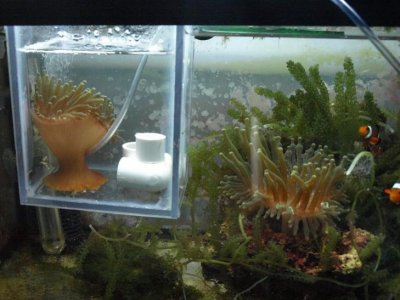
I've read a few anemone research papers and they get around your problem by doing 100% water changes.
The pic enclosed is my holding tank. It holds only 1.7L of water. It sits inside another 10 gallon tank. I am treating the BTA in the holding tank with Cipro. I can add as much antibiotic as I like into the holding tank and not worry about messing up my tank biology.
I change the water in the holding tank 2x a day to make sure that the antibiotic concentration is always OK.
You can keep anemones in a tank like this, doing 1x 100% water changes per day, indefinitely. The trick is you have to be careful with your replacement water. My make up water is always 35.0 +/- 0.1 ppt and the temperature is +/- 0.2 deg C of the tank water.
It may be ugly hanging a bunch of these in your tank but it is easy, fast and effective.
 

Attachments

  • H tank.jpg
    H tank.jpg
    58.5 KB · Views: 17
BTA is one thing. Magnifica and Gigantea is another. They are big, require a lot of water movement. I am not sure that air stone alone is enough water movement for these two species.
I have a 48X18 12H inches tank divided into 4 sections each 12X18 12H. This is my brood stock tank for my clownfish. I will use this to keep 4 anemones. I will use 4 PH for circulation, block off with egg crate so that the anemone cannot get to the PH. Now I just have to get enough light for them. I will have a huge sump with sand and rock for filtration. I thinking of just get 2 Radions for this and mount each Radion to light two sections. That should be enough light. Neither species require sand so I can have something that they will attach to that is easily remove.
So far that is what I am thinking.
 

Similar threads

Back
Top