The 'help me hammer down my nitrate' thread...[Mature Tank with Problems]

Sk8r

Staff member
RC Mod
Because it IS a problem to anyone trying to run a healthy tank of whatever type. And NOTE: I may have found something that works. Pg 3.
I can join you in this one, because the 8 day power-out and use of Prime handed me a problem...as in nitrate exceeding 100. Things were still alive. Some fish and corals survived.
Where do I want to be? Let's say I'd like it barely visible on the test. But right now I'm shooting for 20.
So let's test and fess up to some nitrate levels. I'll agree---they're really embarrassing. But let's see what we can do to better it.
I've worked about every fix in the book, but what it boils down to is that you have more crud in your tank than your rock and sand can handle. You need to knock the crud down, and maybe even get more rock going on the problem.

I've made it down to 30. And I"m working on it. 105 gallon tank, some corals, predominately euphyllia stony [kalk in ato], Coralife 200 skimmer, mostly damsels.
My big damsel manages to stir the sandbed: a golden domino, she gets under the rockwork and throws sand with her tail. Furiously. So sand is not where my problem is hiding.
My heater went squirrel---I figured that one out; everything happens to this poor tank. But we didn't lose anything.
I'm beginning to see some evidence of bristleworms and pods repopulating: I thought I'd lost them all in the 8 days of chill-down; but enough survived. I did lose all my cheato moss, but for some reason I'm not seeing hair algae pop up, just a little bubble, which has gone away.

Biggest help so far is water changes---at one point a 44% water change, because that poor tank also had to be moved out from the wall so we could lay new flooring, and then pushed back again. So I decided to go a 30% water change one better, granted that I have a nutrient excess in there. That did help, about 10 points off the nitrate level.

I'm continuing the water changes.

Any of you want/need to come along? Step one is test the nitrate and own it.
 
Last edited:
Sorry to hear about your 8 day power out.
Wait till the grid 'goes down'

Anyways, I'd like to highly advise setting up/DIYing, and or buying an ATS.

Other than a long power out, get some good algae growing (on the ATS)-
nitrate (and Phos.) problem solved!
 
I had nitrates of about 80, phosphates of .3 and dosed NoPox 3ml (6ml total per day) per 25 gals of actual water for 10 days and now both not detectable even after two weeks still no detection and I feed pretty heavy to 7 fish fed 3x per day and my corals fed broadcast 2x per week and once a week target fed.

I know everyone says NoPox is the same as vinegar and vodka but there has to be more than that because I don't smell anything in the bottle. Anyway NoPox works, they claim to feed the natural bacteria that feeds on nitrates and phosphates.

I'm now a believer in NoPox! :thumbsup:
 
I pretty well had things going well before the power out, in terms of a monster mature fuge that kept things in good shape. I now have a generator---horse/barn door.

Turf scrubbers are in their diy and early commercial phase. I have the room. THey are on the one end large, and on the commercial end, still pretty pricey, but they do seem to be a good bet. They're taking advantage of the algae we so curse in the typical setup phase, and they are definitely a tech to watch and try if you have the space and time.

Alas, in the situation I had, I don't think it would have survived, but neither did my fuge except in nooks and crannies. It is getting better in there. And I tried one other innovation on which the jury is still out...a large MarinePure ceramic block. I'm running it with PolyFilter pad just in case it should loose any aluminum into the tank. It's run in anaerobic conditions, ie, no flowthrough, and is a way of providing more live rock without live rock. We are waiting to see how effective this is. Like rock, it takes 8 to 12 weeks to set up as live, ie, for bacteria to colonize.
 
I have CHemipure which has been through one Chlorox round and is approaching another. It didn't appear to dent the problem---but then I have no way to know how high the nitrate really was, since it was pretty well off the scale.

I am dosing vinegar,which is something that novices should approach very, very cautiously and ONLY with the official chart in hand. THis is ongoing.

And I just reamed out the skimmer and pump, with a vinegar soak and brush, so I could get the coralline off. It was delivering microbubbles like mad, and is now behaving itself much better. [Vinegar dosing can improve the performance of a skimmer, and there are many operations in which a skimmer in good condition is a necessity, if you're trying to get crud out of a tank.]
 
MicroBacter7 worked wonders for me I had a mishap when I was forcing my new skimmer to work (doesn't work like that) and had some crazy fluxs something like 60 nitrate 1.0 nitrite 0 amonia (nitites were eating it up)
I used 3 cap's for 7 day's some prime the first 3 days and by day 8 I was zero across the board and the clearest water I have ever seen my clowns were floating xD
 
One of the problems I have is because of the Prime I used when toward the end of the 8 days no-power I had some fish loss, and the crash of the fuge downstairs. I used it, it saved the tank, but it does convert the nitrate in some way that bollixes up the test. They swear that it doesn't impede the bacteria processing it in any way, but it's one of those 'undocumented features' of the product that makes me a little worried about using it again. The Microbacter7 is interesting. As with any bacteria-in-a-bottle, you can overload, and you can also end up with a dud bottle if it's been stressed. I'm already applying 4 fixes (water changes, the vinegar, the ChemPure, and the ceramic block) so I'm hesitant to toss yet another into the mix. I'll keep that one on the shelf and see where the next set of water changes bring us.
 
I've just recently started reading about nitrate fixes when my API test read 50 even though two other, more reputable tests tell me 10-20. But I'm really just amazed at how much of a "wild west" this field is. Literally every one, whether it's vodka, vinegar, nopox, biopellets, ceramics, you find stories of them being miracle cures, and nightmare stories of crashes or cyano outbreaks worse than the algae outbreak that forced you to try it in the first place. So if I ever do have a nutrient issue, I'm terrified of all of them.

I need all of you experts to pick one, agree it's the best, and tell me it's the only sane choice.

Edit: 5 minutes after posting this, I learned about algae scrubbers. The craziest method yet.
 
Last edited:
The method I used (and still use) is a Bucket DSB. Now, DSBs are known to be problematic for various reasons which is why having one in a 5g bucket is such a good idea. The way it is set up, if I suspect it of being a problem itself, I just turn off the pump supplying it and yank it off the system.

Mine is set up pretty standard. I started with an empty salt bucket (Who doesn't have these taking up space?) and drilled two holes in it for 1" Uniseals. It took some carving of the plastic ribs on the outside of the bucket to get the Uniseals to sit flat but that just took time and effort. Ideally you want the two Uniseals opposite each other but that isn't 100% required. The uniseals get connected to a pair of pipes with the drain side run back to the sump and the inlet side run to a dedicated feed pump that pushes 300gph+. The bucket is filled with sand, the finer the better. Once full of sand, I used a valve on the pump to adjust the flow. The idea is to have as much flow across the surface of the sand as possible without blowing it out the drain. The high flow rate prevents detritus from building up on top of the sand. Once it's up and running with water and sand, you want to cover the bucket to prevent algae growth (which is why salt buckets work so well) and don't/shouldn't introduce any higher life into the bucket. All you want is sand and water.

The idea behind the Bucket DSB is that bacteria will colonize the sand grains. At the top of the sand bed where there is lots of flow and therefore lots of oxygen, the bacteria will use oxygen in the water to convert ammonia into nitrates. Lower down in the sand, the concentration of oxygen decreases which forces the bacteria to switch to using nitrates as their oxygen source. Since the result of using nitrates as an oxygen source is the creation of nitrogen gas, the nitrate levels in the system gradually decrease as the nitrogen gas escapes into the air.

While I admit to only having a vague idea of how all this works, I know that it has worked on my system. I went from 40-60 ppm nitrates down to undetectable levels in about 3 months. To date the system has been running a Bucket DSB for a number of years now and I've not seen any detrimental effects. Simple and effective, my kind of fix although your mileage may vary.
 
Bringing Nitrates down

Bringing Nitrates down

Hi,

I have had good results with Instant Ocean's Natural Nitrate Reducer. The beads settle everywhere on the rocks and convert No3 to N. I got rid of an 75% infestation of fuzzy red algae that way and it is completely harmless to the reef.

I now use Hydroton (google for info) in my filter bag (can also be used in a media reactor) with great results. I don't measure the water column because the nitrates in my tank like to hang out in the nooks and crannies of the rocks and raise big families and then grow luxurious colourful gardens. Probably why IO Reducer worked so well.

polaravic
 
I'm not sure why I don't have a nitrate problem. I just use filter socks and a skimmer, I feed heavy too. The only diff between my tank and others that I've noticed is that I vacuum my sand bed, and clean up detritus in my sump. So those might be good things to try if anybody's having issues.

I'm not trying to brag, so I hope nobody takes this the wrong way. I did have a flare up when I rearranged all my rocks, so I sympathize with how annoying massive waterchanges can be. But after a month my tank restabilized and I'm cruising.
 
I'm not sure why I don't have a nitrate problem. I just use filter socks and a skimmer, I feed heavy too. The only diff between my tank and others that I've noticed is that I vacuum my sand bed, and clean up detritus in my sump. So those might be good things to try if anybody's having issues.

I'm not trying to brag, so I hope nobody takes this the wrong way. I did have a flare up when I rearranged all my rocks, so I sympathize with how annoying massive waterchanges can be. But after a month my tank restabilized and I'm cruising.


What do you use to vacuum your sand bed?
 
My tank is only a few months old so I don't have the bio load as most do but I found vodka dosing by chart has been incredibly effective in getting my nitrates and more importantly my phosphates down. My system is only 40 gallon total so with 5 gallon water changes and light vacuuming of the sand bed, plus dry skimming the tank inhabitants are happy. Two rock nem's, torch, and some more LPS and softies are thriving.
 
I too had nitrates over 100, I dosed vodka and vinegar and in 2.5 months had it down to about 5. Slowly worked up my dosage and it really helped. I also added a DIY ATS but they competed against each other I think. So when I got the nitrates under control I stopped dosing vinegar/vodka and now am just relying on ATS to work.

Corey
 
What do you use to vacuum your sand bed?
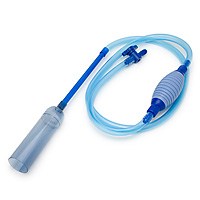
For a long time I was using a thing I made, I stuck one of the extender tubes from an actual vacuum cleaner on the end of some 3/4" tubing. I like making stuff like that for my tank. But when I bought a used tank it came with a proper gravel vac that has a fancy bulb you squeeze to start the siphon. It looks like this kinda, but without the stick part between the big tube and the vinyl tubing:
jbj%20gravel%20washer.jpg

The larger tube on the end pulls up the sand and tumbles it around so it gets all rinsed off. But then the sand falls back down onto the floor cause it's heavy and only the dirty water gets pulled out the tank. So you squeeze the bulb to start a siphon and then poke the big tube around in the sand until you've removed as much water as you want. I do 10% every week. At first I was slower so I could only vac 1/2 the sand each week before I had enough water, but with practice I can do the whole thing now.
 
Well, it's risen again. Back to just north of 50. Corals are all happy and extended, but the numbers aren't good.

The first thing you suspect when you have a contradictory or off-the-wall test is the test kit itself. So I tested the tank with a new kit. Same result. It really is that high.

The only thing I have left to try is what I'm preparing for now...breaking down the sump/fuge and moving out the pockets of brown debris that have collected in unreachable areas of the sump. It's not as bad as you might think. I can put the rock/coral frags/MarinePure block into a bucket. I can disconnect the (exterior) return pump (Iwaki 100) because my s.o. had the smarts to install it with a connector that can disconnect the pump from the bulkhead connector---ie, a connector to a connector, which means not having to rotate either the pump or the sump to get the two parted.

I have an older EShopps sump, which has a couple of areas where bad stuff can collect. I'm thinking of drilling a hole in the waterfall section near the base so stuff can escape instead of piling up. It'll be delicate: I don't want to compromise the bottom. But this entry-chamber design was later altered in their sumps and I'm figuring out why.

I am now running ro/di for another 32 gallon water change, this one to be instituted from the sump, which will be scrubbed out, rinsed out, vinegared out, and restocked with rock and such, then reconnected, refilled---all this within about 4 hours, so no issues.

Messy. I suppose I'll Clorox that bag of ChemiPure which hasn't helped, just because I can, and maybe it can help, with less to deal with.

If this doesn't work, I'm out of ordinary ideas and may have to resort to the un-ordinary.

The corals are absolutely happy and colored properly, the fish are healthy, the inverts are tootling about doing their thing. But I don't like that nitrate reading.
 
Last edited:
I am currently using vinegar, as above.
Things in use:
water changes
vinegar
ChemiPure
Ceramic block
and a test of the test kit.
...the only one that seems to knock it down is water changes. But it bounces back. That argues for a reservoir of problems somewhere in the system, and the sump's unreachable inflow area stands out to me as a likely place, where I can see stuff piled up. It may have caught all the crud from the dieoff in the power-out, and is just holding onto it.
 
I am currently using vinegar, as above.
Things in use:
water changes
vinegar
ChemiPure
Ceramic block
and a test of the test kit.
...the only one that seems to knock it down is water changes. But it bounces back. That argues for a reservoir of problems somewhere in the system, and the sump's unreachable inflow area stands out to me as a likely place, where I can see stuff piled up. It may have caught all the crud from the dieoff in the power-out, and is just holding onto it.

If these deadspots are the culprit, this will probably happen again. Have you considered getting one of the newer, better designed sumps? You could transfer as much good stuff as you could from the old fuge and your high nutrient water will help fuel new growth.

I honestly have zero experience with any type of fuge, so this idea might be terrible. Just throwing it out there.
 
Back
Top