What gives anemone their color

As I stated in another post:
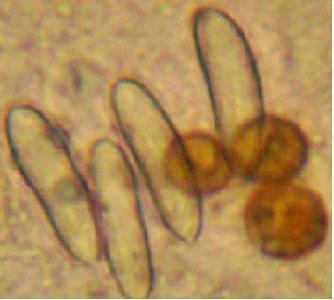
When I look at a BTA under the microscope it is obvious that they have at least two different symbiotic "algae" associated with them.

Symbiodinium species are the brownish single celled dinoflagellates that populate the slime layer on the inside surface of the anemone. In BTA's they give it the brownish color.

There are also zoochlorella species that live within the matrix of the epidermal cells. These vary in color giving the anemone its green to pink color.

Here are some things to understand about these photosynthetic species.

Symbiodinium are found on the slime layer of the gut side of the anemone. That means they are found on the gut surface and the inner surface of the anemone tentacles. When an anemone gets sick from a bacterial problem in the gut it purges the surface slime and with it goes the symbiodinium as a brown slime. This is usually a bad sign.

Zoochlorellae are found inside the matrix of the epidermal cells. They cannot be purged without killing the cell.

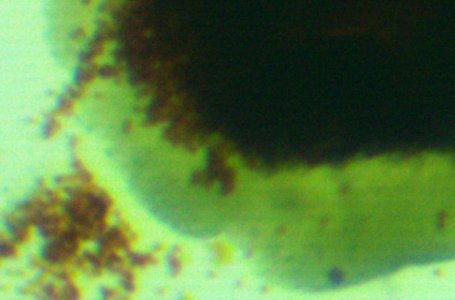
I uploaded two photomicrographs. One shows the two different algae found in a tentacle mash. The second shows a tentacle that has been severed from an anemone. The limitations of the forum download rules severely limit what I can download.

OK let's set some ground rules about this thread.

I already know that I am an idiot so please don't try to prove that fact!

Ask questions about facts. Do not waste time with a bunch of "what ifs."

I know that what I have posted is very limited so if you would like additional photomicrographs I will get them if possible and if you ask nicely.

My time is limited so I may not get back right away and if there are 10,000,000 people on this post... well I may not get back at all especially if I feel that everyone thinks I am an idiot, which is a fact.

OK lets go!
 

Attachments

  • nem algae.jpg
    nem algae.jpg
    38.7 KB · Views: 2
  • tentacle.jpg
    tentacle.jpg
    75.8 KB · Views: 2
I already know that I am an idiot so please don't try to prove that fact!

Ask questions about facts.

You use words like "bifurcated" and "zooantelope". You're already light years ahead of me. I use words like cut, and algae... I have to cut and copy those words...

My question. My mind is mechanical, I'm in the trades, not medical.
Does this algae, Symbiodinium, or zoochlorella produce oxygen, like other algae? You have BTA, and from the sounds of it, a lot of them. Have you ever tested PH of the (discharged sick anemone) discharge, compared to, a healthy individual, of which you would have to cause damage of one, to get a sample?
 
Ray,

I will not question your opinions nor call you an idiot. I believe you have studied this quite a bit, and could provide some interesting data.

I'm not sure everything is correct, but that goes with all the information we take in. We ourselves determine what is accurate, and throw the rest out.

With that said, please email me with all the slide pictures you take if possible. I want to try and understand as much as I can. How and why they bleach.

Let me ask you...can you culture an anemone and determine what bacterial infection it has and if some could be viral infections. We need to have some gig's cultured. This would be ground breaking. Identifying if these infections can be gram positive, anaerobic, aerotolerant, facultative, etc. Knowing the correct antibiotics to treat with is really unknown at this point. This is why we're using broad spectrum antibiotics like Cipro and Bactrim. One thing we do know is that most of the infections are gram negative and bacterial.

I we can pinpoint the specific antibiotic's needed, zooxanthilae issues would probably go away. This is just my guess. As I stated on the other thread, I believe that when the Nem is in poor health, this results in the loss of zoo. I just don't know. Nobody does for sure.
 
Hey, quick questeion:

Where can I get a decent scope?

Also, how hard would it be to identify bacterial infections? We have Google right? We should be able to find slide pics of multiple infections.
 
You use words like "bifurcated" and "zooantelope". You're already light years ahead of me. I use words like cut, and algae... I have to cut and copy those words...

My question. My mind is mechanical, I'm in the trades, not medical.
Does this algae, Symbiodinium, or zoochlorella produce oxygen, like other algae? You have BTA, and from the sounds of it, a lot of them. Have you ever tested PH of the (discharged sick anemone) discharge, compared to, a healthy individual, of which you would have to cause damage of one, to get a sample?

>>Does this algae, Symbiodinium, or zoochlorella produce oxygen, like other algae? <<
Most likely yes but I don't know for sure.

>>You have BTA, and from the sounds of it, a lot of them. Have you ever tested PH of the (discharged sick anemone) discharge, compared to, a healthy individual, of which you would have to cause damage of one, to get a sample? <<
Never tested the pH and probably there would be no difference since pH is like "temperature," it quickly mixes with the surrounding until it is a constant.
 
Let me ask you...can you culture an anemone and determine what bacterial infection it has and if some could be viral infections. We need to have some gig's cultured. This would be ground breaking. Identifying if these infections can be gram positive, anaerobic, aerotolerant, facultative, etc. Knowing the correct antibiotics to treat with is really unknown at this point. This is why we're using broad spectrum antibiotics like Cipro and Bactrim. One thing we do know is that most of the infections are gram negative and bacterial.

I do not have a micro lab and I have had only limited experience identifying bacteria, but as I pointed out in another thread that this is a pretty simple project.

According to the literature, bacteria in anemone are concentrated in their tentacles. All you have to do is snip off a few tentacle for a sample.
This would mean cutting off the tentacles, rinsing them once or twice with sterile sea water and putting them into a vial of sterile sea water. I could help with learning how to do this.
Send the vial to any place that does bacterial ID packed in ice. Tell them that you need to have the sample homogenized, plated and any bacteria found identified. Tell them that this is an exotic sample from a sea anemone. That should be it.
The rub is that research costs money; so, I do not have any clue what they will charge you. If you are serious, I could check around to get some estimate for you but it would be better if you had a friend in the business.

BTW gram negative says "œE. coli" or other fecal contamination to me.
 
Ray,
The paper:
Distribution Patterns of Zoochlorellae and Zooxanthellae Hosted by Two Pacific Northeast Anemones, Anthopleura elegantissima and A. xanthogrammica
I think you over generalized. The paper go into two types of algae in two specific pacific coast anemone species. One of which account to the general green color of these two species.
You generalized this into coloration of S. gigantea. Do you have any references as to this is true, or any of your observation that this is true?
It have been well know that most the colorful coloration of anemones, clams and anemones are from proteins in their tissue. In order to claim this is not true you need to prove that it is not, you need to show that your version is true.

Just from one paper which show the general green coloration of two Pacific coast anemones species is due to Zoochlorellae does not prove that all the coloration of multiple anemones are from symbiotic micro organism.

I think you conclusion from reading this article may be inaccurate.
 
.....
I do not have a micro lab and I have had only limited experience identifying bacteria......

....
When I look at a BTA under the microscope it is obvious that they have at least two different symbiotic "algae" associated with them.
Symbiodinium species are the brownish single celled dinoflagellates that populate the slime layer on the inside surface of the anemone. In BTA’s they give it the brownish color.

There are also zoochlorella species that live within the matrix of the epidermal cells. These vary in color giving the anemone its green to pink color.....

It is easy to stain a sample of bacterial after stain them and look at them under the microscope. To look at anemone tentacles and the relationship between the various organism and organelles, one must embedded them in blocks, slides them, stained them, then took at them. All of these need to keep the architecture and relationship of these various structures and organism unchanged from live.

The two quotes above seem to be contradicting to each other IMO. So which of the above is true?
 
I think with the amount of anemone's that have been in hobbyists tanks, someone by now would have had an anemone change it's original color. Anemone's get transferred between hobbyists, and have bleached in the process. I can't help but think, if it was possible, it would have happened by now, multiple times. I had a RBTA for years, under PC. I transferred it to a tank with MH, and wha lah, it instantly had a green disk, I never saw before. I think, if there IS any color changing, it's the lights, not the anemone (my guess).

With the amount of BTA chopping you do, why not try it out? Try to change the color of one, it sounds like you have an idea of how they tick. Best of luck to you.
 
Wouldn't it be nice to change all the green BTA to one of these hot shot Sunbust BTS or the like?
I have done Zooxanthellae transplant for bleached anemones before and got the anemone recovered to his original color, not the color of the animal used for transplant.
 
Well, I'm fixing to snip some tents of the next sick new and bring them to a friend of mine at the lab next door.

I cannot wait to see what bacteria is responsible for so many deaths. I'm just clueless.
 
Thank you for contacting us. If you provided a valid email address, someone from Lab Tests Online will respond to you soon.

Your information was received as follows:

I am a Laboratorian or Other Medical Professional

The General Subject of my comment is Question about a test

Comments:

Hi, I'm looking for a lab that will culture and identify a very specific bacteria. My friends and I are clinicians and keep reef aquariums. Here's our problem. We keep the two most sensitive sea anemones in the world (S. Gigantea, and H. Magnifica). About 75% or more succumb to stress during the shipping process, get an infection and die. We've been able to save 50% with antibiotic therapy (Ciprofloxacin and Septra DS). However, we are unable to identify the bacteria responsible for the anemones that do die. The highest concentration of bacteria during this time is found in the anemone's tentacle. We would like to send 1 small tentacle in for Culture and Gram Stain. Can you give us a price for testing? Would the sample need to be temp controlled and sent via 1 day air? How soon can we expect results? We are not in a hurry.

Kindest regards,
John Smith
 
Well, I'm fixing to snip some tents of the next sick new and bring them to a friend of mine at the lab next door.

I cannot wait to see what bacteria is responsible for so many deaths. I'm just clueless.

I think you would want to snip from a healthy gig as well. This way you can compare the results. I have a feeling that the bacteria may be present (in different amounts) in both and that the healthy nem simply has a way of controlling it.
 
Back
Top