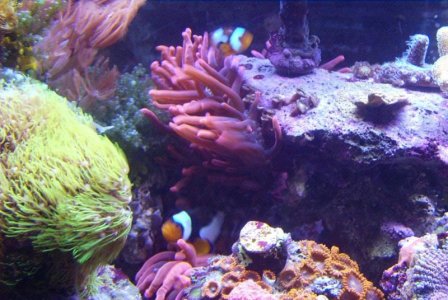
What makes a clown go in a anemone?

EC - while I can understand your thoughts about altering an animals behavior through a wildly different method of being raised, then how could this explain stocked fish? Each year, thousands (if not millions) of captive raised fish (salmon, trout, bass, northern, panfish, musky, the list goes on) are raised by the Fish and Wildlife department and released into the streams and rivers around the country. There is a portion of die-off (expected since the entire batch is raised to a size where in the wild many would have been picked off by predators), but there is no arguing the effectiveness of the stocking program.

I have observed a difference - therefore a difference exists :) Several other people have also observed a difference. Therefore it is real to them as well :) I'm not trying to cause an argument - but it is the classic "proving a negative" issue. Just because you manage to get your captive-raised clowns into anemones, doesn't mean that it is as easy or occurs as naturally as it does in the wild. Even a casual review of posts in this forum will reveal dozens of examples of people who cannot get their captive raised clownfish to be hosted by an anemone - even in an anemone which they are known to be hosted by in the wild. You are responding with logic that is somehow trying to refute the facts.

It is a FACT that wild caught clowns are captured from anemones - they are simply not found in the wild away from anemones. If they do not IMMEDIATELY associate with anemones at a very early post-larval stage, they are eaten or die. It is impossible to understand this behavior at a quantitative level due to the pelagic larval stage of clowns - ie maybe 50% of all clowns are born without strong hosting instinct, but in the wild these clowns automatically die - while in captivity they survive(?) Who can say? One thing is certain - if hosting behavior is at all associated with age (similar to imprinting behavior with other creatures) then a younger clown who has an intensely strong hosting instinct may (in captivity) be forced to chose a surrogate host because a preferred host is not available. We see this over and over again where captive-raised clowns are "hosted" by heaters, or where they "learn" to live in leather corals or frogspawn corals - and refuse to move when an appropriate anemone host is added to the tank at a later date.

Just saying...

By the way your example of stocking streams is a bad one - because for many of those fish it is a one way trip where they are artificially introduced into degraded environments and they die after one season. In most cases this is not an instance of Fish & Game re-establishing spawning populations. It is a case of them manually introducing fish over and over again for recreational purposes. Many environmentalists consider these stocking programs an absolute failure - and they are rethinking stocking programs throughout many Western watersheds.
 
Last edited:
You cannot argue that assosiating with various items is not instinct. Every clown I have seen likes to rub against something be it a coral, nem, powerhead, heater, PVC elbow, etc... You can however argue that assosiating with a nem is learned. I bet that the post larval clown babies see other grown clowns living in this squishy things with tentacles and figure out that it is a safe place and good to call home. Hosting a heater or powerhead could be just because their is no nem, or something similar like an unnatural host of the said clown species or corals(elegance, torch, hammer, frogspawn, etc.). Or you could say the nem assosiation is learned which may be why people believe putting a picture of their clown in a nem works.
 
My tank raised occ clown took a long time to go into his LTA. It was well over a month before he ventured in and it took a change. It was when I added my second clown, both were under an inch long, they started checking it out together and were living in it within a couple of days. 16 years later they are still in it most of the day. I think every clown fish has the instinct but, with anemones that are not their natural hosts, the behavior is not completely predictable.
 
I bet that the post larval clown babies see other grown clowns living in this squishy things with tentacles and figure out that it is a safe place and good to call home.

Scientists have shown that clowns locate anemones on the reef by smell, and clowns will associate with anemones even when other clowns are not present.
 
If it truly is an instinctual and not a learned trait, then it cannot matter where the fish is born/raised

That isn't how it works, and I think this is where many people are confusing the issue. "Instinct" is not a fixed, never changing, immovable behavior. ALL behavior, be it instinctual or learned, is influenced by environmental conditions. It doesn't matter that we call a given behavior instinct. It's still subject to change in response to changes in environmental conditions.

Most breeders do not keep anemones in with their brood stock. The eggs are laid, and develop, in the absence of an anemone. After metamorphoses, when a clown in the wild is searching for an appropriate host, a captive fish is usually deprived of a host. From this crucial time in the fishes development, through the "grow out" phase, CB fish are typically deprived of a natural host. These fish must learn to survive without a natural host. Life is drastically different for a wild clown. The eggs are laid right next to their natural host. As the larvae develop within the egg, it is being bathed in chemicals from their natural host. After the larval stage, the fish fallows these chemicals to find a natural host of their own. From this point, they spend the rest of their lives relying on the anemone for their vary survival. This is all they know. They don't know life without an anemone. If we remove one of these fish from its anemone, the drive to return to the anemone, will be overwhelming. CB fish don't have the same life experience, so we can't expect them to have that same overwhelming drive to find a host.

I don't think anyone is saying that CB fish won't go into their natural host if it is provided. All I'm saying is that the drive to do so, may not be as strong for CB fish, as it is for wild fish. I deal mostly with wild clowns. When I started keeping clowns there simply weren't many CB clowns to be had, and I like the perfect body plan of wild clowns. I've never seen a wild clown take its time to jump into its natural host. I have seen CB clowns take there time though. I've also seen CB clowns jump right in. I had a CB pair of ocellaris that tried to eat through the bag, while I was floating a magnifica. When I placed the anemone in the tank, the fish were in it, while it was still in my hands, and before I could get it to the rocks. I, the owner of my LFS, and his employees, watched a pair of ORA Picasso's take about three months to move into a magnifica. This is after I assured them that the fish would be in it by the next day. Naturally, I wanted to choke these stupid little fish, for making a fool out of me.:mad2: I can not believe this could ever happen with wild fish. For a wild fish, an anemone means the difference between life and death. If they have the opportunity, they don't waste any time getting to their natural host.
 
i've never had any problems with my percs going into nems.
 

Attachments

  • rbtafarm.jpg
    rbtafarm.jpg
    81.7 KB · Views: 22
I just want to ask this(not to be snooty or stubborn). Being that the two 3 month old B&W ocellaris clowns are from a pair that laid their eggs right under a small group of RBTAs, they were saturated with the chemicals of the RBTA that their parents are hosted by, does this mean that they would recongnize the chemicals/smell of a RBTA if I added one? I think it would be interesting to see breeders include host nems in their brood tanks and see if that increases their assosiating rate. I am going to attempt to get an LTA to host the clowns I have, but I guess I will see how that goes. I still have to wait 6 months for me to start looking for LTAs, 8 actually so the mandarin I am getting can settle in.
 
I just want to ask this(not to be snooty or stubborn). Being that the two 3 month old B&W ocellaris clowns are from a pair that laid their eggs right under a small group of RBTAs, they were saturated with the chemicals of the RBTA that their parents are hosted by, does this mean that they would recongnize the chemicals/smell of a RBTA if I added one?

That's a good question. All we can really do is guess at the answer as of now. I would assume, if the eggs were laid at the base of their natural host, and the fish were provided with their natural host right after metamorphoses, that the drive to find a host would be relatively strong later in life.

You bring up another interesting question. Could we in effect change a fishes natural host????:confused: If the eggs develop under an anemone, other than their natural host, will the young fish seek out that species of anemone after metamorphosis???:confused: I think it would, but I have no evidence to back that up. I guess the determining factor would be where the fish gets the determination of which species of anemone to seek out. If it is strictly a genetically passed on trait, then we can't change it. If the fish is simply fallowing the same chemicals it was exposed to while in the egg, we should be able to change symbiotic relationships. I think the latter is true, but again, I have no evidence to back that up.
 
This guy was reared next to a piece of pvc pipe, no anemone was ever seen by him until he came to my tank. He needed a little time but eventually found the way. I worry about people getting natural hosts for common clowns. They are significantly harder to keep. Please, anyone reading this thread, make sure you can take care of the anemone first, then think about adding clowns.

ClownLTACloseupS.jpg
 
I have had several kinds of anemones and of all the clowns I've had, none of them go in. They hang ever so close and sometimes look like they are, but don't.

Good question, I don't know but when you find the answer plz let me know coz my darn clowns don't go in them either:sad2::blown: They rather host the hammers and torches makes me so mad:mad2:
 
That's a good question. All we can really do is guess at the answer as of now. I would assume, if the eggs were laid at the base of their natural host, and the fish were provided with their natural host right after metamorphoses, that the drive to find a host would be relatively strong later in life.

You bring up another interesting question. Could we in effect change a fishes natural host????:confused: If the eggs develop under an anemone, other than their natural host, will the young fish seek out that species of anemone after metamorphosis???:confused: I think it would, but I have no evidence to back that up. I guess the determining factor would be where the fish gets the determination of which species of anemone to seek out. If it is strictly a genetically passed on trait, then we can't change it. If the fish is simply fallowing the same chemicals it was exposed to while in the egg, we should be able to change symbiotic relationships. I think the latter is true, but again, I have no evidence to back that up.

I would like to test this. I think keeping a batch of babies in the future from my pair(if they are hosted by the LTA) and split it in half. One half raised with an LTA after metamorphisis, the other just plain jane grow out tank. Then I could have my eventual coral QT hold an LTA and see how the ones raised with out it react after they reach 6 months or sell to someone who does have an LTA for them...
 
I would like to test this. I think keeping a batch of babies in the future from my pair(if they are hosted by the LTA) and split it in half. One half raised with an LTA after metamorphisis, the other just plain jane grow out tank. Then I could have my eventual coral QT hold an LTA and see how the ones raised with out it react after they reach 6 months or sell to someone who does have an LTA for them...

Good experiment and worth doing but I think this test has been done, but in a different way than you describe. Most tank raised occelaris clowns are not raised near anemone's yet most will eventually accept an LTA, all will accept a magnifica in my experience. My pair fits this pattern too.

If your hypothesis is that they will accept non-natural host anemones quicker if raised near them, that would be interesting to test.
 
Last edited:
I would see what happens with an RBTA, but don't want them taking up real estate on my rock work. Are yours regular ocellaris? I think the B&W varient is only located in the Australia region. I am not sure if the regular varient is or not, but they may have different tastes in nems if they don't live in the same region...
 
I would see what happens with an RBTA, but don't want them taking up real estate on my rock work. Are yours regular ocellaris? I think the B&W varient is only located in the Australia region. I am not sure if the regular varient is or not, but they may have different tastes in nems if they don't live in the same region...


Mine are the common amphiprion ocellaris. Standard coloration (see below). As far as I know, they range from Southern Asia down to Northern Australia. I am not sure they have different color morphs in different parts of their range. I also don't know if they have different hosting patterns. I would guess not, but one of the true experts should chime in here. Below is another pict I took today:

I would never add an RBTA to my tank. I have many SPS colonies and the last thing I want is an anemone that wanders or splits.

ClownCloseup2S.jpg
 
Back
Top