

BonsaiNut
Premium Member
EC - while I can understand your thoughts about altering an animals behavior through a wildly different method of being raised, then how could this explain stocked fish? Each year, thousands (if not millions) of captive raised fish (salmon, trout, bass, northern, panfish, musky, the list goes on) are raised by the Fish and Wildlife department and released into the streams and rivers around the country. There is a portion of die-off (expected since the entire batch is raised to a size where in the wild many would have been picked off by predators), but there is no arguing the effectiveness of the stocking program.
I have observed a difference - therefore a difference exists
 Several other people have also observed a difference. Therefore it is real to them as well I'm not trying to cause an argument - but it is the classic "proving a negative" issue. Just because you manage to get your captive-raised clowns into anemones, doesn't mean that it is as easy or occurs as naturally as it does in the wild. Even a casual review of posts in this forum will reveal dozens of examples of people who cannot get their captive raised clownfish to be hosted by an anemone - even in an anemone which they are known to be hosted by in the wild. You are responding with logic that is somehow trying to refute the facts.
It is a FACT that wild caught clowns are captured from anemones - they are simply not found in the wild away from anemones. If they do not IMMEDIATELY associate with anemones at a very early post-larval stage, they are eaten or die. It is impossible to understand this behavior at a quantitative level due to the pelagic larval stage of clowns - ie maybe 50% of all clowns are born without strong hosting instinct, but in the wild these clowns automatically die - while in captivity they survive(?) Who can say? One thing is certain - if hosting behavior is at all associated with age (similar to imprinting behavior with other creatures) then a younger clown who has an intensely strong hosting instinct may (in captivity) be forced to chose a surrogate host because a preferred host is not available. We see this over and over again where captive-raised clowns are "hosted" by heaters, or where they "learn" to live in leather corals or frogspawn corals - and refuse to move when an appropriate anemone host is added to the tank at a later date.
Just saying...
By the way your example of stocking streams is a bad one - because for many of those fish it is a one way trip where they are artificially introduced into degraded environments and they die after one season. In most cases this is not an instance of Fish & Game re-establishing spawning populations. It is a case of them manually introducing fish over and over again for recreational purposes. Many environmentalists consider these stocking programs an absolute failure - and they are rethinking stocking programs throughout many Western watersheds.
Last edited:


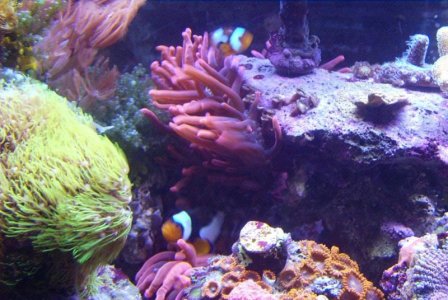
 If the eggs develop under an anemone, other than their natural host, will the young fish seek out that species of anemone after metamorphosis???


