I have been in and out of reefing for 25+ years now and as I re-enter this latest time LEDs seem to be the hot technology. For those in the know, I was wondering where LED technology for reefing will be headed over the next couple of years (i.e. spectrums, intensity, cost, new capabilities, etc...). I am a little hesitant to spend big bucks when my lighting might seem obsolute 9-months from now...

You are using an out of date browser. It may not display this or other websites correctly.
You should upgrade or use an alternative browser.
You should upgrade or use an alternative browser.
Where will LED be in 2 years?
- Thread starter mktang
- Start date

Acrotrdco
New member
Find a LED fixture that allow you to swap to newer bulbs, so when newer bulbs come out, swap the bulb and keep the fixture.
Not all LED fixtures allow you to swap individual bulbs right now, however, the one I'm using now could do that, but other brands often solder multiple LED bulbs onto a PCB so you simply can't replace a single burnt bulb or just change a few to mix colors.
For example, technically I can already use the latest Cree XM-L bulbs (running 700mA at 3w) on my fixture, except I don't really need to make an upgrade this soon, perhaps sometime down the road.
Not all LED fixtures allow you to swap individual bulbs right now, however, the one I'm using now could do that, but other brands often solder multiple LED bulbs onto a PCB so you simply can't replace a single burnt bulb or just change a few to mix colors.
For example, technically I can already use the latest Cree XM-L bulbs (running 700mA at 3w) on my fixture, except I don't really need to make an upgrade this soon, perhaps sometime down the road.


brassmonkyballs
BMB
I have been in and out of reefing for 25+ years now and as I re-enter this latest time LEDs seem to be the hot technology. For those in the know, I was wondering where LED technology for reefing will be headed over the next couple of years (i.e. spectrums, intensity, cost, new capabilities, etc...). I am a little hesitant to spend big bucks when my lighting might seem obsolute 9-months from now...
Right now...the best LED set ups are DIY. None of the available commercial fixtures use what I consider high power LEDs and I wouldn't recommend 1 of them given the prices and the ones I have seen have left me more than disappointed compared to DIY versions...by far.
There are a multitude of DIY examples using Cree LEDs that are truly impressive and by far blow away any MH/T5 on the market. Recently there are some Chinese LEDs putting out decent lumens at reasonable costs that are being used and look very promising.
Where will it be in a few years? Well Cree is leading the pack by far. The push is output in lumens per watt. I am not sure they or anybody else making LEDs recognizes hobbiest reef lights as a market. The technology advances almost monthly. Its a question of how much you can push it and the technology behind manufacturing them to be able to perform. We have to remember the market for manufacturers is anything that uses lights...street lights, automobile lights, home lights of all shapes and sizes, etc. They are not targeting our market and color temperature so those producing fixtures are likely to need to charge higher prices. Prices are justified by not needing to replace bulbs on a regualr basis and the lower cost to run them compared to MH/T5.
To me I will never buy another "regular" light fixture again. Leds are just too good based on my experience and other DIY I have seen.
As for worrying about being obsolete 9 months from now? In reality they will be obsolete in a month if you DIY.....if you buy a ecoxotic or evolution, they were obsolete before they ordered the chips and assembled them. LEDs are moving fast and will be part of all our lives in every aspect over the coming years. Don't worry about being obsolete in this case....it will be years and years before needing to replace them....on the order of 7-10 years. The only reason to replace them is that you're bored or you just don't like them.

Alex T.
Active member
I saw a DIY LED setup a few months back from someone who has some serious electrical, carpentry and general tinkering skills. With all that said, I wouldn't trade my Galaxy Ballasts with Radium and VHO actinic combo for any of the LED or t5 setups out there. The depth of color in corals from these systems just seems lacking when compared to the richness and real life shimmer that only halide can provide for now.
Saltwatercoral2
New member
Right now...the best LED set ups are DIY. None of the available commercial fixtures use what I consider high power LEDs and I wouldn't recommend 1 of them given the prices and the ones I have seen have left me more than disappointed compared to DIY versions...by far.
There are a multitude of DIY examples using Cree LEDs that are truly impressive and by far blow away any MH/T5 on the market. Recently there are some Chinese LEDs putting out decent lumens at reasonable costs that are being used and look very promising.
Where will it be in a few years? Well Cree is leading the pack by far. The push is output in lumens per watt. I am not sure they or anybody else making LEDs recognizes hobbiest reef lights as a market. The technology advances almost monthly. Its a question of how much you can push it and the technology behind manufacturing them to be able to perform. We have to remember the market for manufacturers is anything that uses lights...street lights, automobile lights, home lights of all shapes and sizes, etc. They are not targeting our market and color temperature so those producing fixtures are likely to need to charge higher prices. Prices are justified by not needing to replace bulbs on a regualr basis and the lower cost to run them compared to MH/T5.
To me I will never buy another "regular" light fixture again. Leds are just too good based on my experience and other DIY I have seen.
As for worrying about being obsolete 9 months from now? In reality they will be obsolete in a month if you DIY.....if you buy a ecoxotic or evolution, they were obsolete before they ordered the chips and assembled them. LEDs are moving fast and will be part of all our lives in every aspect over the coming years. Don't worry about being obsolete in this case....it will be years and years before needing to replace them....on the order of 7-10 years. The only reason to replace them is that you're bored or you just don't like them.
apparently you havennt seen AI sols'.
Acrotrdco
New member
Right now...the best LED set ups are DIY. None of the available commercial fixtures use what I consider high power LEDs and I wouldn't recommend 1 of them given the prices and the ones I have seen have left me more than disappointed compared to DIY versions...by far.
...
Apparently you haven't seen the PAR from some of the commercial fixtures.
This is the PAR reading from mine.
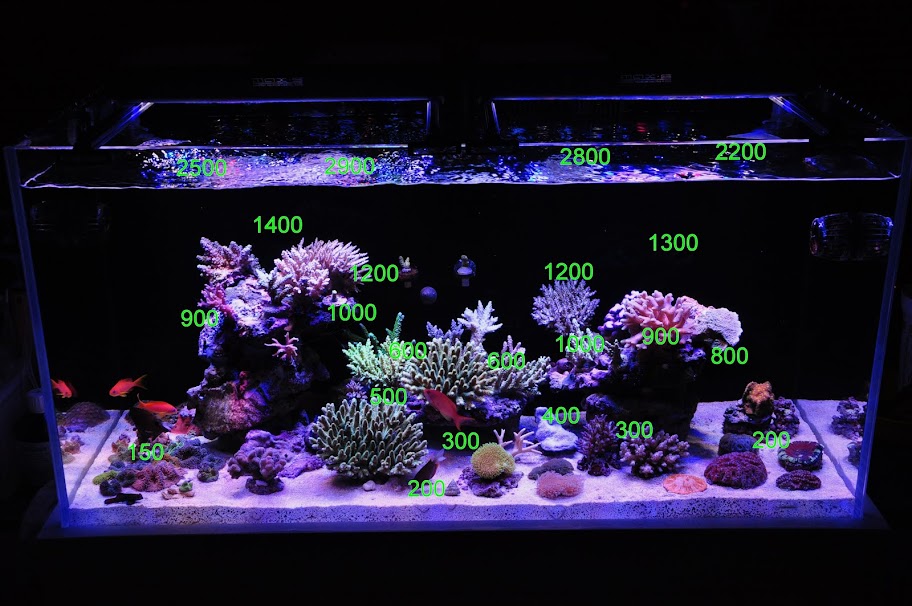
http://www.reefcentral.com/forums/showthread.php?t=1965294
LED are not ready for prime time.
See above.
There're tons of people who've used LED on their SPS tanks with great results, in both growth and coloration.
http://www.reefcentral.com/forums/showthread.php?t=1968168
apparently you havennt seen AI sols'.
x2

widmer
Drug Enthusiast
While the fixture manufacturers have some catching up to do, LEDs are already nearing the limits of the laws of physics as far as how much light per electricity. Example: the Cree XP-E royal blue LED that all of us DIY are using, puts out 500 mW radiation @ ~450 nm when you feed it one watt of electricity. That's turning 50% of the electricity you give it into PAR. Over the next however many years, it simply wouldn't be possible to develop it to a point where it is putting out more than 2x as much light per watt...
Like I said they are not ready for prime time.
Led fixtures need to come down in price by a half. Also everyone should come with a controller that will let you do sunset / sun raise. Have user replaceable bulbs when they burn out. It will happen over a reef tank. No way all the LEDs with last 5+ years.
When you start seeing LED at major websites and not these fly by night sites that are just set up to sell LED to us.
After looking at a DYI set up with LED, I would have be using more power than my t5s and cost that would be $500, since I got the t5 for free and replacement bulbs for my 92 gal corner tank I'm setting up.
At this time only really a DIY set up is affordable for mot reefers.
Led fixtures need to come down in price by a half. Also everyone should come with a controller that will let you do sunset / sun raise. Have user replaceable bulbs when they burn out. It will happen over a reef tank. No way all the LEDs with last 5+ years.
When you start seeing LED at major websites and not these fly by night sites that are just set up to sell LED to us.
After looking at a DYI set up with LED, I would have be using more power than my t5s and cost that would be $500, since I got the t5 for free and replacement bulbs for my 92 gal corner tank I'm setting up.
At this time only really a DIY set up is affordable for mot reefers.

TenKreefer
New member
wrong
When you start seeing LED at major websites and not these fly by night sites that are just set up to sell LED to us.
QUOTE]
So I guess the time is now?
No.When you start seeing LED at major websites and not these fly by night sites that are just set up to sell LED to us.
QUOTE]
So I guess the time is now?
You can only buy fixtures. Most go DIY, where you buy the stuff from fly by night sites set up just to sell to reefer.
Like other have said this is like when t5 came around. Now you can buy t5 retro from just about every major reef site.
Acrotrdco
New member
While the fixture manufacturers have some catching up to do, LEDs are already nearing the limits of the laws of physics as far as how much light per electricity. Example: the Cree XP-E royal blue LED that all of us DIY are using, puts out 500 mW radiation @ ~450 nm when you feed it one watt of electricity. That's turning 50% of the electricity you give it into PAR. Over the next however many years, it simply wouldn't be possible to develop it to a point where it is putting out more than 2x as much light per watt...
LED is nowhere near the limits, the XP-G we're using now, is rated at about 70-80lm/w at 750mA, while the newly released Cree XM-L, can do up to 140lm/w at 1500mA, that's already a 200% brighter than the current technology.
Cree had already developed the 200lm/w bulb which will be available to the public in another 6-9 months - that's ALREADY 300% higher than Cree XP-G in terms of lm/w output.
I've had a lengthy discussion with friend of mine who's a PhD in EE, he told me technically LED development would start to slow down at about 280 lm/w and eventually hitting the limit around 300-400 lm/w, however some recent development suggests that the physical barrier should be even higher, at 500-600 lm/w.
Only time will tell what's the physical limits of LED technology.
Like I said they are not ready for prime time.
Led fixtures need to come down in price by a half. Also everyone should come with a controller that will let you do sunset / sun raise. Have user replaceable bulbs when they burn out. It will happen over a reef tank. No way all the LEDs with last 5+ years.
When you start seeing LED at major websites and not these fly by night sites that are just set up to sell LED to us.
After looking at a DYI set up with LED, I would have be using more power than my t5s and cost that would be $500, since I got the t5 for free and replacement bulbs for my 92 gal corner tank I'm setting up.
At this time only really a DIY set up is affordable for mot reefers.
Do you ever own a dimming controller for your T5/MH fixture, or did the majority of T5/MH owners had that kind of functionality with their T5/MH?
Why then, do you think it's a mandatory requirement for LED to become prime?
It's all dollar and sense, if you can pay extra for the controller and dimming capabilities, then by all means go for it, otherwise folks like myself are perfectly happy with a much more affordable LED fixture without dimming, but that didn't cost us an arm or a leg.
Big differences between t5/mh and led. This is like AC pumps vs DC pumps. The reason all DC pumps are controllable bc its a lot easier to make it controllable.
LED could VERY easily be set up with sunset / sun raise. Just have it ramp up at start up. Even DIY kits come with adjustable setting for output.
LED could VERY easily be set up with sunset / sun raise. Just have it ramp up at start up. Even DIY kits come with adjustable setting for output.
brassmonkyballs
BMB
You are correct.....I never saw the AI's...now those are nice but very very pricey but at least they use CRee's. These other ones such as evolution are using 119 1W LEDs in each panel and personally I don't think they look very good. The AI's look great...then again because of the Crees.
Apparently you haven't seen the PAR from some of the commercial fixtures.
This is the PAR reading from mine.
http://www.reefcentral.com/forums/showthread.php?t=1965294
See above.
There're tons of people who've used LED on their SPS tanks with great results, in both growth and coloration.
http://www.reefcentral.com/forums/showthread.php?t=1968168
x2
widmer
Drug Enthusiast
LED is nowhere near the limits, the XP-G we're using now, is rated at about 70-80lm/w at 750mA, while the newly released Cree XM-L, can do up to 140lm/w at 1500mA, that's already a 200% brighter than the current technology.
The popular Cree XP-G R5 that everyone is using produces 240 lumens at 750 mA (=2.43 watts), which is ~100 lumens/watt, not 70-80
The highest binning XM-L produces 560 lumens at 1400 mA (=4.3 watts), which is ~130 lumens/watt, and yes this is approximately 2x as bright as the 70-80 lumen/watt XR-E series that are in most manufactured fixtures.
Cree had already developed the 200lm/w bulb which will be available to the public in another 6-9 months - that's ALREADY 300% higher than Cree XP-G in terms of lm/w output.
That sounds interesting. Link?
I've had a lengthy discussion with friend of mine who's a PhD in EE, he told me technically LED development would start to slow down at about 280 lm/w and eventually hitting the limit around 300-400 lm/w, however some recent development suggests that the physical barrier should be even higher, at 500-600 lm/w.
I'm not an expert, but from what I gather, this is an overgeneralization. While 300-400 lumens might be the limit, the question is 300-400 lumens of what color? This is because the equation for lumens differentiates between amounts of radiation for different colors. It is also why we never see blue LEDs described in terms of lumens. Thus, these 300-400 lumens might be possible, but they also might just be 300-400 lumens of narrow band yellow light. You can read more about it on wikipedia.
Again, per the laws of physics, with the XP-E royal blue bin D16 LED as an example, producing 500 mW of usable radiation when feeding it a 1 watt of electricity means they simply cannot get more than twice as efficient as they already are.
TheFishMan65
New member
Everyone is shooting for some variation in white since that is what most people want in lighting. The problem is that white is caused by flourescence (maybe). The cover is coated with a phosphor that glows when subjected to the wavelengths that the LED puts out. So white is a two part issue. Getting the best reaction in the phosphor and getting the most light to hit it. This maybe why pinning a limit is so hard for white LEDs.
Similar threads

- Replies
- 39
- Views
- 957

- Replies
- 9
- Views
- 2K

