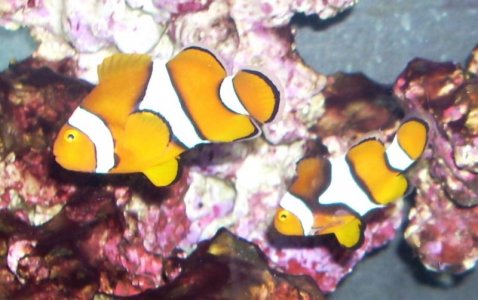
Wild Onyx Clownfish. Take 3

Did they still had white patches or where they just breathing heavily?

They had smaller white spots but not as bad as my previous Solomon clowns that had brooklynella. Stress was the leading cause of loss this time around. The clowns stopped eating yesterday and I got really worried thinking they were on the way to a serious outbreak. So I found regular 37% formalin, did a freshwater dip (RO/DI, temp adjusted) and put them in a sterile tank. All the right steps one would think but may be wrong timing.
 
I have a photo of them dead but if I posted it here everyone would get really sad. It's actually pretty tough to look at it for me too.
 
Not sure if it was Brooklynella that killed them. I treated a clown at a store here that was covered with brook and after one single formalin dip and relocation into a clean tank it recovered.

I got a normal percula pair from the Solomons on Saturday and so far they didn't get any white patches but the female started breathing a bit heavy last night.
They had been for a week at the dealer and looked OK there.
I did a formalin dip before putting them into the QT.
I will do another dip later today and then think about giving them also antibiotics.
I'm not sure this is just brook that we are dealing with on Solomon percula.
 
I'm really sorry to hear that. I know how you feel...
Looking back at it it does look like too many things were done too soon...
Thanks for posting it publicly as others can learn from this...
We should chat on the phone about techniques sometime...
 
I'm really sorry to hear that. I know how you feel...
Looking back at it it does look like too many things were done too soon...
Thanks for posting it publicly as others can learn from this...
We should chat on the phone about techniques sometime...

Thanks. Based on my previous experiences I knew it could go wrong but I still decided to do this on the forum because the majority of hobbyists perceive clowns to be an "easy" fish when in reality they can be tough when newly imported or placed with other sick fish at whole sellers, fish stores, etc. if there's one big lesson to be learned it is the value of quarantine tanks because something like this could have easily wiped out a tank with other fish.
 
Clownfish, especially percula and ocellaris, are very fragile fish when freshly imported. But after acclimated they can be very hardy.
 
But after acclimated they can be very hardy.

Agree. Once established they can tolerate a wide variety of swings like nitrates, temperature change, etc. However, getting the wild caught clowns to that point can be a challenge. There is one LFS that is one of the only few left that still buys wild caught Ocellaris. I would say 25% of their new wild ocellaris clowns come down with brook at the store but the rest do fine. As a matter of fact I am considering getting a pair of wild Ocellaris clowns from them. Love the Solomon true percs but don't know if I am ready to deal with them after having just lost the onyx pair.
 
I can say that all the fish in the DT now, tough as nails. Want to say my Tang is even tougher than my clown.
 
Saw this black true perc at LFS. Really cute and nice but missing the third white bar by his tail.
VUrl3jO.png
 
Looks pretty good. Wild?

I got a wild pair of the normal Solomon percula last Saturday. They had been at the store for a week and were looking ok. I only took them because the female is pretty big and should be ready for breeding. Her "original" mate looked pretty bad and she was biting him so I took the little guy in the next compartment instead because he looked much better.
They got the mandatory formalin dip and then went into the QT:

attachment.php


The female was eating like a pig but started breathing a bit heavy Monday night so I gave a dose CP to the tank. This morning the breathing issue was better and she was going after live tigger pods. This afternoon she was still going after food but didn't eat it. I suspect it's the effect of the CP.
I will clean the tank tomorrow. She also has something hanging under her cheek which may or may not be flukes. I will examine that tomorrow when I have them out during the tank transfer/cleaning.

The good news is that I've seen so far no signs of brook.
 

Attachments

  • DSCN1363 (2).jpg
    DSCN1363 (2).jpg
    55.9 KB · Views: 4
Looks pretty good. Wild?

I got a wild pair of the normal Solomon percula last Saturday.

attachment.php


The good news is that I've seen so far no signs of brook.

Nice pair of clowns and look healthy.
I didn't ask if the black perc was wild or TR, but it's paired up with a smaller male that has similar colors to your new pair.
 
I feel the loss was rather medication related than directly caused by disease, especially since the one that didn't show symptoms perished at the same time with the one who showed symptoms of brook.
Next time I would advise against dosing formalin in the tank. Dips and transfers to a clean tank should be sufficient. In fact in most cases one correctly done formalin dip may be enough - at least for the beginning until they regain strength to go through a full TTM & Dip regime.
If you feel you need to treat against velvet (or do more against brook) I would rather use CP but do full water changes every 3 days (or sooner if needed).
I would also recommend to put some "decoration" into the tank. At a minimum one or two ceramic flowerpots.
Another thing I always have, even in an QT/HT, is a small HOB or in tank bio filter to prevent ammonia or nitrite spikes.

BTW: This isn't to criticize but to pass on my (costly learned) experience to help with your next wild clowns.
 
Last edited:
I feel the loss was rather medication related than directly caused by disease, especially since the one that didn't show symptoms perished at the same time with the one who showed symptoms of brook.
Next time I would advise against dosing formalin in the tank.

BTW: This isn't to criticize but to pass on my (costly learned) experience to help with your next wild clowns.

Thanks. I thought running it full time would prevent re-infection. On a good note I purchased wild caught true perculas from Solomon and one of them (male) has a black dorsal fin. It's amazing how nicely wild clowns color up. The male is barely over an inch big and already has black markings on top. The female has black but not as much. These are established clowns. Here are some pics.
Male:
hnWRe9P.png

Female:
y7TtRCq.png
 
Back
Top