Any thoughts on the lack of sexual reproduction of anemones in aquaria?

The annual coral spawning event occurs at different times for different reefs. For 2009, GBR is predicted to occur Nov 6th thru Nov 8th, and again in December. In the Marianas it occured a week after the July full moon. The Atlantic event after full moons in late summer. Since this has probably been occurring on schedule for millions of years, yet rarely happens in our tanks, it is not unreasonable to speculate that our tanks simply lack the correct changes in moonlight, temperature, etc., that occur in nature. I would also speculate that since we keep corals from different oceans, and all corals on a reef have their specific "message" that triggers release, perhaps there are also inhibitor messages as well. Or the corals get "confused" (too many chemical messages, so they do not react to any). Anyone have corals exclusively from one reef? When does that reef's annual spawn occur? Watch your tank those evenings. Fill us in.

Dan
 
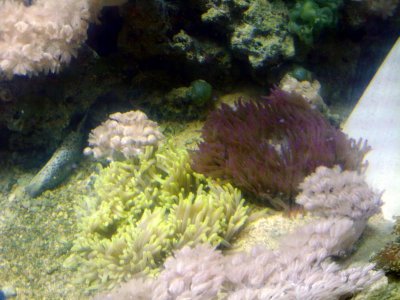
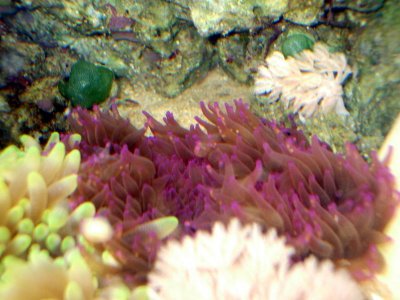
Marc, the purple is the female and the green is the male. I know now because they just spawned in my 30 g tank.
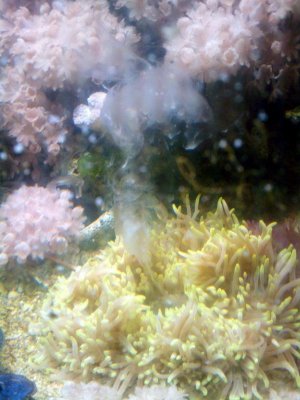
Well I just finish doing a bunch of water change on my tank. I was out of the office for about 1 hr this afternoon. When I got back at about 6 the tank was a little cloudy. Looking closely the green H. malu was pumping out sperms. I grab a few pictures with my phone and start to do water change. I keep 12 g of premixed water all the time in my office for situation like this. I just slow siphon the water our right at the mouth of the male and got most of the sperm out, replace water 1 g at a time while I do this. I squirt some of the sperm laden water to the female. The strange thing is that even as the male discharge the sperm, the female did not release any eggs. Most of the eggs in the tentacles seem to disappear down to the body of the anemone but none was released through the mouth. This morning when I see the eggs, I estimated that there must be 100+ eggs in the tentacles total, now I only see maybe 10. There was no egg released.
At 7 PM my light turns off. I did not wanted to change the usual condition of the tank, so I did not turn the tank light on but just use my office overhead light only. The male have finished releasing sperms about 45 min ago and the female have not release any eggs. After the 12 g water change, the tank is slightly cloudy only and the spawn even was over with no eggs released. I only see a few eggs in the tentacle of the female while when I first got back to the office and notice the spawn, most of the eggs was still in the tentacles. Now almost all are in the body of the female. The female column is raised about 1.5 inches above the sand

Is it possible that H. malu use internal fertilization and release fully formed babies? Anybody ever have H. crispa or H. malu released eggs? If internal fertilization for this species is the case, I am in luck. I will keep you guys and gals update. I will see if I can get the pictures out of my phone and post on this thread later. If anything developed from this even, I will repost in a new thread. IMO, it is highly likely that H. malu use internal fertilization as it is not very logical for the anemones release eggs and sperms too far apart. I am very excited regarding this even. I keep multiple anemones in the same tank, hoping that this would happen. I keep the anemones that I think is H. malu because I read about Anna Scott able to reproduce them in aquarium (her initial writing indicated that this is the species not H. crispa). I hope I can do the same. We will see over the next several weeks.

About my tank, it is a Finnex all glass tank (with a back chamber came with a skimmer which was removed) with 150 DE MH. It is skimmer less. I have a clip on fan that turn on with the MH and a Finnex digital heater in the back chamber set at 80 degree. My office temperature varies usually mid 70’s. It just got much cooler over the last few weeks and the day length is much shorter now than the last few months. The tank is right inside a wall to wall window with night light from the parking lot below (office is on 3 floor). Lost month I have start to run carbon to clear the water. The tank has 3 inches of fine sand, set up 3 years ago and has always at the same place. I got somebody change 10 g of the water the first week of every month for me. It is fishless at this time although I had an Onyx Percula pair in it until about 2 months ago. They are at www.gcreef.com at this time producing some very nice babies. If any of you guys and gals want nice Onyx, you may want to contact them. I have had pictures of these anemones and fish in the past here and there.

Anyway, I am leaving my office now. I am in luck because my wife and children are leaving town this afternoon. I am on call this weekend so I will have to hang around the hospital. I will see if I an extract the picture from the phone and will post them here later.

 
Two pictures, one initially an done after spawn finished
 

Attachments

  • 2009-10-23 17.53.42.jpg
    2009-10-23 17.53.42.jpg
    63 KB · Views: 12
  • 2009-10-23 20.02.41.jpg
    2009-10-23 20.02.41.jpg
    69.2 KB · Views: 16
here is a article from SeaScope spring '89 "Reproduction in the Sand-Dwelling Sea Anemone"

www.instantocean.com/uploadedFiles/InstantOcean/OceanKnowledge/SeaScope/Past/SS_Vol06_1989.pdf

I read the article posted above in SeaScope Volum 6 Winter 1989. In it Colin J. Lau report of H. malu reproduction at Waikiki Aquarium in Hawaii. Lau reported that this species does produce planula larvae from internal fertilization. I am not certain of the regarding the species. They described a smaller anemone than the pair that I have.
From my observation, I am certain that H. malu does not broadcast eggs, rather the eggs are fertilized internally inside the female. This is very good new for me. I do have lots of circulation in the tank with two Korallia 2 in a 30 g. I will stop one and may change the other to a Korallia for the next week or two.
 
...yes i too think they may be diff. or a sub-species, based on size and geographical location wrt clownfish/hosting anemones. I have seen what i think are the anemones being described at the lfs. They were smaller having more translucent of a yellow colored tentacle and bright red/orange column. We see many similarities between different genus and species that even if they are not the same it's very likely your assumption is correct.

Your purple malu looks so much like mine. It too hasn't grown larger than ~8" in over 2.5 years. I am very interested to see the dominate color morph and variations if you're successful with this. I wonder if air stones would be a better choice for flow or if they'd get ejected via salt spray, where's a Archimedes screw pump when we need one?
 
Thanks. Anybody have an opinion on how and what I should feed the baby anemone with if and when I have some babies?
 
Anybody ever have H. crispa or H. malu released eggs?

Yes, my large purple H. crispa has released eggs on at least 2 occasions, and at the time it was the only H. crispa in the tank so they were not fertilized. FWIW, the fish loved eating them. It was the feeding frenzy that I first noticed.
 
Seriously! I've seen my maxi nems spawn at least three times in the last year, with male and females in the tank (cool that the eggs appear to be the same color as the parent) and only a ac70 fuge as flow, no floss or slimmer. I've yet to see anything grow, though i did see a few glowing specks (under actinics) on rocks a week later, nothing came of them.
 
I think the major problem is the skimmer and all the fishes, invert etc in our tank.

My best LFS don't use any skimmers. The main coral tank is really large. Few months ago, all the goniopora in the tank spawned at the same time. And now, we can see baby gonio EVERYWHERE.
 
:( :(
I was so close to getting baby Malu. First back got chewed up by the pumps. I was going to aerate the tank with air pump and turn off the circulation pump at night when the time come for the female Malu to release the babies.
Bad luck struck and my Finnex tank crack over the weekend and I lost my female Malu and got a smelly wet office Monday morning. I got two Malu's now but I think I got two males.
 
I have a large red female hadonni which spawned within hours of placing it in the tank. I thought this was a stress induced spawning but approx six months later it began to spawn on a regular basis about every month or so. I don't really keep a record of dates and whether they tie into the lunar cycle etc. My other (green) hadonni was also a female and they tended to spawn on the same evening. But it was always the red which started first. I've since sold the green but the red continues to spawn regularly. I'm constantly looking for another nice hadonni so who knows, I may get lucky the next time and find a male.
 
I had an LTA spawn one time. The release of gametes was very quick. Had I not just happened to be watching my tank and instead saw it a half hour later, I would have missed the whole event. I used to use one of those "lunar tracker" type of nightlight controllers... have no idea at all if it had anything to do with it.

I later got a pair of ocellaris that basically harassed it to death...
 
I think the first anemone that will be reproduce sexually in aquarium will be either S. gigantea or H. malu with most likely first and Gigantea distance 2nd. The reason why I think this is that they are both internal brooder and will release fully formed anemones from what I read. One of the researcher have already reproduce H, malu in captivity but I was not able to find out exactly how she did this.
I will continue to try to sexually reproduce these two species in aquarium.
We all know how difficult it is to get a Gigantea to live in aquarium. Getting a pair is at least three times as difficult.
With these two species, I think we will need to turn off the circulation pump when we anticipate the release of the babies and use air stone to aerate the tank. I know that the H. malu released the babies about 4 days after spawned and they release the babies at night. Now if I only get a female H. malu. My female died when my tank cracked over the weekend. I still have a male and I have acquired another male (I think)
 
My Epicystis crucifer spawn regularly and I have at least 15 offspring, some approaching adulthood now. Otherwise I've had BTAs and maxi-minis spawn, but no babies, despite multiple individuals in the tank.
 
Gary,
Did you document any of these, at least any pictures of the baby anemones when you first notice them? I would love to see them.
 
Back
Top