Are grounding probes necessary?


What you need to understand about Steven Pro is a lot of his articles contain highly speculative information. For example, I once read an article (see link below) where he talks about daily water changes and FW dips as possible treatment options for ich. :hmm2: Don't get me wrong, I enjoy reading some of his unconventional theories/philosophy. But at the end of the day, he is just a hobbyist the same as you & I. So, I wouldn't put as much stock in being "fact" the info he gives as I would some of Reefkeeping's other authors. For example, Randy Holmes-Farley - a chemist with a PhD from Harvard. :spin1:

http://www.reefkeeping.com/issues/2003-08/sp/
 
What you need to understand about Steven Pro is a lot of his articles contain highly speculative information.

My articles do also. Steven and I have been at this a long time, I have been at it as long as there was a salt water hobby and there were plenty of un conventional things that we did that seem like lunacy today. I used to treat my water with Clorox and I still use a UG filter. Today virtually all the information comes about on the net. I have never seen any filters or fact checkers on the net, have you?
I am not saying Steven is right or wrong as I never met him but I am saying that much, if not most of the information you read about on these forums or even on the net came about through rumors, conjunction, suppositions or gibberish.
100% of everything I have submitted to a real aquarium magazine or virtual aquarium magazine has been published as fact. I am an electrician so what makes what I write fact? Nothing. I could be making it all up.
It is true that Randy has more degrees than a thermometer, but Randy is a chemist "and" a hobbyist. He is an expert chemist but not aquarist nor is anyone else as they don't give degrees for hobbies. Marine biology also does not count as that is a broad study of sea life usually not focusing on keeping tropical fish. There are so many things that we think we know but are just taking for granted that it is mind boggling. PO4 and nitrate for instance. Are they important? Not so much as we learn that many very healthy reef tanks have very high numbers of these. Do we need to change so much water? Not really as there are plenty of very old tanks where water is rarely changed. Ich, do we really need to quarantine everything? I don't and no one knows why ich kills everything in some tanks and nothing in others.
Many people think cleaner shrimp will cure ich. No, really, they do.

OK I forgot my point. Have a great day :dance:
 
I didn't even realize it was the "New to the Hobby" forum.
I just randomly picked a thread and posted some useless information that came about through rumor, conjecture, suspicions and gibberish. :smokin:
 
Paul,
You know I've got nothing but love & respect for you. Not that kind of love, Paul - man love. :love1: Anyway, I've been doing this since I was just a pup (so, late 70s), and I still think nothing beats the look of a FO with an u/g filter & dead coral skeletons. ;) Hey, if it weren't for Paul I wouldn't understand the importance of feeding live blackworms & soaking pellets in Omega 3 fish oil.....
 
I can not speak to the diseases, but if you sucked on a 9volt battery every day I bet you would get cotton mouth after awhile.

BUt, stray currents will cause havoc to your pumps, and cause serious galvanic corrosion.
 
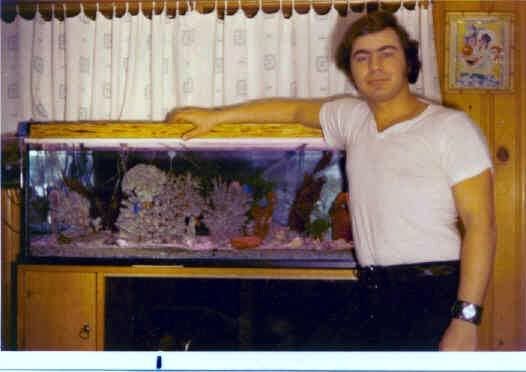
You mean like this?


I can not speak to the diseases, but if you sucked on a 9volt battery every day I bet you would get cotton mouth after awhile.

Not if you put a ground probe up your nose.
 
Of course, I used to bleach them every couple of weeks. You had to.
This was taken in 1979 when I transferred everything from that 40 gallon into this 100 gallon. The basement wasn't finished yet as I was still working on it. You can see some of the white corals in the tank that I must have just removed to bleach.


And today.

 
and how easy is it to install a grounding probe

It's super easy.

Put the probe in the tank or sump, secure it and then plug it into a grounded outlet.

The plug end will either only have the ground pin or will have the ground pin and 2 plastic (so it's non conductive) fins to plug into the hot and neutral slots.

$T2eC16Z,!ygE9s7HJ-n1BRvPRwVp1w~~60_57.JPG
 
You can use that cool pictured or get an old stainless steel radio antenna, stainless steel or silver spoon or anything made from those metals, connect a wire to it, (outside the tank) and connect it to a ground like the third hole in an outlet. But I realize many of you would be afraid to do that (Sissies) so go and buy a regular ground probe.
 
I don't know about fish health. In theory without a ground there is no current BUT I have been working on high power for 12 years and funny as it is the worse shock/electrocution I've ever had was my fish tank. If I had a ground probe the breaker would have tripped and I would have known before stepping into a puddle if salt water bare foot and then sticking my hand in the tank :-( ouch.
 
From what I was told the the electricity does not effect the fish and corals because they are not grounded.

It;s more for our safety to avoid what happened to Adam.

When you stick your hand in the tank and are standing barefoot on the floor you complete the circuit and your body is the path of least resistance for the electricity to flow through.

You always want to give the voltage another option to take than your body, that could be very bad. :(
 
...It;s more for our safety to avoid what happened to Adam....:(

Actually, no... that's what a GFCI is for. If you rely soley on your breaker tripping, you're playing Russian Roulette. (Says the person who "found" a bad powerhead after tripping their GFCI.)
 
Actually, no... that's what a GFCI is for. If you rely soley on your breaker tripping, you're playing Russian Roulette. (Says the person who "found" a bad powerhead after tripping their GFCI.)

I agree, but without a ground probe, the GFCI may not trip until you complete the circuit to ground. I'd rather not be the conductor, so that's why I think such probes are a good safety tool in conjunction with a GFCI.

Not sure it helps with fish health or not, but I have two of them (sump and tank) for the safety reason above. :)
 
i agree, but without a ground probe, the gfci may not trip until you complete the circuit to ground. I'd rather not be the conductor, so that's why i think such probes are a good safety tool in conjunction with a gfci.

Not sure it helps with fish health or not, but i have two of them (sump and tank) for the safety reason above. :)

+100
 
I don't think 2 are any better than 1 if you remove the stay voltage from the water it is removed from all the water not just the sump or tank.
 
Back
Top