Catalina Gobies

ThRoewer

New member
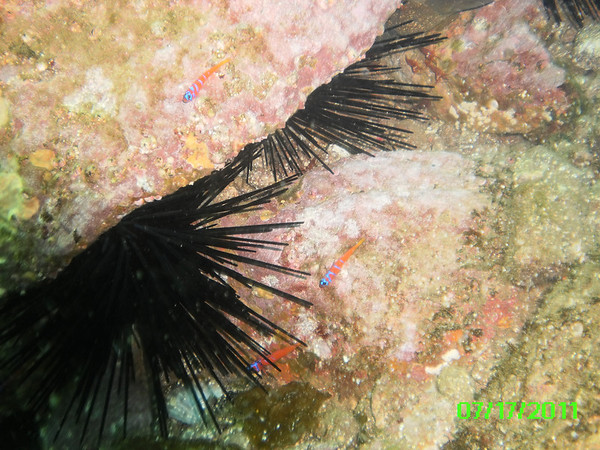
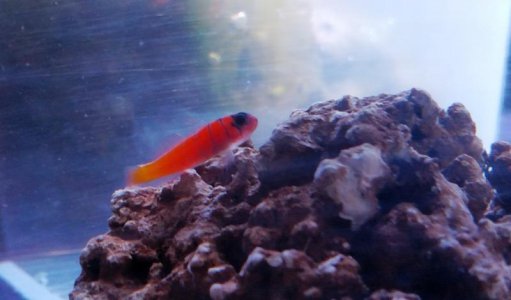
Picked up this little guy (Lythrypnus dalli) at AC on Memorial day:

attachment.php


Unfortunately they had only one.

So far I have it in a 1 gallon tank with no pump (could induce heat), a small live rock and some sealettuce. I plan to update that later to a 5 or 10 gallon tank, but so far the little guy seems to do fine.

Currently I only feed live tigger pods and one feeding every few days seems to be quite sufficient.

I tried to get it some company and ordered 2 more from LA, but one came in dead and the other didn't make it through the night :(
Right now I have 2 replacements on order (as order fill-up to my ORA Marine Betta from DD). Let's see if those come in better.
 

Attachments

  • L. dalli 2016 06 18.jpg
    L. dalli 2016 06 18.jpg
    38.7 KB · Views: 5
I'd like to hear those plans as well.
I saw some very cool strawberry anemones on a recent trip to SF and have been trying to figure how how I can keep some with out using a chiller.
 
It works so far and the fish doesn't indicate to have a problem with it.
There will for sure be a pump in the bigger tank.
I plan to put that tank downstairs in the hallway where it never gets too hot.
For chilling I plan to use evaporation via a fan combined with a simple ATO system.
Light will be minimal.

Sent from my XT1254 using Tapatalk
 
Apparently these are seen in San Diego waters now too. A diver came by my place to pick up some nems and showed me a plethora of nice nudi pics and some Catalina gobies, which he says he's spotted in SD. Awesome looking fish, too bad it needs such low temps to thrive.


Sent using your IP address
 
They are native to SoCal and especially to Catalina Island (hence the name), so I'm not surprised they also show up in San Diego (and along the coast of SoCal). I wonder if you can find them in Mission Bay.

I think they can handle a bit higher temperatures during the day as long as they have a cooling off over night. It is something temperate species experience in the wild all the time. I've seen North Sea gobies doing fine in tidal puddles that were not just warm but outright hot.

So 22°C during the day should be fine as long as the temperature drops to 18°C during the night.

Back in Germany in the early 80s I had one, but it didn't like the tank temperatures and came down with a really bad case of ich and then got eaten by the Actinia bermudensis I had there as well. Back then you had to largely rely on LFS info and books.

I may end up building a small custom acrylic tank for these - I always liked these guys and would like to try to breed them.
 
They are native to SoCal and especially to Catalina Island (hence the name), so I'm not surprised they also show up in San Diego (and along the coast of SoCal). I wonder if you can find them in Mission Bay.

I think they can handle a bit higher temperatures during the day as long as they have a cooling off over night. It is something temperate species experience in the wild all the time. I've seen North Sea gobies doing fine in tidal puddles that were not just warm but outright hot.

So 22°C during the day should be fine as long as the temperature drops to 18°C during the night.

Back in Germany in the early 80s I had one, but it didn't like the tank temperatures and came down with a really bad case of ich and then got eaten by the Actinia bermudensis I had there as well. Back then you had to largely rely on LFS info and books.

I may end up building a small custom acrylic tank for these - I always liked these guys and would like to try to breed them.

That would be neat to see them in Mission Bay. The diver stated he was down about 50 feet and saw the CG here in SD. My tank hits a high of 79-80 before my chiller kicks in, so doesn't look like it would be too successful for my tank. Neat fish though, very pretty.
 
Well, one down again. Let's see if the other one makes it or if my first has to stay lonely.

Sent from my XT1254 using Tapatalk
 
I got one about a month ago and hes doing great. I was told it was specifically acclimated for higher temps. I don't know how true that is or if it works but that's what we were told by the distributor. Its been a month and hes doing great, active and eats like a pig! I hope he survives long term.
 
A LFS here had a IM Nuvo Concept Abyss with a minor flaw for a good deal so I took it for the Catalina Gobies. With roughly 15 gallon volume it is just right.
I set it up on Thursday in the coolest spot of the house, put the fish in and added a load of tigger pods.
I haven't seen them since, but also no bodies. Let's see how this works out.
 
Looks like at least one died. I found something that may be remains.
And unless the other one is hiding deep in that small rock it's likely gone too. :headwally:
Heat is for sure not the cause as the first did just fine in a gallon of water without even a circulation pump.
 
After doing some more research on these it seems their temperature range must be larger than generally assumed.

Description of four small reef fishes from Ecuador: Oxycirrhites typus (Cirrhitidae), Acanthemblemaria balanorum (Chaenopsidae), Arcos decoris (Gobiesocidae) and Lythrypnus dalli (Gobiidae)
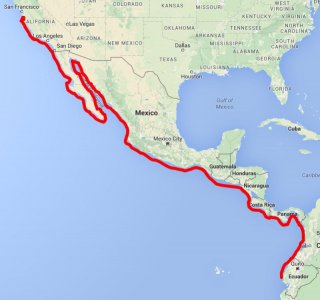
"D i s t r i b u t i o n. - Tropical eastern Pacific endemic gobiid species, known from central California to Panama (Eschmeyer and Herald, 1983; Bussing, 1990). Its range is herein extended to southern Ecuador."

fishbase.org lists their distribution: "Eastern Pacific: Gulf of California to Ecuador and north of Peru"

This would make their range roughly from Monterey Bay to Ecuador, including the entire Tropical East Pacific

attachment.php


attachment.php


This would also mean that their range encompasses 3 climatic regions. At least those collected in Central America should not just handle tropical temperatures, but actually like them.

My suspicion is that the ones that show up in the stores come from somewhere south of the border as I somewhat doubt that commercial collection of them in California waters is permitted. Most likely is that they come from Costa Rica or Nicaragua. That would make it more than likely that they tolerate tropical water temperatures.
 

Attachments

  • Catalina Goby Distribution.jpg
    Catalina Goby Distribution.jpg
    55.4 KB · Views: 5
Do you have any images of a build thead for your Abyss?

No. After all the gobies died I cleaned it out and shelved it.
The plan for it now is to put my Janssi pipefish and my Yasha gobies in there.

The next Catalina gobies will go with the Blue-spotted Jawfish into my East Pacific biotope.
The other fish I will add there are some barnacle blennies and the Fantail pipefish.

Now I just need to find some corals, zoas, anemones,... from the East Pacific.
 
Found this article about Catalina Gobies and their relatives:

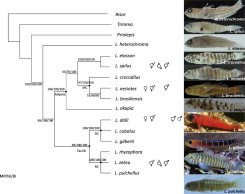
Extreme gender flexibility: Using a phylogenetic framework to infer the evolution of variation in sex allocation, phylogeography, and speciation in a genus of bidirectional sex changing fishes (Lythrypnus, Gobiidae) (Full PDF here)

Abstract

The genus Lythrypnus is a group of marine gobies that exhibit extreme gender flexibility as bidirectional sex changers. The genus consists of 20 described species and several undescribed species that are distributed in the Americas. Five species have been characterized with respect to sex allocation and gonad morphology. The hormonal, morphological, and behavioral aspects of sex change have been studied extensively for one species, L. dalli. These data, however, have not been interpreted in an evolutionary context because a phylogenetic hypothesis has not previously been proposed for the genus Lythrypnus. We propose the first phylogenetic hypothesis for the genus based on molecular data from three mitochondrial genes (12s, ND2, and Cytb), one nuclear gene (Rag1) and one nuclear intron (S7). We also include three previously undescribed Lythrypnus species. Our results support the monophyly of the genus with L. heterochroma, an Atlantic species, as the basal taxon. After the divergence of L. heterochroma, there are two main clades, one comprised of species distributed in the Atlantic, the other comprised of species distributed in the Pacific. These data indicate an Atlantic origin for the genus, followed by divergence after the closure of the Isthmus of Panama. Our data also support the monophyly of three previously described species complexes, the L. rhizophora complex and L. dalli complex in the Pacific, and the L. mowbrayi complex in the Atlantic. We mapped patterns of sex allocation within this genus onto the fully resolved and supported topology, and found that sexual plasticity and gender flexibility is likely a synapomorphy for the genus. Overall our results create a well-supported framework to understand the phylogeography of the genus, and to interpret the evolution of sex allocation in Lythrypnus gobies.

attachment.php


Highlights
► In this paper we propose a phylogeny for a genus of bidirectionally sex changing fishes, Lythrypnus. ► Sequence three mitochondrial genes (Cytb, 12s, and ND2) one nuclear gene (Rag1) and a nuclear intron (S7). ► We investigate the evolution of sex allocation within the genus. ► Phylogeny revealed one major split into an Atlantic and a Pacific clade separate by the Isthmus of Panama. ► No trends in sex allocation variation were inferred from common ancestry.

Keywords
Lythrypnus; Bidirectional sex change; Hermaphroditism; Isthmus of Panama; Phylogeography
 

Attachments

  • 1-s2.0-S1055790312001649-fx1.jpg
    1-s2.0-S1055790312001649-fx1.jpg
    22.4 KB · Views: 5
This may be of interest too even if it isn't specifically about Catalina Gobies:

Habitat selection and recruitment of an assemblage of temperate zone reef fishes (Full PDF here)

"Abstract

Spatial and temporal patterns of recruitment are described for young-of-year of nine species of rockfish (Scorpaenidae, genus Sebastes) in a giant kelp Macrocystis pyrifera (L.) C.Ag. forest off central California, USA. Though all nine species recruited during or soon after the months of maximum coastal upwelling, variation in timing of peak recruitment among species corresponded to the sequential parturition of pelagic larvae. Recruits of each rockfish species exhibited strong and significantly distinct habitat selection based on substratum type and relief, algal type, and vertical position in the water column. To determine the effect of habitat structure on the distribution and abundance of recruits, observations of habitat selection were made within an unmanipulated M. pyrifera forest and compared to sites where the presence of M. pyrifera was altered. Whereas variation in substratum type can contribute to spatial pattens of rockfish recruitment, the temporal dynamics of algal abundance, especially M. pyrifera, may strongly influence temporal, as well as spatial variability of rockfish recruitment. These results indicate that the structural composition of a reef, particularly the occurrence of M. pyrifera, strongly influences the magnitude and species composition of local recruitment of this rockfish assemblage.

Keywords
Habitat selection; Macrocytis; Recruitment; Reef fish; Rockfish; Sebastes"
 
Back
Top