
DI cartridge life span?

DI cartridge life span?

I honestly haven't tested my tap water. Didn't think it was necessary since I was passing it through RODI.

I definitely don't have 65 psi coming out of my DI canister but it seem to be at least that going into the RO membrane. I don't have a gauge but I work a lot with fuel pressures and seems to be at least 65 psi.


Sent from my iPhone using Tapatalk
 
One thing to check is the ratio of waste water to good water. should be about 5 to 1, no less than 3 to 1. 5 waste 1 good. I measure the amount of each over 30 seconds.
 
I honestly haven't tested my tap water. Didn't think it was necessary since I was passing it through RODI.

I definitely don't have 65 psi coming out of my DI canister but it seem to be at least that going into the RO membrane. I don't have a gauge but I work a lot with fuel pressures and seems to be at least 65 psi.


Sent from my iPhone using Tapatalk
You should be able to get a water evaluation from your local water company.
 
ee5ed7c16e00b8fef2b5b5e635c768f5.jpg


The tubing is routed correctly, but your RO membrane isn't doing its job.

Feel free to give us a call when you are in front of the system if you'd like to get it resolved.

Russ
 
On a side note you will get a lot more use out of your DI resin if you run two canisters of resin in series. When you use a single canister of resin and you start to see your TDS readings rise you need to replace the resin even though it still capable of absorbing more pollutants.

Just so no one gets confused - running two DI carts in series does not let you use the first exhausted cartridge for a longer period...

Russ
 
You should also look into an RO flush kit. When water sits inside the membrane, there is TDS creep. So the 1st bit of water coming out of the membrane is pretty high (for post membrane) TDS which will use up your DI faster. So if you make small amounts like 2 gallons frequently, the DI will wear out very fast.


Sent from my iPhone using Tapatalk

What you want to address TDS Creep is a DI Bypass, rather than a Flush Kit.

Russ
 
I definitely don't have 65 psi coming out of my DI canister but it seem to be at least that going into the RO membrane. I don't have a gauge but I work a lot with fuel pressures and seems to be at least 65 psi.

Water coming out of the DI will only be at a few psi - maybe 5 psi.

Water pressure coming INTO the membrane needs to be measured with a gauge. Depending upon which brand of membrane you have, its performance was tested by the factory at 50, or 60, or 65 psi. Nothing says theis is the BEST pressure to run at, it is just the pressure specified by the manufacturer for their testing purposes. Get a pressure gauge add on kit - less than $15.

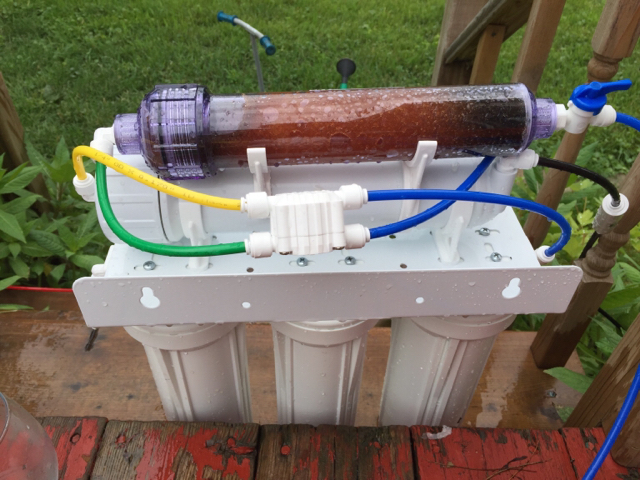
Also - DI cartridges should never be horizontal. A horizontal DI is a sure sign of what we call "an ebay system."

Russ
 
Water coming out of the DI will only be at a few psi - maybe 5 psi.


Water pressure coming INTO the membrane needs to be measured with a gauge. Depending upon which brand of membrane you have, its performance was tested by the factory at 50, or 60, or 65 psi. Nothing says theis is the BEST pressure to run at, it is just the pressure specified by the manufacturer for their testing purposes. Get a pressure gauge add on kit - less than $15.


Also - DI cartridges should never be horizontal. A horizontal DI is a sure sign of what we call "an ebay system."


Russ


Thanks for the info. I brought the unit back to my LFS and they tested it. The unit works fine and suggested I add another inline sediment cartridge as there was a lot of sludge build up on the first one and some slippage into the first Carbon cartridge.

They replaced the DI for me and I bought another sediment cartridge.

I will try it like that.

Why do you say the DI should not be horizontal? I see a lot of systems like that.

In your opinion how should it be? RO Water flowing up the DI cartridge or down it?

That's an easy modification I can do.


Sent from my iPhone using Tapatalk
 
From our FAQ's:
Horizontal DI housings are a design intended to minimize the original cost of the system - you should be prepared for the tradeoffs. Horizontal DI units typically contain 8 oz. to 16 oz. of resin. Typical 10” x 2.5” vertical DI cartridges contain 20 oz of resin. Obviously the more resin contained in the housing the longer it will last and the better treatment it will provide.

Some horizontal DI housings are not refillable - you'll therefore have to pay for a new housing every time you need to replace the DI resin. The cost of repeatedly replacing the horizontal housing will far outweigh any money saved up-front in purchasing the unit.

Perhaps most importantly, horizontal DI housings are a less than ideal arrangement for water treatment. DI resin beds shrink/settle through normal use over their life span. You'll note that a cartridge that was full when new can sometimes have a ¼ inch of empty space in it when fully expended. When DI resin settles in a horizontal housing, it leaves a pathway (of least resistance) along the top of the housing where water can flow while coming into minimal contact with the DI resin.

You’ll note that the output from the DI housing is at the center of the end of the housing. Depending upon how your system is configured, RO water may enter the DI housing in port, fill up the housing until the water level reaches the out port (i.e., fill up the bottom half of housing), and then exit the DI housing. Your RO water has been in contact only with half the resin in the housing.
 
For the systems used in this hobby, go with bottom up flow through the cartridge. If we're talking about DI tanks that's a different story.

Russ
 
Back
Top