Dinoflagellates.

that's why you turn lights off... drive them into the water column.

Also, bacteria need media to settle in/on. You can mix them in by day and turn UV on by night.

It worked.
 
that's why you turn lights off... drive them into the water column.

Also, bacteria need media to settle in/on. You can mix them in by day and turn UV on by night.

It worked.

It is working. My tank looks great this morning (relatively). My thinking is I'm constantly adding the phyto/coral snow but constantly killing the dinos. I've been running the lights on their normal cycle and basting my corals and rocks.

When I finally shut off the UV I will continue the phyto/coral snow and see what happens.
 
Hoping someone can save me going back through the thread:
When culturing skimmate, should the solution be kept in light or dark? Is aeration/circulation necessary?

I have to treat a skimmerless tank but have several other systems with skimmers that I can culture from. Unless there are other suggestions, I plan on collecting skimmate from other systems and adding dinos from the affected tank to the culture. I have not ID'd the species that we are fighting yet, but thought that if I added the species I want preyed upon, there is hope that there are predatory organisms in the skimmate and I would be able to monitor what grows in the culture. I can borrow a scope in a week or two to snoop around the culture to see what the dominant microbes are.
 
When culturing skimmate, should the solution be kept in light or dark?
Is aeration/circulation necessary?
I'd say Inconclusive. Try both, see what you get!
I've seen some benefits from both, but I think the sunlight one has been more effective. The sunlight one did "crash" eventually - grew sheets of green cyano and stopped killing dinos.
But before it did, I used it to seed a 10 gallon sand bed that's now full of ciliates of many varieties.

I plan on collecting skimmate from other systems and adding dinos from the affected tank to the culture. I have not ID'd the species that we are fighting yet, but thought that if I added the species I want preyed upon, there is hope that there are predatory organisms in the skimmate and I would be able to monitor what grows in the culture. I can borrow a scope in a week or two to snoop around the culture to see what the dominant microbes are.

Sounds great! Look forward to seeing what you get.
 
I don't think 5 days is long enough for the black out method. I chickened out at 8 or 9 days, others who have stopped short have reported the dinos have come back a few weeks or a few months later. My tank was spotless, not a single sign of any sort of algae.

I would keep getting bio-diversity in to the tank, on a daily basis, keep the pH high (8.5) and strictly use blue spectrum lights only for the next 2 weeks.
Make sure you are siphoning out the dead dinos and any areas of the sand they remain on, replacing with synthetic salt water (TMCPR or similar (no DOC's).

I'm perplexed as to why you keep insisting there is a "blackout method". There isn't one. Have you read the numerous reports of people emptying out all the water from their tanks and storing the dry rocks for months only to fill it back up with water and get dinos again? You do realize some dinos can encyst and just come back at a later time, correct? Extended blackouts are completely unnecessary and do not work lest your purpose is to kill your livestock.

All the success reports lately have come from people doing a simple 3 day blackout followed by increased feedings and phyto/pod dosing. All the reports of anyone doing 5+ day blackouts have reported death of corals. Coincidence?

UV DOES work. It's worked for numerous people on here. The bacteria that are in the water column are inconsequential because there are a lot more on the rocks, sand, walls, pumps, sump, etc. Pods we are dosing are benthic.
 
blackout just drives the pods into the water column for the UV to blast them.

Unless you have the kind that buries into sand (someone had that at some point).
 
I'm perplexed as to why you keep insisting there is a "blackout method". There isn't one.

I glanced over it as a misplaced word, at least for ostis where I think we have proved it useless on it's own.
In some cases blackout has reduced the amounts of something, but in this thread we know better.

Know your enemy!
 
The coccolithopores are on my mind these days and of course that means another experiment.

What I'm doing is siphoning the sandbed every three days to see what's in there and how fast it accumulates.
I'm on my third round today and the amounts of gunk that keeps coming out is amazing.

The coccolithopores are to small to identify in a microscope and the coccoliths are even smaller so that makes things difficult.
I don't know enough about the coccos but at some stage they are naked, making them an excellent food source in the microscopic world.

What I can tell so far is the main ingredients are around 50% dark green/brown particles and ~50% highly reflective white particles that are much smaller but still visible in my custom made siphoning tube.

I'm repeating this 10 times to see what happens.
 
Fighting dinos atm with growing frustration every day.

Started with me noticing some brown stuff on the sandbed when i changed water, went away in a few days, but took longer and longer to dissapear every weekly waterchange...

With the brown stuff covering the sand and corals starting to look worse and worse i started to do a 20% 20% 20% waterchange over the weekend and vaccumed the shallow sandbed. Things looked nice for about an hour...

Did some research and found out i had a case of the dinos, tank looks nice in the morning, and by the time the lights go out sandbed is a brown slush.

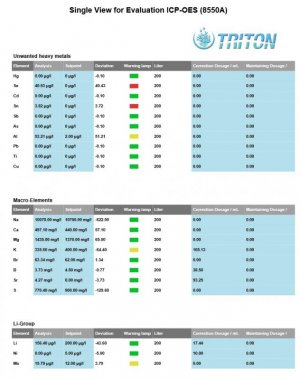
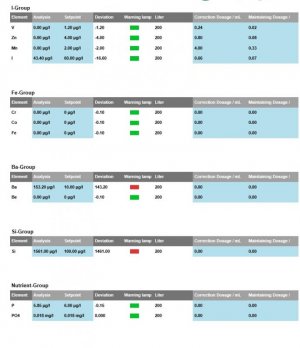
Sent in a watersample to triton and it came back with this.

http://www.triton-lab.de/en/aquarium-administration/aquarium/auswertung-b/icp-oes/12165/pdf/online/

Si waaaaaay high, ordered new DI resisns for rodi, some Si filtermedia, Salifert Si test.

Salifert Si i get a reading of 0...
Dont know if theres any errors in the ICP-OES for Si...

Allso measured No3 at 25ish with salifert, used to have dose no3 to keep it up...

Doing Kalkwasser via the topoff now, put my UVC back on the tank, changing GFO/GAC every week, Sera marine silicate clear in the sump, skimming as wet as i can.

Corals seem to do a bit better, dinos is hard to tell but doesnt seem to getting worse thankfully...

Thanks you RC for beeing awesome and excuse my spelling/grammar misstakes.
 
url didnt work so heres the results of the tests.
 

Attachments

  • 1.jpg
    1.jpg
    56.1 KB · Views: 7
  • 2.jpg
    2.jpg
    54.4 KB · Views: 7
so what do these coccolithopores look like in your tanks?

I have unusual white floating sand particles that only seem to show up when I do a water change. They're not precipitating calcium because that tends to be "fluffy". It's not sand since that sinks at these sizes. It looks like little foam pellets (1-2mm).

I don't know what these things are, but I'll try to take a microscope picture.

I don't have dinos any more, but I do have other unusual characters. The latest is a brown sponge fuzzy growth that doesn't spread by water, but looks to be encrusting.

<a href="http://s1062.photobucket.com/user/karimwassef/media/DB378788-C0A6-41EF-B7F8-790BD9131F44_zpsro0ztcm9.jpg.html" target="_blank"><img src="http://i1062.photobucket.com/albums/t496/karimwassef/DB378788-C0A6-41EF-B7F8-790BD9131F44_zpsro0ztcm9.jpg" border="0" alt=" photo DB378788-C0A6-41EF-B7F8-790BD9131F44_zpsro0ztcm9.jpg"/></a>

<a href="http://s1062.photobucket.com/user/karimwassef/media/91798012-B56B-438A-AC76-E0D6DE2D067B_zpsbddmhbbd.jpg.html" target="_blank"><img src="http://i1062.photobucket.com/albums/t496/karimwassef/91798012-B56B-438A-AC76-E0D6DE2D067B_zpsbddmhbbd.jpg" border="0" alt=" photo 91798012-B56B-438A-AC76-E0D6DE2D067B_zpsbddmhbbd.jpg"/></a>

and an infestation of parasitic featherdusters that encroach and damage my LPS

<a href="http://s1062.photobucket.com/user/karimwassef/media/877BF727-3F8D-44C0-B22D-114534742130_zps7ycgzpaq.jpg.html" target="_blank"><img src="http://i1062.photobucket.com/albums/t496/karimwassef/877BF727-3F8D-44C0-B22D-114534742130_zps7ycgzpaq.jpg" border="0" alt=" photo 877BF727-3F8D-44C0-B22D-114534742130_zps7ycgzpaq.jpg"/></a>
 
Does anyone have ostreopsis dinos they'd be willing to ship to me (southeast us) for testing purposes?
I want to see if the beasties that have developed a taste for my dinos (ciliates mostly) will show an interest in the most common problem dinos.

My cultured 10 gal sandbed now eats up as many dinos (amphidinium and coolia) as I can provide from my main tank on a daily basis. Today I'm going to siphon all visible dinos out of the top layer of my DT sand and add it into the cultured sand. If it goes as expected, I'll transfer most of my cultured sand into the DT in a day or two.
 
url didnt work so heres the results of the tests.

Darizzo seems to have deleted his post accidentally so I repost it for him.

***************
Fighting dinos atm with growing frustration every day.

Started with me noticing some brown stuff on the sandbed when i changed water, went away in a few days, but took longer and longer to dissapear every weekly waterchange...

With the brown stuff covering the sand and corals starting to look worse and worse i started to do a 20% 20% 20% waterchange over the weekend and vaccumed the shallow sandbed. Things looked nice for about an hour...

Did some research and found out i had a case of the dinos, tank looks nice in the morning, and by the time the lights go out sandbed is a brown slush.

Sent in a watersample to triton and it came back with this.

http://www.triton-lab.de/en/aquarium-administration/aquarium/auswertung-b/icp-oes/12165/pdf/online/

Si waaaaaay high, ordered new DI resisns for rodi, some Si filtermedia, Salifert Si test.

Salifert Si i get a reading of 0...
Dont know if theres any errors in the ICP-OES for Si...

Allso measured No3 at 25ish with salifert, used to have dose no3 to keep it up...

Doing Kalkwasser via the topoff now, put my UVC back on the tank, changing GFO/GAC every week, Sera marine silicate clear in the sump, skimming as wet as i can.

Corals seem to do a bit better, dinos is hard to tell but doesnt seem to getting worse thankfully...

Thanks you RC for beeing awesome and excuse my spelling/grammar misstakes.
***************

 
Thanks for posting those charts.
I find those high Si levels interesting and I would think it should have led to a diatom bloom.

Now you need to identify your dinos.
How can dinos outcompete diatoms with parameters like that?
 
so what do these coccolithopores look like in your tanks?
I think you may be looking at marine snow. It's a cocktail that grows untill it sinks.

My experiment has only been going for a week, but the added haziness is interesting.
If it's coccos I would have a eureka moment, but it could be precipitation or bacteria.

I'm excited since the absence of at least half of the dinos seems to be causing this.
 
Wow yeah, really expected high Si to mean a diatom bloom that would exclude dinos.
Wonder what the microscope will show.
 
When I said pods, I meant dinos.
I wondered about that.

Point on the lights out thing. Lights out is not a cure. But it is not pointless either.
First, like you say, lights out drives most dinos to the water column. (Read a thread the other day where pumps off for 30 min drove some dinos to the water column). Nothing makes mine leave the sand. [emoji20]

Secondly, all of the reports of dinos I've seen occurred under reef lighting, therefore -although there are species of dinos that don't need light - we are dealing with species that are light loving.
Yes, they won't automatically die in the dark, they can hunt other things, or just encyst. But darkness slows them down. Which is excellent, if our treatment strategy involves outcompeting them.
 
Back
Top