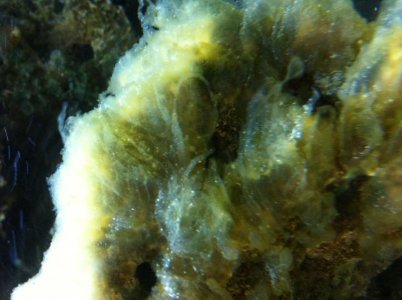
Dinoflagellates.

So yesterday, despite the garbage weather and chilly water, I went back to the Fort Pierce Intracoastal (basically the beach that the Smithsonian Marine Station sits on) on a quest for snails (Cerith, periwinkle, nerite). There were no ceriths to be found, but I managed to collect a dozen each of periwinkles, nerites, and keyhole limpets. I grabbed a floating piece of macroalgae to put under the microscope, as I can usually find dinoflagellates stuck to things like that. This area is where I presume that my Ostreopsis population originated.

Put it under the scope, plenty of life covering it (and in just the water), but no dinoflagellates that I could find at 100x magnification.

At that time, I also took samples from my tank, a little schmutz from a couple of rocks, and I found something a little different than before. Previously, samples after my first blackout contained around 20-30 each live and dead Ostreopsis cells. The samples from yesterday contained zero dead and exactly two live cells. This could be due to the 55w UV sterilizer, or could be due to the series of 3-day blackouts I've been doing every week and a half or so. Who knows. All I know is that it makes me a bit happy to see so few of them living!
 
I don't know of any animal that will eat them, but there probably is one. I wouldn't bet on it being practical for use to stock, though.
 
I don't know of any animal that will eat them, but there probably is one. I wouldn't bet on it being practical for use to stock, though.

I actually think most filter-feeders eat them like shellfish, sponges etc.
Cyano is drawn to them and often covers dino mats on the sandbed.

My snails died first when the dinos bloomed.
I bought 10 more later when I thought it was safe.
They have multiplied to more than 100 and I have seen a snail track across a dino patch.
My snails could have built up a tolerance from low dose exposure since they don't die anymore.
I've heard that toxic Cyanobacteria don't always produce toxins and same could possibly apply to dinos.

I don't think even a colossal clean up crew could compete with a skimmer.
 
Is this Dino's?

I've been battling this sh!t for months, must have siphoned out bucket loads, but keeps coming back.

For some reason it seems to be on the decline, but still small patches, I always believed it to be Dino's, but just wanted to confirm.


cf0cefdb5f046d2e570d22d9f0a8acff.jpg
5bf84894a28c6469db95f06649ec917c.jpg
6fbf45ebebc0244262a4e1cd17dd2af1.jpg
 
I actually think most filter-feeders eat them like shellfish, sponges etc.
Cyano is drawn to them and often covers dino mats on the sandbed.

My snails died first when the dinos bloomed.
I bought 10 more later when I thought it was safe.
They have multiplied to more than 100 and I have seen a snail track across a dino patch.
My snails could have built up a tolerance from low dose exposure since they don't die anymore.
I've heard that toxic Cyanobacteria don't always produce toxins and same could possibly apply to dinos.

I don't think even a colossal clean up crew could compete with a skimmer.
I agree.

I have a small triostegus that is still alive (lost more than 20 tangs and surgeonfish) and eats quite a bit of this slime. He started with small nips just from time to time, I think he has also developed something that helps keep alive. I don't think on immunity to this toxin but maybe his guts are deliberately not processing the stuff.
 
Here's some interesting observations. I posted earlier in this thread, that I had successfully beat my dinos, but I expected them to come back. Well they did, and I beat them again, but heres the funny thing. When the initial bloom started, I had removed my gfo, and used only large amounts of carbon to hopefully remove the toxins being released from the dead/dying dinos. I have 2-TLF phosban reactors, one for gfo and one for carbon, I simply made them both carbon. After the dinos had been gone for a few months, I decided I better put some gfo back in one of the reactors before I had a phosphate problem.
I put 1 cup of BRS gfo into one of the reactors, and within 2 days the dinos were back. They got nasty within a week, so I removed the gfo and started dosing peroxide again at 2ml/10 gal for a week, then 1.5ml/10 gal for another week. I also increased the volume of food I was feeding in an attempt to raise the nitrate levels as others have noted this helps get rid of dinos.
After 3 weeks, all the dinos were gone again. It's been a month without dinos now again, and I've got to say I'm not going to use BRS gfo again. It could be any gfo will cause the same result, and the lower nutrient levels in the tank caused the dino's to thrive due to the lack of competition from other algaes not present, I don't know. It just seems like the gfo was a major trigger in causing them to come back.
Ive been in this hobby a very long time, and I honestly can't remember many people having problems with, or having dinoflagellates at all in the past. What has changed to allow dinoflagellates to thrive in our tanks? GFO was not used then, and I'm wondering if using too much GFO and having ultra low nutrient levels in our tanks are giving the dinos everything they need to thrive, since there seems to be a very common problem with them in the last 10 years. Homemade 2 part solutions weren't really used then either, Bionic and Balance were the main solutions used, and Calcium reactors and Kalkwasser top off, were by far the most common ways used to maintain alkalinity and calcium levels.

Just my thoughts,
Leland
 
Ive been in this hobby a very long time, and I honestly can't remember many people having problems with, or having dinoflagellates at all in the past. What has changed to allow dinoflagellates to thrive in our tanks? GFO was not used then, and I'm wondering if using too much GFO and having ultra low nutrient levels in our tanks are giving the dinos everything they need to thrive, since there seems to be a very common problem with them in the last 10 years.
I stopped using BRS GFO recently and my dino growth is practically gone. In my limited experience back in the hobby after decades I have had nothing but problems with GFO. It messes with my PH, grows dino's like crazy and of course you can forget about growing macro algae. I'm pretty sure it ruined my coral growth and I even think it may have killed off my pods. I won't likely be bothering to try and use GFO again. The only thing I might experiment with would be an alternate and proven phosphate reducer media if that ever exists. But it really doesn't appear I need that anyway. At the end of the day there is really no substitute for keeping a healthy sand bed that is not filled with nasty detritus. And I find that I have to keep my sand bed stirred to accomplish that. At least until I can get some critters that do it well enough for me.
 
I have a kalkwasser reactor for my top off, and I don't have a problem with phosphates at all. I was worried that I might cause elevated phosphates from feeding the tank more to purposely increase the nitrates, so thats what prompted me to add the gfo again. I have mangroves and syringodium grass in my refugium, and it does grow much better when I don't use gfo, for obvious reasons.

Leland
 
I had dino's for about 5 months. I tried to lower nutrients, even though they were already low. I tried black out periods, hydrogen peroxide, and adding Kalk to increase ph. I'm not sure what effect any of this had but one day the dinos just started to disappear. They were gone in a week.

I think if you give it time they will go away on there own.
 
Leland. I bet we could find several ways to have less dinos, but keeping SPS corals healthy at the same time is the real problem.
 
IU fan. I can't tell for sure if those are dinos. You seem to have some red slime and gunk in it as well. If you post another photo with the flash on we could see the colors better.
 
I've had a dino problem for quite some time now, and decided recently to start to tackle it. I took some footage through my microscope which you guys might be interested in, url is

https://www.youtube.com/channel/UCPjIGEVS4kL-zqCaM6FkPtw

Theres 7 short vids of the stuff at up to 1000x magnification. Theres a couple of vids of weird slug / worm things, but mostly its the algae. What I don't get is that it dosent look like this is dinos now to me. Although I think I can see a few dinos, like in vid 3, the majority of the blobs don't seem to me moving and look too small to be dinos. Any opinions would be appreciated. I emailed the link to Pants - will see if he gets the time to look.

Background - this is a bit of the green slimey stuff from my rock, which is very fragile, can be blown off with a pump, rapidly comes back, and is very nutrient starved (phos reads 0 on hanna, not sure nitrate).

Cheers, Pete
 
I had dino's for about 5 months. I tried to lower nutrients, even though they were already low. I tried black out periods, hydrogen peroxide, and adding Kalk to increase ph. I'm not sure what effect any of this had but one day the dinos just started to disappear. They were gone in a week.

I think if you give it time they will go away on there own.

I had the same experience. I had Dinoflagelates for several months and tried everything ultra algae x , blackout, vacuum the sand everyday, lower nutrients, increase nutrients, water changes , no water changes ect .
few days ago after no trying anything for a while( I kept vacuum the sand) and this week they just stating to die and today I could only see very little .
I hope they totally disappeare in 1 or 2 days.
I really don't know why this happen but I am very happy 😀
 
peterpion what is in video 3 is a dinoflagellate. I'd expect to find some in every tank.
You can see it move with it's flagellate and the grove they all have is also visible. It's not Ostreopsis.

I don't know what that much smaller plankton mass is.
I think it's for sure too small to be dinos and it's almost out of range for a light microscope.
Judging by the round form I'd not expect it to be bacteria either.

Do you have a picture of what it looks like on the rocks?
 
....rising nitrates from 0 to 25 ppm....

Rewinding back a few years when SPS did very poorly in my tank.
I remember the 2-3 months right after I added some new live rock and everything took off like a space rocket.
That was rocks from the local fish store and die off was next to none at all.
Earlier this year I did the same with imported rocks and die off was extensive so I assumed it was the raised nitrates causing the reduction in dinos.

Now I wonder if it was something else than the nitrates.
Perhaps introduced parasites, bacteria or competition.

Last year I asked a few local reefers with healthy tanks to keep a sterile dry rock in their tank for a while so I could sample their fauna and introduce it to my tank.
Regrettably they were not interested.

Over here we have limited resources and import is only fish and inverts every few months.
This year we got live rock and it don't know of any SPS for the last 5 years.

Many of the products for reef-keeping are not available.
I'm thinking live sand, bottled plankton or anything that will add to the tanks microfauna.

You get the idea.
If you give this a try please post your findings.
 
Here is my current status.

While the sand bed is covered in dinos and cyano my SPS are doing fine with decent growth and some color.

As soon as the blue lights turn on dinos flock to the shaded areas.
This is how the sand looks throughout the night. It's mostly cyano with lots of dinos entangled in it, hence the brown color.
I vacuumed the top layer last weekend, but in around two days it looked the same as before.


GGLx1090.jpg


GGLx1089.jpg
 
Hi DNA,

Thats pretty interesting. Also that you have cyano with dinos entangled, I am wondering if I have similar, although I see very little filamentous, which I believe cyano is - do you know if its always filamentous?

I took a few pics today of the rocks, and also added a vid on youtube of the algae moving in the current, which I think gives a better idea of how it looks.

Not sure how to use the upload image function here yet, so here goes, if the images don't appear i'll try again.
 

Attachments

  • IMG_0708.jpg
    IMG_0708.jpg
    56.8 KB · Views: 14
  • IMG_0709.jpg
    IMG_0709.jpg
    53.7 KB · Views: 13
Back
Top