
Dinoflagellates.

I've battled both ostreopsis and gambierdiscus. I never found anything that could beat gambierdiscus (UV, low nutrients, Ultra Algae X, lights out, peroxide, diatom filtration, etc.). I had to break down the tank. Unfortunately, after restarting, I developed an ostreopsis bloom. As several others have reported, ostreopsis can be beaten by nutrients. Grow turf algae at all costs (not chaeto or macro algae - they were just hosting more dinos)! Why skim if you are just pouring it back in? I removed the skimmer all together and did my best to grow algae wherever I could. I made a simple upflow algae screen and later a down flow version. As algae starts to grow on the screen, dinos eventually disappear in the tank. I removed my skimmer last June and have been dino free since August.

I respectfully disagree. Ostreopsis cannot be beaten by nutrients reduction before killing your corals. My nutrient level is as low as 0,0, acroporas are really pale whitish starving to death and despite the aquarium sits in the sunlight I get no algae at all, neither on the glass walls or the botton. Nutrients are so low I can't run an ATS. Therefore I can't admit that they can be beaten with nutrient strip.

Anyhow, it's very interesting what you stated about the skimmer, I had a similar experience six weeks ago: I neglected one of my aquariums (no skimmer, no reactors, nothing but manual water replenishment) and it was the first to beat the ostreopsis bloom.
 
Freshwater will instantly kill your sps and it'll just come back. Blow it off with a turkey baster

Nop....
I have dipped acros in fresh water many times; if you respect temp and pH they will stand a short 15" dip with no issues, time enough to get rid of any kind of dinoflagellate.

I wouldn't blow them with a turkey baster unless I ran an UV sterilizer. They would spread all around, just what they need to win the battle. Much better siphoning them out of the tank.
 
You can find examples of what they look like in this thread. The user Pants can also help you id them if you post a photo of the dinofalgellate. You do need a microscope to both see the actual dino and a somewwhat more capable microscope to get a photo that can assist with an identifcation.


Bubbles can be sign of cyano or dinos, so their presence does not always mean dinos. As others have suggested, a turkey baster is a good way of blowing off the frag that does not harm the frag.

Dennis

In fact bubbles can be sign of many things, not just dinos or ciano. It can be the result of any bacterial digestion for example.
 
I respectfully disagree. Ostreopsis cannot be beaten by nutrients reduction before killing your corals. My nutrient level is as low as 0,0, acroporas are really pale whitish starving to death and despite the aquarium sits in the sunlight I get no algae at all, neither on the glass walls or the botton. Nutrients are so low I can't run an ATS. Therefore I can't admit that they can be beaten with nutrient strip.

Anyhow, it's very interesting what you stated about the skimmer, I had a similar experience six weeks ago: I neglected one of my aquariums (no skimmer, no reactors, nothing but manual water replenishment) and it was the first to beat the ostreopsis bloom.

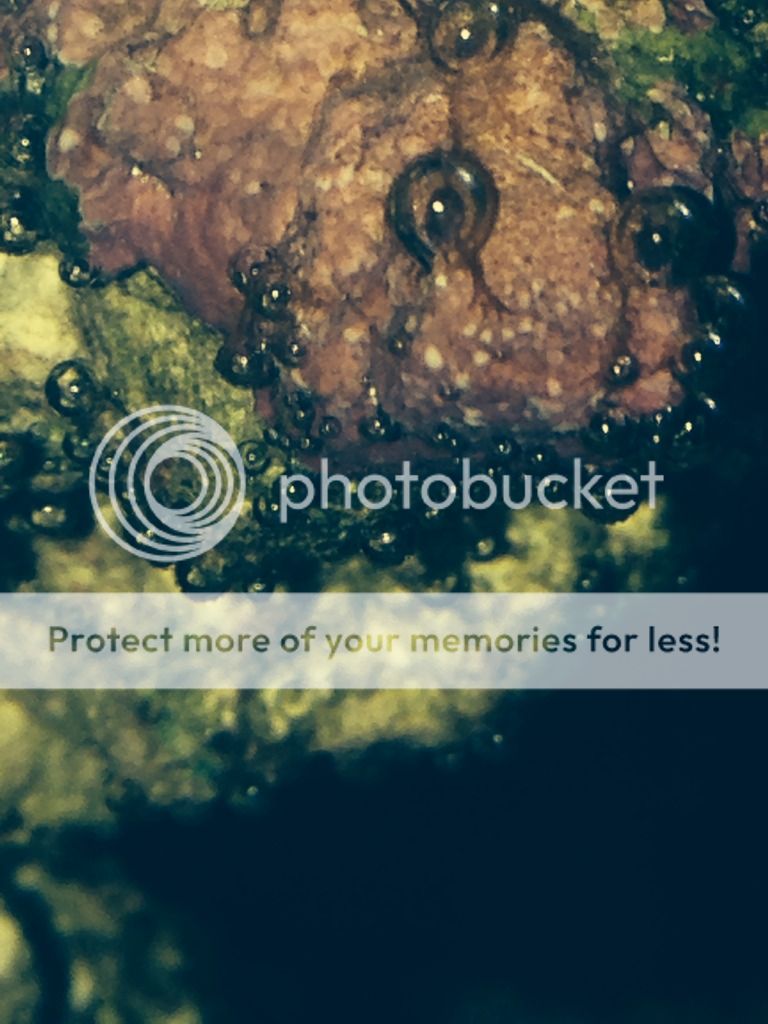
I think you misunderstood what I wrote. I am saying that you have to increase nutrients to defeat ostreopsis, just what you found in the neglected aquarium. The ostreopsis and gambierdiscus thrive in a low nutrient environment. I was dosing nitrates, silicates, iron, iodine, aminos, etc and not using any type of filtration in order to get algae, diatoms, cyano or something to grow to outcompete the dinos. That's why I took my skimmer out.
 
Nop....
I have dipped acros in fresh water many times; if you respect temp and pH they will stand a short 15" dip with no issues, time enough to get rid of any kind of dinoflagellate.

I wouldn't blow them with a turkey baster unless I ran an UV sterilizer. They would spread all around, just what they need to win the battle. Much better siphoning them out of the tank.

It worked for me
 
I suspect that dinoflagellates can spread whether you use a turkey baster or not. I'm skeptical about that making a noticeable difference to the spreading, especially over the long haul.
 
Here is what I've been dealing with:

The bubbles seem to form during the evening hours.
photo-15.jpg


I know this is a bad pic. The dino/cyano/algae/??? is stringy with bubbles attached. The bubbles are at the end of the strings.

photo-14.jpg


I had a lot of it hanging down from my frag rack. One member said it looked like dino, so I have been preparing for the worst. I replaced the frag rack. I just through out the old one instead of cleaning it. I then blew off the sps coral with a turkey baster. I didn't think about suctioning it. I also scrubbed some of the rocks with a toothbrush. This may have made things worse, since it probably spread it. I have the all the power heads on and will change out the filter media every day. I also started dosing 1ml of peroxide and blacked out the tank.
 
I read this through - and darned if I can't find the post again - but there was a post that could have been written by me that basically said that coraline algae is nearly non-existant in my tank, I have either cyano or dino (I'm still figuring all this out) and I've never tested positive for nitrate nor phosphate and alk usage seems rather high. My snails are PO'd and not moving for a week now.

I'm running a bit of GAC and GFO in hopes of knocking down the green hair algae (which I might have mistaken for dinos). Now I have growing (slightly) red stringy snot with bubbles and I know it could be mix of dino and cyano.

This is still a relatively new tank (running for a month or so) so I'm not sure if I knocking down the PO too much too fast to allow all the beneficial bacteria to bloom.

What's really curious: keeping alk at 8 dkh is challenging. Was on my other tank as well. If I dose enough saturated kalk in my ATO to keep alk where it needs to be, CA wanders higher (it's now past 520). I'm running @.5 dkh/day with like 4 fish, a frag of SPS birdsnest and frogspawn in a 60 gal total volume system.

And I ran through .5 dkh/day alk prior to the little corals added to the tank as well.

Would dosing a bit of carbon (vodka/vinegar) help out in my particular situation? I'm still piecing all the complex bioprocesses together. Seems my alk usage is really high given what's in the tank. Which makes me suspect something is amiss process/balance wise.

I'm unsure whether to just it go and cycle and hope for the best or nip all this in the bud somehow.

The red stuff is noticeably present on the rocks I moved over from my previous system and slowly growing. I'd take them out but for the tube worms on them.
 
If your Alk usage is high without corals or coralline, then it's precipitating out as calcium sand or forming on rock or other structures.
For me, my artificial rocks were sucking part of it. Part was going to sand and part was destroying my pumps and plumbing.

You need to raise Mg and watch your pH, Alk and Ca (they go together or it's meaningless).

As far as removing nutrients, I think that's the wrong way to go if you have dinos but the right way if you have algae.

Before taking action, take a picture of the macro and micro form and identify what you have.
 
0.5 dKH per day isn't very much. My soft coral tanks ran through 2-3 dKH per day due to coralline growth. Depending on how quickly the corals and the coralline is growing (even though there's very little), 0.5 dKH per day might be reasonable. I'd check inside pumps and check the heater for buildup. If you post your parameters, we might be able to help more.
 
Thanks guys. Ill post in another thread. Mg hasn't been a problem which is why it's puzzling me. But if .5 isn't much ill be satisfied.

Full parm battery in the AM.
 
I installed a 55 watt UV sterilizer in my 600 gal system two days ago and I am still dosing H2O2. Redox has reached 650 mV peak and now it is stable at 480 mV, skimmer working like crazy.

On the microscope I still spot some ostreopsis cells but not many. I see some stringy snots but they are whitish which means they are not loaded with ostreopsis. I stir the water strongly every evening when lights off to encourage ostreopsis planctonic stage and be processed by the sterilizer.

It seems to be working...
 
Once you get that 55 watt UV sterilizer, you really don't have to continue H2O2 dosing. The UV sterilizer starts working almost immediately and within a few days you really won't see much strings left if at all. What I did when I got mine was I did a 3 day blackout, installed the sterilizer before turning the lights on, and when I turned the lights back on I really didn't see any strings at all. 2 months later and I still don't see any. I see a lot of other algae's growing as well - some red cyano, some gha, and a thin layer of some kind of clearish algae that is producing bubbles on my rocks < - I'm not sure what kind of algae this is but it doesn't disintegrate when I turkey baste it, it has a foothold on the rocks and is hard to get off even with a toothbrush but at least I'm fairly certain it isn't dino as it also doesn't go away at night. I did have a diatom bloom on the sand that went away in about 2 weeks but all this tells me the other algaes were able to grow and are now competing for my nutrients.

EDIT: I should also probably add that H2O2 never really did anything for me and that I have the flow through the UV at very low - ~300gph on a very small 34 gallon tank. YMMV but it's working for me when nothing else did. Keyword there is "working". I don't have access to a microscope so I can't say for certain.
 
Last edited:
I am still dosing H2O2 as it seems to help and does not harm corals or fish, I am also trying to keep pH high by dosing kalk (skimmer's air inlet is connected to the outside so it never goes under 8,2). Flow through the 55W uv sterilizer is about 400 gpd.

NO3 and PO4 are close to 0,00 ppm

Everything is cleaning up but I still get some biofilm (not dinos) everywhere. I can still see some ostreopsis string, whitening up and slowly vanishing which is a good sign. I think that I am on the right way, it may take some time to fully get rid of these scoundrel critters, but tendency is what matters.
 
My tank has been at pH 8.4-8.5 for at least half a year.
High pH alone does not make a dent in Ostreopsis population, but it may change it's behavior.

I'd like more of you to try to add fresh live rock.
It did wonders for Montireef and led to big but temporary changes in my tank last year.
Also in the past when my corals were doing really poorly and I didn't know why, fresh live rock was an instant improvement for at least 3 months.
 
I did a two day blackout combined with a four treartment one week on algae x x fuana marin followed the insctutions on there web site and the tank has been clean on dinos for months
 
My tank has been at pH 8.4-8.5 for at least half a year.
High pH alone does not make a dent in Ostreopsis population, but it may change it's behavior.

I'd like more of you to try to add fresh live rock.
It did wonders for Montireef and led to big but temporary changes in my tank last year.
Also in the past when my corals were doing really poorly and I didn't know why, fresh live rock was an instant improvement for at least 3 months.

Give me a few more weeks and I'll be able to comment on this. It's only been roughly one week since I implemented things a bit further.

I took everything a few steps further and started over with 100% fresh aquacultured rock, skimmate added to tank. I even unplugged my skimmer. I had a brief relapse of dinos at first before doing any of the above steps on the newly setup tank, but it was incredibly light and nothing like before. Only time will tell if taking this approach works.
 
Tank suffered an ostreopsis outbreak yesterday despite of the 55W UV sterilizer. I have to vacuum twice a day just to deal with it. Now I am not so sure about the UV sterilizer effectiveness and H2O2 either.

I think I'm going to try a different route: foster copepods to thrive and hopefully they will eat it all. I have switched the skimmer off, no phosguard, no GAC and lots of food and phytoplancton (nannochloropsis, isochrysis and tetraselmis)
 
Back
Top