Dinoflagellates.

Apologies. I posted this in the dino experiment forum today but thought more may see it here.

I had my new DIY 178 gal up and running for less than a year when dinos took over and wiped out my SPS colonies I'd had for 3-4 years. I do not have a positive ID (90% sure they're Ostreopsis) on the species but did bring a microscope home from work to confirm I have dinos.

There were some maintenance issues I wanted to deal with anyway, so I decided to do a complete tank tear down.

All fish and inverts went to QT and are currently there awaiting the restart. Inverts were dipped in fresh water and hydrogen peroxide prior to entering QT.

One of my QTs was getting enough light to allow the dinos to bloom. I had it placed near my grow light for this year's garden. That QT was shut down and all inverts and fish are now in a 40 gallon breeder that only receives ambient light.

Questions: I'm worried about introducing them again during restart. I plan on running fresh water through the system before adding salt.

I have some nice inverts but wonder how to add them with confidence.

Any suggestions on both fish and invert additions?

Sorry for the long post and thanks for the help,

Adam
 
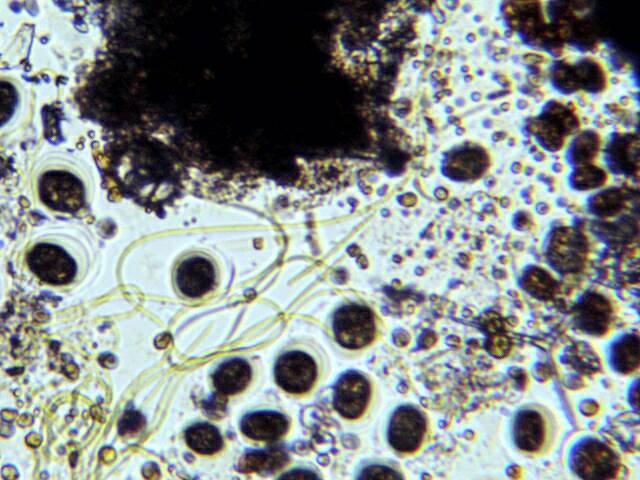
Here is what I got. Re-post from other thread. Since I have taken the pictures below I have played with microscope further and with different light settings I can see a little tail on them (flagella) and some waving going on around the perimeter.

At night it goes away for the most part (likely due to the water movement), but during the day it multiplies and covers most surfaces like rocks and sand pretty quickly. Appearance is of a mat covering surfaces, with few strings coming up with air bubbles in them here and there, but high flow likely doesn't let those get too big. With flow pointed directly at the thing even with a turkey baster I can remove it fairly easily, but normal water movements is not enough.
Finally, I do not see it bothering corals in any way nor any other inhabitants other than snails. They do seem to be a bit slow, possibly due to lack of food since most surfaces are covered with either this stuff of coraline and they do not eat this brown stuff.

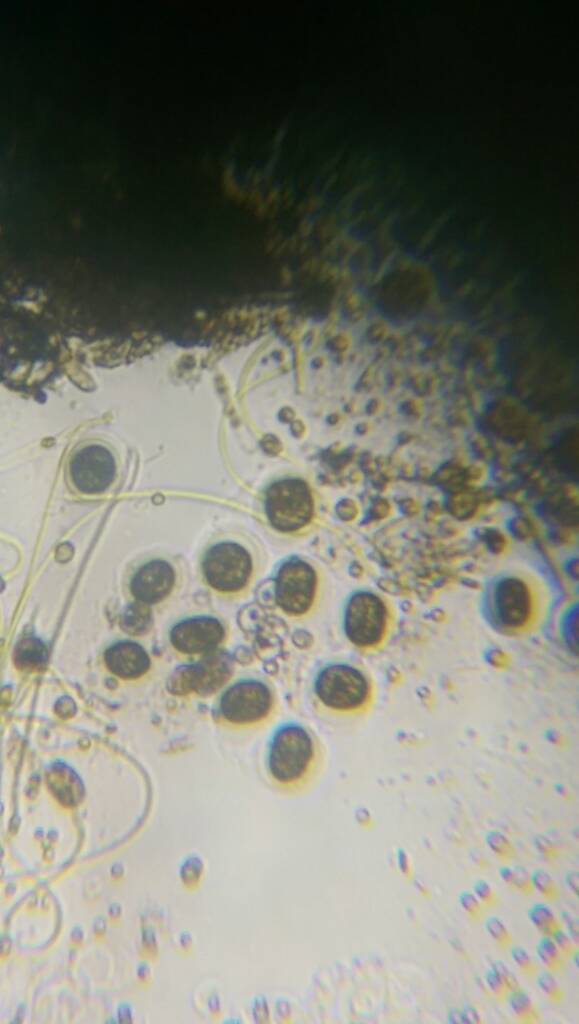
Here are some pictures from the tank and from microscope (click to see bigger versions). I did go down to 100x on microscope, but that seem to have crushed most of these cells and what came out looks like bunch of smaller cells. In fruit terms it's like a transparent pomegranate. Don't have a picture of squashed ones, but it seems like they left the cell shaped box behind, i.e. looks like something diatoms build out of silica around the main cell body. So based on that for now I presume this is some sort of diatom.


Adamwheel your are certain to reintroduce the dinos with your current livestock.
If you are lucky they might not thrive in the new one, but there seems to be a trend in getting dinos again after restart.

---

Raidendex. I'd say you definately have dinos, not diatoms. (Dinos have a hard outer shell).
I'm sure it's not Ostreopsis. Perhaps it's Prorocentrum or something else.
Do take a look at pants site. http://www.algaeid.com/identification/
 
Yep, I looked at that website. While mine do look similar they seem to be a little different. Here are some videos I just took. Last one has a little better detail where you should be able to make out flagellum.

Sorry for being a bit shaky I was just using DSLR on a tripod looking into one of the holes at the top of the microscope with 100mm macro lens. But it seem to come out well. I'm glad I did not buy microscope with some crappy 1mp camera for extra $100-200.

Not sure the exact magnification that these came out at since I did not use the eye pieces, so the video names just go by the objective used.

These are still being processed atm, so check back in a bit if nothing shows up for some of them.


Yep, I looked at that website. While mine do look similar they seem to be a little different.

Very nice shots.

You are right these are a bit different. These are Gambierdiscus. They are related to Ostreopsis. They cause ciguatera shellfish poisoning so you'll find a good amount of info o them if you google that name.

They don't ship terribly well so I haven't gotten a good sample. (maybe that means they will be easier to kill) I've also only seen them in tanks from Europeans.

Like Ostreopsis, they encyst, so beware them coming back if you do get rid of them.

I'd appreciate a sample if you wanted to mail one up here.
 
What strange is that I shared water/rock/sand with another system as recently as two weeks ago and in that tank they did not grow at all it seems, only a bit on the chaeto. They do also seem to go away with time and running carbon helps to keep snails alive.
 
Btw what made it come back was me adding about 400-500ml of H2O2 which was way too much as I found out :) even corals changed colors, although none died due to it.
What I had for a while since dinos disappeared for the most part was a turf looking dark algae all over the rock. It did not really hurt anything, just made the rock look not super pretty and if you were to run a toothbrush on it clumps of "dust" would come up. Because of this I tried to dose some NoPox for few weeks, but didn't really see much change and the "new" smell from the skimmer was not working for me. So I stopped the NoPox. This after about a week or so cause few patches of cyano here and there. Being somewhat bored I decided to H2O2 the cyano, thus the large dose.

This did remove the cyano, but what came back was a blanket of dinos. So basically as of right now it looks like the turn algae is somewhat suffocated by dinos and nothing is really competing with them. Chaeto is growing in the sump, but not too fast. So I would say that eventually some other algae will step in and reduce the dino population again, however it seems like they will likely to remain there and wait for a new opportunity later on.

It is strange to me that my second tank never got this, even though I made no attempt to shield the systems. For water changes I would drain water from the 180 with dinos and put it in the other system, yet it never would grow anything. The only difference I see between them is that there seem to be a small clump of some unknown redish algae growing in the sump, but I doubt that it alone is responsible for keeping dinos at bay.
 
These are good videos raidendex.

I think Pants should ask for permission to use them on his site.
 
A survey on dinoflagellates in reef tanks.

I wanted to do it years ago, but since we have not yet got to the essence of dinoflagellates I think it's the best step in moving forward with this mistery.
The aim is for us to easily be able to compare our tanks and parameters in order to pick out what we have in common and hopefully what it is that makes dinos tick.

It will be very extensive and next to everything about your tank will be included.
Finishing it should take less than 10 minutes.

Send me a private message here on RC.
Once I have 5 willing to take part it's on.
Everyone with a dinoflagellate problem can take part.

It will be categorized into the types of dinos you have.
Reefers with unidentified dinos can also participate. (Identification is very important, so do it first if you possibly can).

A spreadsheet format is what I have in mind.
I'd send it to you via email and once you have filled it in and sent it back you'll receive everyone else's contribution.

Updates will be emailed to everyone when new info gets added.

-----

This is a repost.
 
I can try to ship it a little later, busy with end of the semester stuff atm. Or if shipping is a concern maybe I could do whatever you were going to do at my own university. If you know anyone at UCF biology dept. I could bring a sample to them or I can go make friends myself lol.
If you want to use those videos, go ahead. I'm not into the whole copyright thing and feel and information should be free :)

copyme2_blck_bg.gif
 
A survey on dinoflagellates in reef tanks.

I wanted to do it years ago, but since we have not yet got to the essence of dinoflagellates I think it's the best step in moving forward with this mistery.
The aim is for us to easily be able to compare our tanks and parameters in order to pick out what we have in common and hopefully what it is that makes dinos tick.

It will be very extensive and next to everything about your tank will be included.
Finishing it should take less than 10 minutes.

Send me a private message here on RC.
Once I have 5 willing to take part it's on.
Everyone with a dinoflagellate problem can take part.

It will be categorized into the types of dinos you have.
Reefers with unidentified dinos can also participate. (Identification is very important, so do it first if you possibly can).

A spreadsheet format is what I have in mind.
I'd send it to you via email and once you have filled it in and sent it back you'll receive everyone else's contribution.

Updates will be emailed to everyone when new info gets added.

-----

This is a repost.

When I did this a few years ago I used google docs. You can have online survey that feeds the data into a google spreadsheet. It worked really nicely.
 
What magnification do you need for a microscope?

EDIT: Dumb question! I saw the settings used in the videos above.
 
Last edited:
Yep, 40x objective seems about as high as you would want to go. At 100x I squashed cells lol before I got in focus. 10x or 20x 25x all should be fine to the view the 40x.

Without reading the whole thread, anyone try running low micron filter sock for a while to see if that does anything?

I ordered some 1 micron socks (not sure how long they will last before clogging). Will try to blow stuff off the rocks and run water through the sock. For now I installed whatever brs sells, think those are 200. Usually I do not run any, but I guess it won't hurt to catch some of these guys and swap socks once a day.
 
Without reading the whole thread, anyone try running low micron filter sock for a while to see if that does anything?

I didn't use a 1 micron filter sock, but I did use a micron filter with diatom powder for a few hours every couple days. After blowing the dinos off the rock work, the filter would bog down very quickly. It was an effective short term solution to remove them without doing a water change, but they would always grow back quickly within a day or two.
 
I dosed ich attack for 5 days with my simmer and carbon off, it has slowed it down, now green algae is growing on the glass and cyano is starting to bloom which I think might be a good sign, I will try to put some under the microscope tonight.

Any updates on the ich attack cal?

I would really like to see more people try it as I am pretty sure it is what saved my tank
 
I've left the skimmer, uv and carbon off since dosing the ich attack, I run a sulphur denitrator and dose lanthanum chloride so no3 and po4 are under control, I have nothing but green micro algae growing on the glass with 0 diatoms and dinos, for almost a year the glass has been brown. I still have some small patches of diatoms and dinos on the substrate but the cyano that is growing seems to be choking it out, I still find dinos in my 10uM socks but the rocks and corals look great. I'm going to stay the course of letting it go and see what happens, it seems to be working. I am doing regular water changes again as well.
 
I've left the skimmer, uv and carbon off since dosing the ich attack, I run a sulphur denitrator and dose lanthanum chloride so no3 and po4 are under control, I have nothing but green micro algae growing on the glass with 0 diatoms and dinos, for almost a year the glass has been brown. I still have some small patches of diatoms and dinos on the substrate but the cyano that is growing seems to be choking it out, I still find dinos in my 10uM socks but the rocks and corals look great. I'm going to stay the course of letting it go and see what happens, it seems to be working. I am doing regular water changes again as well.

sounds exactly like mine cyano took hold after but cyano is a godsend compared to dinos
 
One of the tanks I maintain..39 gal. Had a bad outbreak of what I thought was green and slime algae 6 months ago. I approached the problem from the point of view of limiting phosphates and nitrates. None of the typical methods worked.
Even though I have never had diatoms in any of the tanks I maintain over the last 10 years I decided to address the problem from the possibility I did.
I attached a uv sterilizer .. Way over what was necessary for this volume( I took it off my 250 gal system)
I hooked up a Rena canister filter.. Again good for a 200 gal system
I continued to run a HOT Magnum canister wit a 10 micron polishing filter
I also contined to run the hob protein skimmer
No water changes for 3 weeks

Diatom algae is completely gone now leaving the green algae on the rock which can easily be harvested by hand

The delima now is what filtration system to use so the problem doesn't reacur
 
Turned off my sump lighting. Seems like that just gives dinos constant place to grow. Now there is a lot of time they have to go without light.

Waiting for 1 micron socks to arrive and will add them to the system, will clean the sump at the same time and install GFO reactor there, probably will replace carbon in the other reactor at the same time.

Once new socks are in will keep same lighting schedule of DT only. Will blow off dinos at the end of each day of the rocks/walls/sand and change the filter sock hour or so later.

Will see what effect this will have and hopefully 1 micron socks will not clog hour later :) Also have some 25 and 50 micron ones on the way, will probably switch to one of them once I see a change in dino population.
 
Back
Top