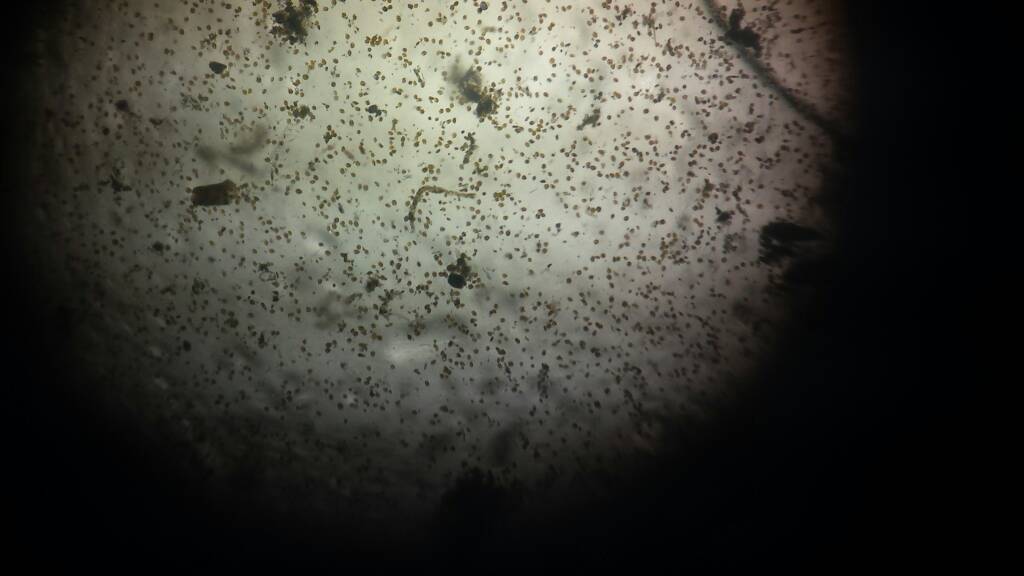
Dinoflagellates.

Detritus collects in my overflow box.
Today I took a sample from the bottom of it and at least 95% are these particles.
Of the rest I assume 4% to be the same particles broken up and 1% unknown.

A quick conclusion could be that 99% of the drifting ditritus in my tank is dino related.

---

Now turn on your brains and think for a while. I see this as another milestone.

.

Hi DNA. Did you consider trying Automatic Roller Mat filtration as opposed to filter socks to permanently remove the particles from the tank or is it simply not enough and dyno's will go right through it?
 
34cygni - yes. I've maintained my cryptic zone. It's so cryptic that a couple of fish have gotten in there and I have no way to get them out without tearing it apart.

They've lived there for 6 months now. Eating whatever pods they find, I assume.

The sponge-coral mucus loop is interesting. I have two Jebao propeller pumps that are on near continuous fast pulse mode, except at night... They continue to jam because of sponges that grow inside the pump against the intake slots. As they swell, they eventually grip the impeller. I have to scrape them out and dump them into the cryptic zone. Those tend be dark sponges - no idea where they came from.

I also have bright yellow sponges that grow on my concrete man made rock. They pop up all over the place. Those may be tunicates though. I have no idea what else is living in my cryptic zone since it's very hard to see in there. It's deep and dark. The acrylic front gets covered up with tiny featherdusters and coralline (that won't grow in my DT). I think the acrylic acts like an optic fiber carrying just a little light down its depth. That small amount of light is what the coralline uses to grow against the plastic in the dark. That makes the cryptic zone even darker, of course.

When I rip it up, I'll have to document my findings.

My corals do produce a tremendous amount of mucus. It's not bad. They expand their polyps and I think they sometimes use it to trap food since the polyps are out while the mucus is blowing. I thought it had to do with my massive surge that creates an intense flowrate against the polyps. I should take a video of that too. It's a little 'violent' but they grow fast in it.

so I have cryptic zone, surge, lots of food, lots of coral, lots of mucus and sponges that pop up wherever there is flow. My biggest pests are featherdusters though. They encroach on all my corals and rocks.
 
I have not read though this entire thread but i have been following for half a year or so, forgive me if this has already been mentioned.
Its been kicked around in the local reef club of trying some technology used over seas using nano micro bubbles to produce a skimming effect in the tank.These nano micro bubbles is thought to be so small that they can get multipe bubbles under contaminants and lift them for skimming which would include Dinos. Micro bubbles would be too big or this to work it would have to be nano bubbles. So bubble size is very important.
This is mainly being used in some aquariums as a trial method to help corals grow by giving them a "cleaning" with these nano bubbles every night while the lights are off. I've read this might remove Dinos and Cyano as well. I came across this link http://www.nabas.us/ that explains how it works in detail and even shows its effects on red tides.
Its been suggested that using a nano bubbler (wooden air stone)in the return section of the tank will get best results since bubbles will be further chopped by the return pump.

Someone mentioned on here a while back (I belive it was DNA but cant remember or find the post)they thought Dinos would not have a chance if they made it inside any decent skimmer well this would turn your whole tank into a skimmer for a few hours a night.
In the link is shows how nano bubbles do not pop but rather disapate so it wont increase salt creep if the bubbles are indeed small enough.
As soon as i can get my hands on a wooden air stone im trying this out.
In my case i would have to do it during peak daylight since my Amphidinium Dinos are only out on the sand during light and retreat into the sand at night.
As mentioned before some people are trying this already for other reasons but it's been suggested to work on Dinos.

Could it really be this simple?
Ideas on low cost nano bubble generators?
Thoughts?
 
Last edited:
I see a lot of theory, but no data.

My skimmer creates a thick cloud of very fine bubbles using very high pressure through a penductor (two of those). The bubbles are not individually visible. The water just turns solid white. As they mix with the reverse flowing dirty water, the bubbles coalesce and eventually (12 ft up) create a thick layer of dark foam and brown liquid.

Some bubbles are so small that they don't rise. They flow with the downward water flow instead and exit the skimmer. They don't pop. They also don't seem to float well. They look more like particulates. In the complete absence of water motion, they will eventually rise.

I'm open to all plausible theories. Just need data.
 
Update on the crubber guys... deff still have dynos, but I don't see any on rock/coral, I know they are in the water. Every day when I take out the scrubber I can smell them within seconds.

I modified my Refugium light schedule to be more in sync with tank lights. I figured my UV wasn't working to it's best and lights were on in Refugium at night any I am sure some dyno's were there sticking to macro algae. So now refugium and tank light schedules overlap by 6 hours, and UV gets about 8 hours of total tank darkness.

I have a theory on how to confirm/deny if tank is almost completely dyno free and would love it if someone could confirm my theories. In my tank, Anthelia sp is very unhappy when dynos are present. This was actually my first sign they were back, one of the anthelias I have stopped opening up. Now, it's finally coming back and opening again, which makes me think I might be slowly winning the battle. Can anyone else confirm that?
 
Update on a few different things I've been looking at.
1. I tried growing dense benthic ciliate cultures in beakers 3 times. Once by published rotifer recipe grew huge uronychia ciliates that can ingest big (dino sized) particles stopped growing after 6 or 7 days then declined, once on pure yeast (a paper said with euplotes they achieved 10/ml to 5000/ml in 6 days on just yeast) mine never got really rolling - hard to estimate right amount of food, one attempt on yeast enriched with skimmate, vitamins etc, never got very far. I guess first one was best. uronychia culture got a liter at about 100-200 per ml. I'll try again later, maybe sooner if I run across any good info for culturing large ciliates on particles instead of bacteria. Some kinds grow well on bacteria and different kinds on larger particles.

2. Have been growing dinos in beakers of sand and tank water with added trace elements. worked well. Got one healthy gallon culture of amphidinium from my tank, got one developing of ostreopsis from robertifly (yay). Should be able to do some experiments on them.

3. Robertifly also sent me some of the Sea Veggies dried seaweed to check for dino connection. Couple people have reported dino blooms coinciding with feeding the stuff. The veggies themselves are clean as expected. No dino cysts. Now to see if I can figure which nutrients in it are fueling growth.
The two species of seaweed are porphyra yezoensis and palmaria palmata.

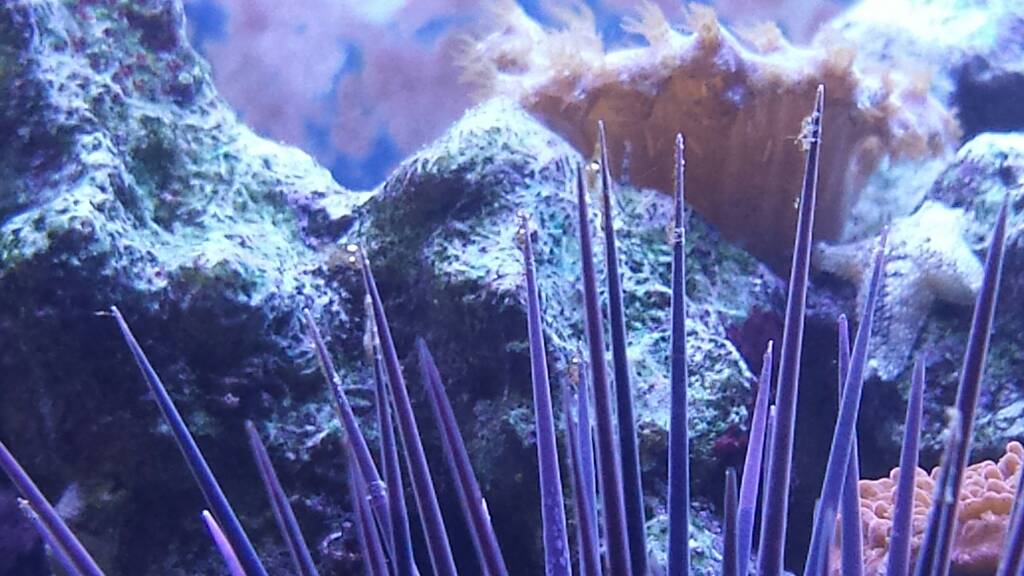
4. The thin brown dino strings I saw growing from roots of caulerpa, saw the same growing from tips of urchin spines.
a1d2552e9e27cdc420f270a0e90e9c5e.jpg

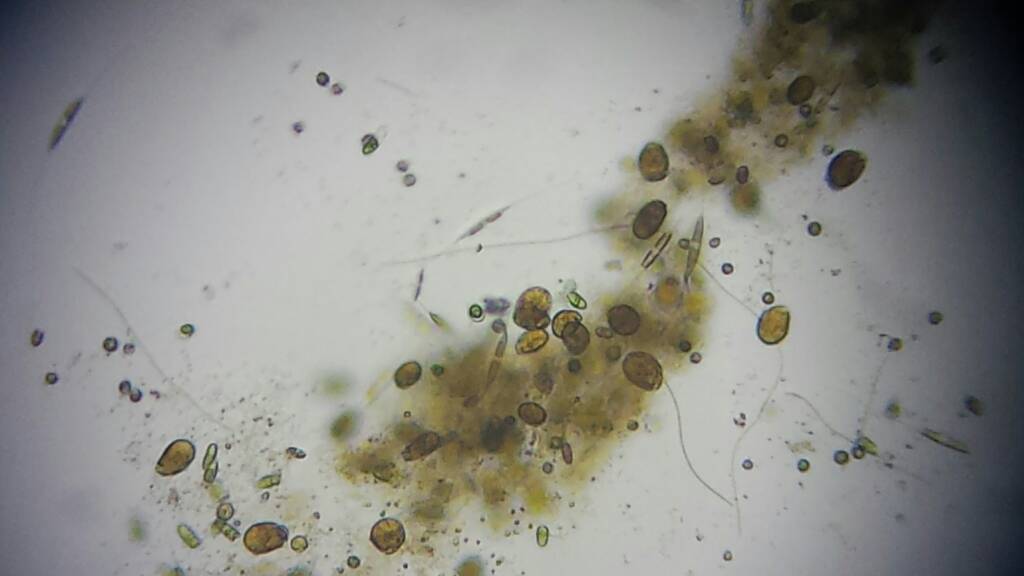
Under the scope, dinos (ostreopsis)!
9753121b88233c5221803e2409b841ce.jpg


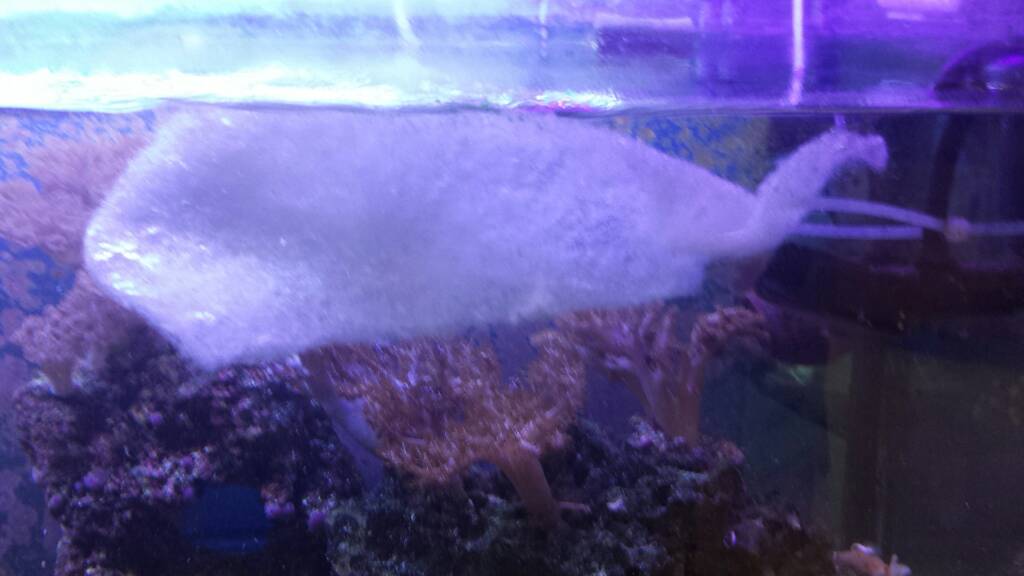
Which makes me think that they really just grab on to whatever isn't mucous protected (no sign on my softies) that sits in high flow, just like the netting used earlier by nvladik. So I put a strip of filter floss in front of pump yesterday
da7f4219875ce9d0126aeeb90fb97b68.jpg

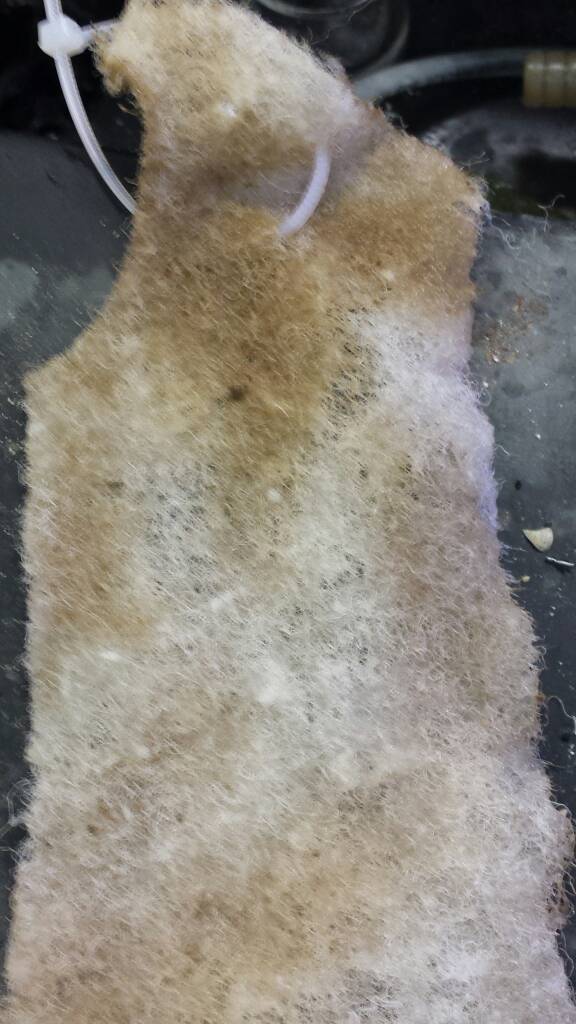
Today, quite brown!
24ef3574aad1ddceb413ab5ee47d445a.jpg

Wrung brown out into a dish
Big ol' Osti party.
038489a6cce11ce440f0df5088fd5b9f.jpg


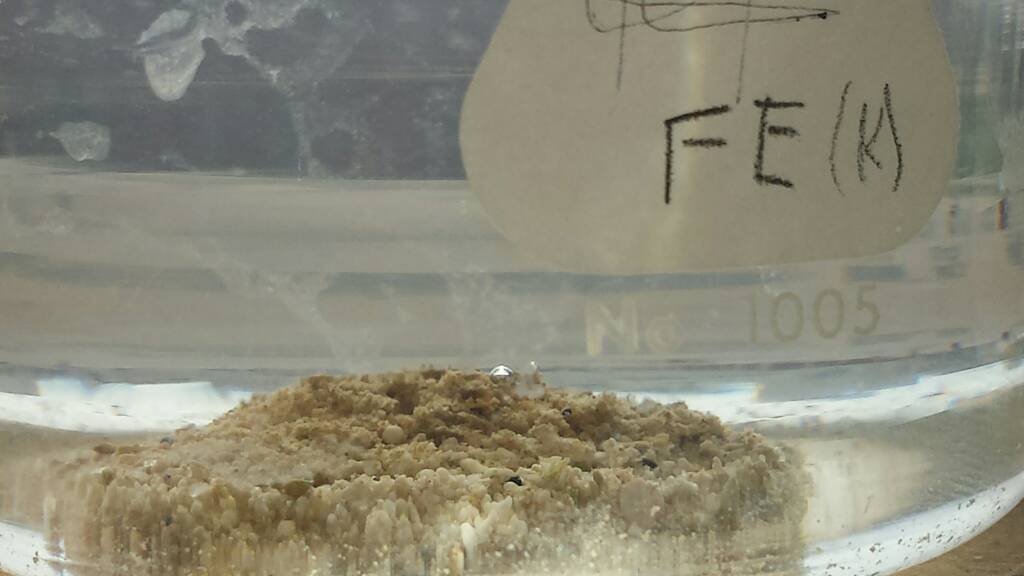
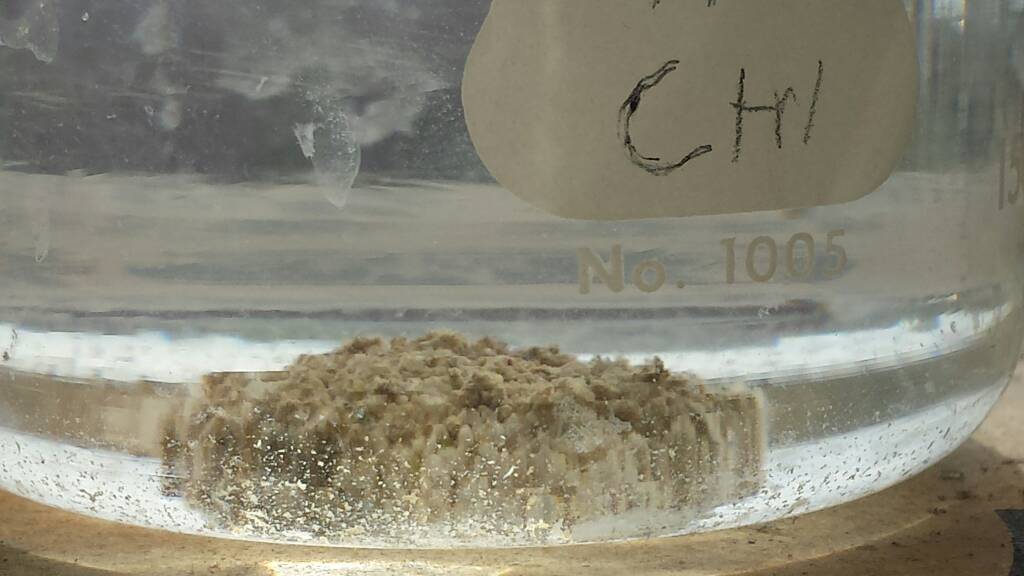
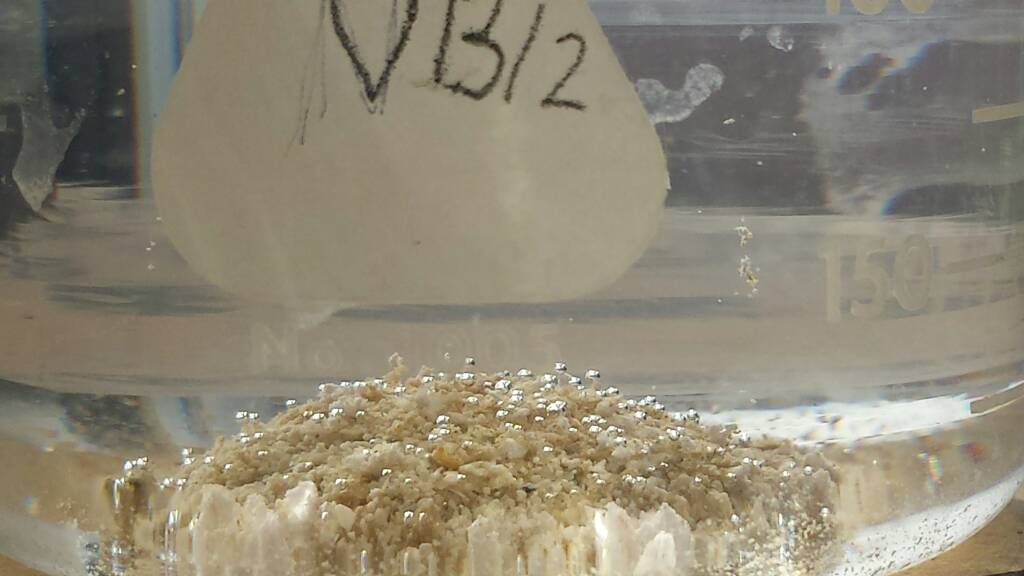
5. I also pulled the few dinos out of my tank and split into beakers. Mix of small amounts of both amphidinium and ostreopsis The population in my tank is small but stable at the time I pulled it out. One beaker got nothing added, one got iron, one b12. Hoping for dramatic growth in one of the treatments indicating a limitation.
 
Last edited:
Those and similar, but more elaborate experiments should be funded.
In fact the whole dino problem should have been researched to hell and back years ago.

I'm very interested in what the iron will do.
 
Guys I am thinking of joining the experiment party. Any recommendations on a microscope that won't break the bank?

One like this http://www.amscope.com/student-microscopes/low-power-student-microscopes/binocular-dissecting-microscope-20x-40x.html
...is super helpful when looking for something through large amounts of material like several ml of water/substrate. Binocular makes it very 3d. Brain can get much more info out of perspective images with both eyes. I've also ripped it off the base and put it up to the tank glass to watch benthic fauna behavior in the tank as opposed to on a slide.
For most everything else, IDing, cell counts, pictures/video (through phone) something very much like this is my go to. If I only had access to one, this would be it. http://www.amscope.com/student-microscopes/high-power-student-microscopes/40x-1000x-advanced-home-school-compound-microscope.html
 
Unknown dino.

Unknown dino.

Hi all, been following this thread for quite a long time but have not seen anyone with this particular species of dinoflagellates except for a user on Reef 2 Reef by the name of DeeBee. This particular strain does not exhibit motility. Here are the pictures taken under 40x. They very much look like zooxanthellae. Any help would be appreciated.
image_3.jpeg

image.jpeg
a>
 
5. I also pulled the few dinos out of my tank and split into beakers. Mix of small amounts of both amphidinium and ostreopsis The population in my tank is small but stable at the time I pulled it out. One beaker got nothing added, one got iron, one b12. Hoping for dramatic growth in one of the treatments indicating a limitation.

Some results. Interesting, perplexing, and not a slam dunk.
100ml in each beaker, the iron treatment was 2 drops of a solution containing 0.10% Fe edta (and 3% K - but my tank already gets dosed a ton of K so it's definitely not limiting). About 100mcg Fe (3mg K).
The B12 dose was 1/10 by mass of a ground up 1000mcg B12 pill. About 100mcg B12. Placed in bright window.
Remember all these are taken out of my tank which I'm keeping at high N and P (20 and 0.50ppm respectively) so micronutrient effects can be seen.

So after 1 day, there were a ton of bubbles in the B12 treatment indicating increased photosynthesis. No other obvious differences to naked eye. Under scope the cell counts were different but not enough to be sure of anything. After 2 days same story about bubbling. this is what they looked like
Iron
61f9f88262c12033027aa199d4c108ca.jpg


Control
5b2fd79b0328b78ab8b41535d44c3ee6.jpg


B12 note bubbles
dee22a50c423ce58c0dbee8f4e69e715.jpg


I would have assumed massive dino increase in B12 and little change in others from bubbles and sample coloration. But it's a good reminder don't presume what you didn't actually observe.
Cell counts under scope. All beakers got equal mixing, sample sizes, magnification etc. Largest number of dinos in a single 40x field of view for each sample was:
  • Control: 3 dinos
  • B12: 28 dinos
  • Fe: 61 dinos

Make of that data what you will. I'll watch same beakers a couple more days to follow progress, and I started the experiment again to see if results are repeatable.
Here's my take. Control population seems to have decreased in the 48 hours in the beaker. likely division was slower than predation. Probably due to trace element limitation. Matches the small steady population in my tank. Just enough micro nutrients trickle to it to through fish food to keep it a light dusting.
B12 definitely increased photosynthetic output, and also seems to have juiced cell division somewhat.
Fe showed greatest increase in dino numbers, clear response.
If I'm hypothesizing, it seems like the B12 increased photosynthetic metabolism so to speak, but I can't help but feel like this would be short lived and cell division would soon slow unless the Fe limitation shown from the other beaker was addressed.

 
This particular strain does not exhibit motility. Here are the pictures taken under 40x. They very much look like zooxanthellae. Any help would be appreciated.

All I can add is that the description sounds a lot like...

If your resolution is really poor on your scope, try paying attention to movement instead of shape. If they are spinning around like a tether ball then it is Ostreopsis. If they are scooting along the surface its probably Amphidinium. If they are really really tiny and just sit suspended in mucous with the odd one swimming in circles then its the tiny guy who looks like symbiodinium that I don't have a name for yet.
 
One like this http://www.amscope.com/student-microscopes/low-power-student-microscopes/binocular-dissecting-microscope-20x-40x.html
...is super helpful when looking for something through large amounts of material like several ml of water/substrate. Binocular makes it very 3d. Brain can get much more info out of perspective images with both eyes. I've also ripped it off the base and put it up to the tank glass to watch benthic fauna behavior in the tank as opposed to on a slide.
For most everything else, IDing, cell counts, pictures/video (through phone) something very much like this is my go to. If I only had access to one, this would be it. http://www.amscope.com/student-microscopes/high-power-student-microscopes/40x-1000x-advanced-home-school-compound-microscope.html

Thanks for the advice. What about something like this: http://www.amscope.com/student-micr...-framework-science-microscope-usb-camera.html

I completely don't mind it going through a computer, plus bigger screen, easy to see, etc.
 
Thanks for the advice. What about something like this: http://www.amscope.com/student-micr...-framework-science-microscope-usb-camera.html

I completely don't mind it going through a computer, plus bigger screen, easy to see, etc.

The ability to illuminate from above is also very useful. Good choice. I don't mind a digital camera attachment on a scope, just as long as they aren't charging a bunch extra (it looks like they aren't) for an imaging device when smartphone cameras are at least as good and usually better.
Also quality used microscopes likely float around places like ebay in abundance - if someone wanted to save a few more bucks.

A week later and still no sign of Dinos. I did add a large UV set up.

Do you know what kind you had? You said you removed sand. I'm guessing yours were on sand only? Brown dusting on sand or snotty stringy? got pics? Success stories and methods are awesome, but more valuable the more we know about the infestation.
 
The ability to illuminate from above is also very useful. Good choice. I don't mind a digital camera attachment on a scope, just as long as they aren't charging a bunch extra (it looks like they aren't) for an imaging device when smartphone cameras are at least as good and usually better.
Also quality used microscopes likely float around places like ebay in abundance - if someone wanted to save a few more bucks.


Do you know what kind you had? You said you removed sand. I'm guessing yours were on sand only? Brown dusting on sand or snotty stringy? got pics? Success stories and methods are awesome, but more valuable the more we know about the infestation.

It was everywhere. I had some LR that was just plain Slimmy. Sorry I don't have pictures, never though of that. Don't know what kind I had.
 
The ability to illuminate from above is also very useful. Good choice. I don't mind a digital camera attachment on a scope, just as long as they aren't charging a bunch extra (it looks like they aren't) for an imaging device when smartphone cameras are at least as good and usually better.
Also quality used microscopes likely float around places like ebay in abundance - if someone wanted to save a few more bucks.

Curious, how do you take pictures with your phone? Right over the eye-piece?

Another small update on my tank. Diatoms and hair algae are back. Hope that's good news!!!
 
Back
Top