I don't think micro fauna (zooplankton) have much to do with dinos. I think the microfloura like periphyton on live rock have more to do with what is controlling the dinos in an aged system. In my opinion you need to increase biodiversity with organisms that consume N & P other than dinos.

You are using an out of date browser. It may not display this or other websites correctly.
You should upgrade or use an alternative browser.
You should upgrade or use an alternative browser.
Dinoflagellates.
- Thread starter DNA
- Start date

karimwassef
Active member
If a trace element was a dino driver, then large water changes would resolve the issue - unless there's a continuous source leaching into the water.
I'm normally a fan of fighting, but in a new system with few corals, I'd remove the corals for their own safety and health... Then restart with a normal ecosystem.
I'm normally a fan of fighting, but in a new system with few corals, I'd remove the corals for their own safety and health... Then restart with a normal ecosystem.
Thanks for the detailed instruction on how to combat the beautiful ostreopsis dino, can I just add huge # of microfauna at this point to seed the rock and sand hoping that they will out compete the available micro nutrient in the water column?
Biodiversity is the key I heard you, but is it too late to establish microfauna at given situation, without doing the drastic UV, black out and hydrogen peroxide route.
If that doesn't work might as well transfer all the sps frags that I just acquired then suck out all the saltwater, dump fresh RO/DI to kill all the dinos then start all over with fresh live rock straight from Fiji if possible.
You have too many dinos to just kill or outcompete. So much poisons/nutrients. If you killed them now, the toxins would be too high for most normal life. Reduce by over 90 or 95 percent then you can start killing them in the tank.
Reduce them by 99+% then you can start to successfully outcompete them for nutrients. But don't let it be a fair fight. The algae/microfauna should outmass the dinos by 100 or 1000 times before you see success.
The dinos have drastically changed the chemistry/biology in your tank to suit their needs. You have to make equally drastic changes to give healthy life a chance to chase out the dinos.
Although you seem to be leaning toward starting over anyway (I don't blame you) I'll finish this up for completeness.
Post Blackout Finishing Touches (week 2)
14. Bring lights up however slowly you need to keep from shocking corals.
15. Add the 2nd UV right in the display tank. So you have one that circulates in the tank, and one that acts in combo with wet skimming to be a dino gate to keep them off your algae fuge/ATS.
16. Add a few plugs of macroalgae from the fuge (or get some more from somewhere) and place them directly on the sandbed. This is in part for more direct nutrient competition, but mostly to really ramp up the microfauna in the sand bed. Chaeto is my favorite for this.
17. If you have spots of cyanobacteria/red slime - cut the pumps off for a minute or two and squirt 1/2 ml to a ml of H2O2 through a tube right onto the trouble spots. Keep your total peroxide use under 1ml/20 gal per day and you should see no widespread effects.
18. At the end of week 2, if dinos are invisible in the tank - only showing up as brown dusting on the floss filter, and the ATS is getting good growth you can pull the macroalgae out of the display tank. You could occasionally dose phyto here to keep the microfauna going, but go easy with it.
19. You can reduce UV use to one unit run only at night.
20. If all goes well declare cautious victory.
Here's exactly what I would do in your shoes:
1. Siphon out all the dinos you can: Replace water as needed with plain Instant Ocean salt mix (not reef crystals). Do it thoroughly, maybe it'll be the only time you have to do this.
2. Take a strip or two of filter floss or dense mesh netting or anything else with a lot of surface area and attach it right in the flow in front of a powerhead and under good lighting. It'll be an Osti magnet. Pull it out daily (or 2 or 3 times a day if you want) and rinse the brown dusting out under tap water, and replace the filter.
3. Get a UV (make that 2 UV's - 2nd one for later) slow flow is better. Hook up one UV so that the output of the UV dumps right at the skimmer intake. Run skimmer wet. Doesn't have to be fancy. petsmart carries a brand that should do the trick.
4. Run activated carbon, and replace every day for the first week.
5. Stop Zeo system, Coral snow, any other carbon dosing etc. Pull out GFO if any.
6. Set up an algae sump/fuge from scratch (if you have one already - nuke it with bleach/peroxide/whatever). Make certain that all water from the display that goes to the fuge goes through your slow flow UV + skimmer first before getting to the algae growing area.
7. Put up an Algae Turf Scrubber (ATS). See threads on the setups, but don't let the perfect be the enemy of the good. If you don't have the stuff to make it exactly to the recommended specifications, fine. Add flow and blast the fuge with several 100W LEDs at 2700k (warm white) for 18hr/day and then you can improve it to get it closer to recommended, but start the algae growth ASAP.
8. Get algae to throw in the fuge: Macroalgae of any kind, great, microalgae too. If you can get chaeto or caulerpa, or anything else green and fast growing, great. Buy locally, beg local reefers etc. Order if necessary. More is better.
9. Test N & P - don't let either get to undetectably low. Add the plainest least complex thing like NaNO3 or KNO3 and similar for P, or if not available - mysis frozen table shrimp etc. - as necessary to get measurable amounts of both. Avoid fancy fish foods that have all manner of vitamins and micronutrient enrichments. Personally, I'd aim for 5-10ppm NO3, .05-.10 PO4. Yes, I know that P level inhibits stony coral growth, but I guarantee you won't see any stony coral growth until dinos are gone anyway.
...all that should be done on day 1 if possible
10. Try to acquire pods that you can dump in the tank on day 4.
11. Day 4: After 3 days (post-siphon) of using the filter floss dino magnet you should have significantly fewer dinos. Do a 3 day blackout in the tank. Run the fuge lights still at 18 or 20hrs/day. If your UV/wet skimmer are not doing their job, then algae and ATS in the fuge will get covered in dinos (bad).
12. At the start of the blackout, add pods to the display tank. If there's lots of pods in the algae fuge, you can suck or scrape some out and dump in as well. don't take algae from fuge and put it in the Display. It'll just die in darkness, and if you put it back in the fuge it'll bring dinos with it. [edit: if acquiring live rock, this is the step where I'd add it]
13. Make sure you are (carefully) cleaning the skimmer every day or two. Keep it running efficiently.
...To be continued (Post Blackout finishing touches)
Post Blackout Finishing Touches (week 2)
14. Bring lights up however slowly you need to keep from shocking corals.
15. Add the 2nd UV right in the display tank. So you have one that circulates in the tank, and one that acts in combo with wet skimming to be a dino gate to keep them off your algae fuge/ATS.
16. Add a few plugs of macroalgae from the fuge (or get some more from somewhere) and place them directly on the sandbed. This is in part for more direct nutrient competition, but mostly to really ramp up the microfauna in the sand bed. Chaeto is my favorite for this.
17. If you have spots of cyanobacteria/red slime - cut the pumps off for a minute or two and squirt 1/2 ml to a ml of H2O2 through a tube right onto the trouble spots. Keep your total peroxide use under 1ml/20 gal per day and you should see no widespread effects.
18. At the end of week 2, if dinos are invisible in the tank - only showing up as brown dusting on the floss filter, and the ATS is getting good growth you can pull the macroalgae out of the display tank. You could occasionally dose phyto here to keep the microfauna going, but go easy with it.
19. You can reduce UV use to one unit run only at night.
20. If all goes well declare cautious victory.

africangrey
Active member
[/QUOTE]Runing zeovit from day 1 with the thought that ULNS would help curd the unwanted algae and beautiful garden of SPS, After getting rid of the algae infestation a month ago, with 3 dose of Coral snow but immediately followed that was something I can't id + really bad case of dino. I have completely stop the dosing of zeostart and sponge power 2 days ago as I feel that the dino were prqbably consuming that to grow even faster. I am still maintaining the zeo reactor at 100gal/hr rate, add combination of 4mL of coral snow and 4 drops of zeobak after dark.
What should I do now, take zeovit reactor (vibe) off line since the mule released may even fuel the dino more? what do you guys think, I've read that zeozym + biomat might help, if so I should administer with zeobak and coral snow, please help!!!!! Really want to get rid of this ugliness.


Haven't done anything accept waiting for zeozym and biomate to arrive from BRS this Friday, as this will be my last approach before starting over. But from last Friday I've shut off all the red LED's, shorten photo period from 8 hr/day to 5 hr, decrease the intensity to 30% from the original 65% from Radion G3, continue daily dosing of 4mL Coral Snow and 4 drops of Zeobak. And things have improved as dino has subsided a bit. Will report back with photos after the addition of zeozym and zeomate.


Last edited:
Ran across something interesting. Seen it pointed out in this thread that it seems like some chemical treatments just select for one kind of dinos - frequently ostreopsis - over others.
In this paper they look at the effect of peroxide on 12 members of the phytoplankton community including green algae, diatoms, dinos, and a cocco.
What they found was that there were a couple of major factors that determined susceptibility to hydrogen peroxide. And it proposes a mechanism for why H2O2 might not hit dinos as hard as we'd expect.
1. cell size or body volume of organism
"Exposure of these species to H2O2 at 6.4 mg/L revealed cell size dependent species sensitivity. It was found that the smaller the cell size the more sensitive it is to H2O2."
"...Likewise, Jeong et al. found log-log relationship between the mortality rate of aquatic organisms (red tide dinoflagellates, diatoms, ciliates, copepods, fin-fish, brine shrimp and shellfish) and organisms' bio-volume, when exposed to hypochlorite, another small molecule oxidizing biocide."
2. protective cell wall
"the cellular structure, particularly the presence of rigid cell wall, may contribute to a species' H2O2 resistance. For example, the silica-mucilage cell wall of the diatoms may have given Sc and Tw their H2O2 resistance (diameter 6.6 and 11.05 μm respectively, not affected by 6.4 mg/L H2O2), as compared to the athecate dinoflagellate Ac of similar cell size (diameter 9 μm, but showed >90% inhibition by 6.4 mg/L H2O2)"
"The rigid cell wall, if present, potentially provides a first layer of defense against H2O2 and HO·, and allowing them to be inactivated before reaching the more sensitive and biologically critical components of cell membrane and organelles."
3. cyanobacteria?
"Cyanobacteria has been shown to be more sensitive than most eukaryotic phytoplankton, partly because of their prokaryotic photosynthetic apparatus. "
"Cyanobacteria community could be most severely affected by H2O2 treatment, as was seen in the field work of Matthij et al. where 2 mg L−1 H2O2 eradicated cyanobacterial bloom of Planktothrix agardhii in the freshwater lake. However, cyanobacterial sensitivity to H2O2 also varied substantially among the species."
(interestingly they report the most sensitive cyanobacteria is oscillatoria - a common aquarium red slime causer that was completely inhibited at 1mg H2O2 /L)
They found that when the cell size got up to the dino prorocentrum micans (45 microns), the rate of inhibition was only 11%, but a small (9 micron) unarmoured dino was 96% inhibited at the same dose.
So if the trend holds, the huge celled armored things in our tanks - ostreopsis - would be practically unaffected by peroxide doses that inhibit tons of other things. The dose required to hurt ostreopsis directly might be impractically huge. anecdotally: on my microscope slides with a few drops of ostis, 1 drop of distilled fresh water has more instant bang (30% of cells shed theca instantly) than 1 drop of H2O2.
In fact, the cyano sensitivity coupled with the tight cyano/dino bond makes me wonder a couple things.
first, is the improvement sometimes seen in dino infested tank appearance with peroxide actually just the killing of the associated cyano? Less pigment, looks better, possibly without really hurting the dinos.
second, does H2O2 actually hurt dino's indirectly through the associated bacterial community? The paper talks a decent amount about how wildly differently bacterial groups react to H2O2 (34cygni alert). If true, this would argue for the usefulness of lower dose, longer treatment H2O2 option.
Finally, the notion that the theca (armor) + cell size might protect vs peroxide leaves open the possibility that amphidinium in our tanks could be very susceptible. Our Amphidinium is not small (20 micron ballpark), but it's smaller, and it's very flat (high surface area/volume ratio). In fact, the small unarmored dino that was 96% inhibited was amphidinium carterae. But our amphidinium is twice as big in each dimension.
In this paper they look at the effect of peroxide on 12 members of the phytoplankton community including green algae, diatoms, dinos, and a cocco.
What they found was that there were a couple of major factors that determined susceptibility to hydrogen peroxide. And it proposes a mechanism for why H2O2 might not hit dinos as hard as we'd expect.
1. cell size or body volume of organism
"Exposure of these species to H2O2 at 6.4 mg/L revealed cell size dependent species sensitivity. It was found that the smaller the cell size the more sensitive it is to H2O2."
"...Likewise, Jeong et al. found log-log relationship between the mortality rate of aquatic organisms (red tide dinoflagellates, diatoms, ciliates, copepods, fin-fish, brine shrimp and shellfish) and organisms' bio-volume, when exposed to hypochlorite, another small molecule oxidizing biocide."
2. protective cell wall
"the cellular structure, particularly the presence of rigid cell wall, may contribute to a species' H2O2 resistance. For example, the silica-mucilage cell wall of the diatoms may have given Sc and Tw their H2O2 resistance (diameter 6.6 and 11.05 μm respectively, not affected by 6.4 mg/L H2O2), as compared to the athecate dinoflagellate Ac of similar cell size (diameter 9 μm, but showed >90% inhibition by 6.4 mg/L H2O2)"
"The rigid cell wall, if present, potentially provides a first layer of defense against H2O2 and HO·, and allowing them to be inactivated before reaching the more sensitive and biologically critical components of cell membrane and organelles."
3. cyanobacteria?
"Cyanobacteria has been shown to be more sensitive than most eukaryotic phytoplankton, partly because of their prokaryotic photosynthetic apparatus. "
"Cyanobacteria community could be most severely affected by H2O2 treatment, as was seen in the field work of Matthij et al. where 2 mg L−1 H2O2 eradicated cyanobacterial bloom of Planktothrix agardhii in the freshwater lake. However, cyanobacterial sensitivity to H2O2 also varied substantially among the species."
(interestingly they report the most sensitive cyanobacteria is oscillatoria - a common aquarium red slime causer that was completely inhibited at 1mg H2O2 /L)
They found that when the cell size got up to the dino prorocentrum micans (45 microns), the rate of inhibition was only 11%, but a small (9 micron) unarmoured dino was 96% inhibited at the same dose.
So if the trend holds, the huge celled armored things in our tanks - ostreopsis - would be practically unaffected by peroxide doses that inhibit tons of other things. The dose required to hurt ostreopsis directly might be impractically huge. anecdotally: on my microscope slides with a few drops of ostis, 1 drop of distilled fresh water has more instant bang (30% of cells shed theca instantly) than 1 drop of H2O2.
In fact, the cyano sensitivity coupled with the tight cyano/dino bond makes me wonder a couple things.
first, is the improvement sometimes seen in dino infested tank appearance with peroxide actually just the killing of the associated cyano? Less pigment, looks better, possibly without really hurting the dinos.
second, does H2O2 actually hurt dino's indirectly through the associated bacterial community? The paper talks a decent amount about how wildly differently bacterial groups react to H2O2 (34cygni alert). If true, this would argue for the usefulness of lower dose, longer treatment H2O2 option.
Finally, the notion that the theca (armor) + cell size might protect vs peroxide leaves open the possibility that amphidinium in our tanks could be very susceptible. Our Amphidinium is not small (20 micron ballpark), but it's smaller, and it's very flat (high surface area/volume ratio). In fact, the small unarmored dino that was 96% inhibited was amphidinium carterae. But our amphidinium is twice as big in each dimension.
karimwassef
Active member
Anything on susceptibility to UV?
karimwassef
Active member
So - question on chemistry...
Why do cyano and dinos create bubbles while GHA or chaeto just exhale with dissolved gases?
Maybe it's really simple... I just don't know the answer (my 9yr old asked and I couldn't give a straight answer - she can tell when I don't really know so I need my credibility back).
Why do cyano and dinos create bubbles while GHA or chaeto just exhale with dissolved gases?
Maybe it's really simple... I just don't know the answer (my 9yr old asked and I couldn't give a straight answer - she can tell when I don't really know so I need my credibility back).

DNA
New member
So - question on chemistry...
Why do cyano and dinos create bubbles while GHA or chaeto just exhale with dissolved gases?
Maybe it's really simple... I just don't know the answer (my 9yr old asked and I couldn't give a straight answer - she can tell when I don't really know so I need my credibility back).
This is my take on this:
If dinos want to bounce between the bottom and surface twice a day they must make sure they can control their buoyancy.
A bubble is a fast trip to the surface and that can be a very long one for such a small animal.
karimwassef
Active member
So it's mobility? Really? Why would cyano have it?
Cyano do a daily trip too. Orienting for better light. That's part of why it looks less bad at lights on than it does later. So maybe that sits have something to do with it.So it's mobility? Really? Why would cyano have it?
I just thought it was structural, dino mucilage and cyano fibers tangled into a sheet both capture bubbles whereas algae fibers (usually parallel) don't.
mathman7728
New member
i have had dino problem but thanks to this thread i think the solution is 1)dirty method, turn off the skimmer, maybe UV at night initially but not needed long term, add phyto on a regular basis for several weeks, add more bio diversity. my dinos are nearly gone (4 months) and everything looks much better. i think the problems started because i was skimming too much and the water was too clean. i don't think we need chemicals to fix this problem...bio diversity and patience....
i have had dino problem but thanks to this thread i think the solution is 1)dirty method, turn off the skimmer, maybe UV at night initially but not needed long term, add phyto on a regular basis for several weeks, add more bio diversity. my dinos are nearly gone (4 months) and everything looks much better. i think the problems started because i was skimming too much and the water was too clean. i don't think we need chemicals to fix this problem...bio diversity and patience....
I just want to second what was said in this post. I came very close to tearing down my tank because I felt I was fighting a losing battle with dino. I read everything I could and decided that I wasn't comfortable using any of the chemical methods suggested (H2O2, Dino X, etc.). Even though hydrogen peroxide had good results for some people I didn't want to risk the health of my fish. Anyway after failing previously trying everything else, I tried the dirty method and it worked. Here is exactly what I did in case anyone else is in a similar situation:
1. Do a water change and try to siphon as much dino as you can off the rocks. This will be your last water change for a while.
2. Stop skimming entirely. No skimming at all.
3. Start to dose MB7 and phyto heavily. I did 5-10mL/25gal MB7 daily to start and the phyto I did not measure.
4. Feed "heavily". Everyone will have a different amount depending on livestock, tank size, so this is just to say try to keep up with normal feeding and don't cut back. Obviously don't go crazy and overfeed, you don't want wasted food sitting in the tank uneaten ever.
5. Add a small amount of live sand (either from an established tank or purchased). I added a few cups.
6. Continue steps 2-4 for ~7 days (this is arbitrary, it just happens to be the length of time I did it).
7. Wrap your entire tank in black garbage bags or anything that will completely block out light.
8. Turn off your tank lights and leave them off for 10 days.
9. Continue steps 2-4 during this time.
10. Unwrap your tank after 10 days and reintroduce lights slowly. I did actinic only for the first few days and basically took a week to get to the normal photoperiod.
I kept heavily dosing MB7 and phyto for close to a month total before cutting back to the MB7 maintenance schedule dosing off the bottle. I didn't lose any coral or fish doing this, but I do not keep SPS. LPS were absolutely fine. Obviously this is to be done at your own risk. I can only say what I did, and what worked for me. Anecdotal evidence only of course, but I think a lack of biodiversity combined with the low nutrient systems a lot of us run that is perfect for dino. I was vodka dosing and trying to eliminate some algae before dino became a problem. The algae is back, but I'd much live with that.
I want to add that in Step 6, I would recommend either reducing your photoperiod or starting sooner (2-3 days vs ~7 days). It took me probably 5-6 days to move on to Step 7 due to work. At that point the dino was already pretty bad again. I wanted to be available in case anything went wrong so it took me a bit longer than I planned. It goes without saying, but if you are going to try anything like this I suggest monitoring your tank chemistry, temp, etc. closely. Also, always have emergency water made up for a water change in something goes wrong.
Last edited:

Kurt03
Active member
I have a 20g fish/coral qt that started to get Dino's. I'm pulling the coral out and possibly the one fish as they have done there time. Let me know if anyone wants me to try anything specific. I've been dosing mb7, phyto, feeding more. Also running skimmer and UV only at night. I am just moving to turning the skimmer off completely. They seem to be declining but I wouldn't mind experimenting a little if anyone has ideas.
Sent from my Nexus 6P using Tapatalk
Sent from my Nexus 6P using Tapatalk
Hey guys. Quick update on my tank. Alk issues continue. With every Alk dose increase, Alk reading drops.  I started out dosing 36ml daily (BRS Two part) and if you guys recall Alk was dropping below 6.5 dKh. I started to increase the dose slowly, and my Alk went down further to 6.4, so I initially thought my testkit was going bad. I cross checked with API testkit, got 11 dKh, ordered replacement RedSea reagent and waited a week for it to get delivered. Replacement kit, and my friend's Hanna confirmed readings of 6.4 and 6.1, I once again find myself thinking API tests are junk.
Last Saturday Alk hit bellow 6. I am still slowly increasing the dosage, did a small one-time increase on Monday and still slowly adding more. I started off yesterday with 6.5 dKH, dosing 60ml of 2-part daily. This morning (testing at the same time daily) it read 6.4, so slowly still going down. Increased the dose again, so as of today I am doing 72ml daily of Alk, 57ml of Calcium.
Tank mostly still looks great, lost some torches and one small SPS colony, my guess is both due to super low Alk.
I started out dosing 36ml daily (BRS Two part) and if you guys recall Alk was dropping below 6.5 dKh. I started to increase the dose slowly, and my Alk went down further to 6.4, so I initially thought my testkit was going bad. I cross checked with API testkit, got 11 dKh, ordered replacement RedSea reagent and waited a week for it to get delivered. Replacement kit, and my friend's Hanna confirmed readings of 6.4 and 6.1, I once again find myself thinking API tests are junk.Last Saturday Alk hit bellow 6. I am still slowly increasing the dosage, did a small one-time increase on Monday and still slowly adding more. I started off yesterday with 6.5 dKH, dosing 60ml of 2-part daily. This morning (testing at the same time daily) it read 6.4, so slowly still going down. Increased the dose again, so as of today I am doing 72ml daily of Alk, 57ml of Calcium.
Tank mostly still looks great, lost some torches and one small SPS colony, my guess is both due to super low Alk.
Kurt03
Active member
im having trouble locating what you mentioned regarding a bio bomb. Unless it is the lights out, import new diverse live rock/creatures, feed phyto, etc.
Also, is there any concern with moving dino infested frag plugs to a non infested display tank? Shouldn't the healthy microfauna in the display tank make short work of the dinos? I will scrub them off etc before moving to the display but there is no way to get them all. just want to make sure to not put my display unnecessarily at risk.
Also, is there any concern with moving dino infested frag plugs to a non infested display tank? Shouldn't the healthy microfauna in the display tank make short work of the dinos? I will scrub them off etc before moving to the display but there is no way to get them all. just want to make sure to not put my display unnecessarily at risk.
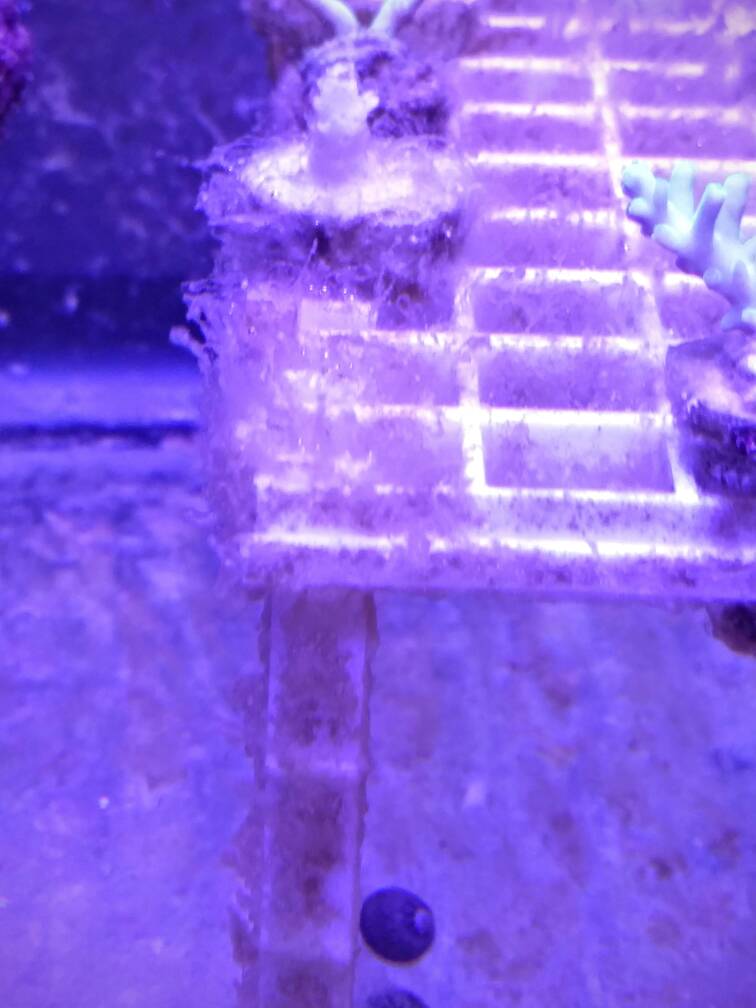
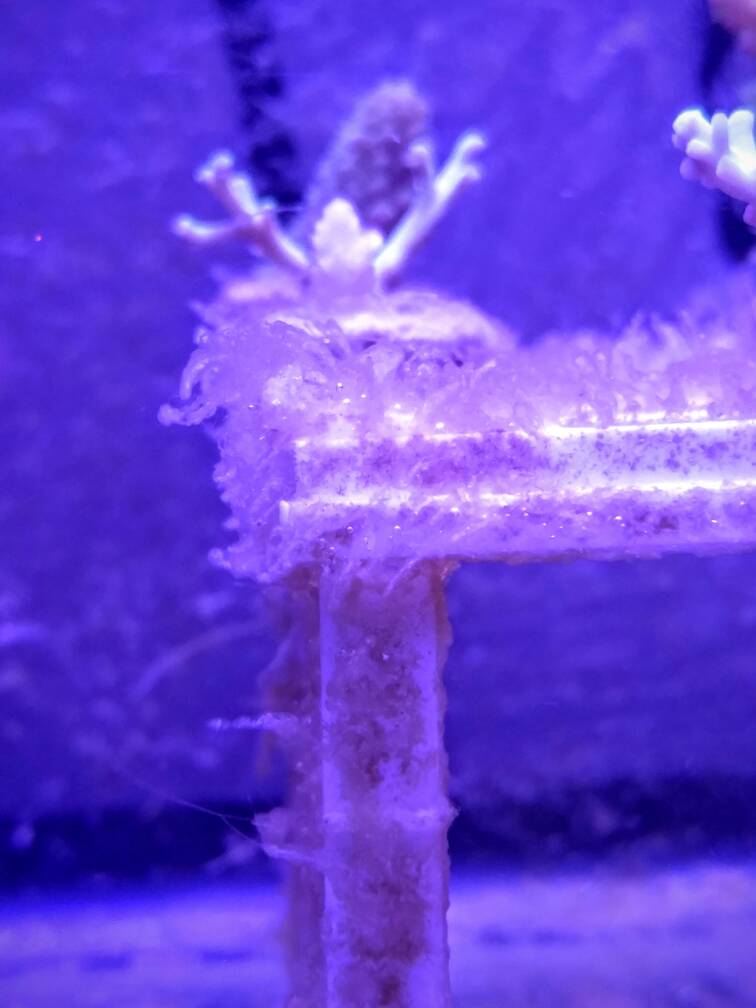
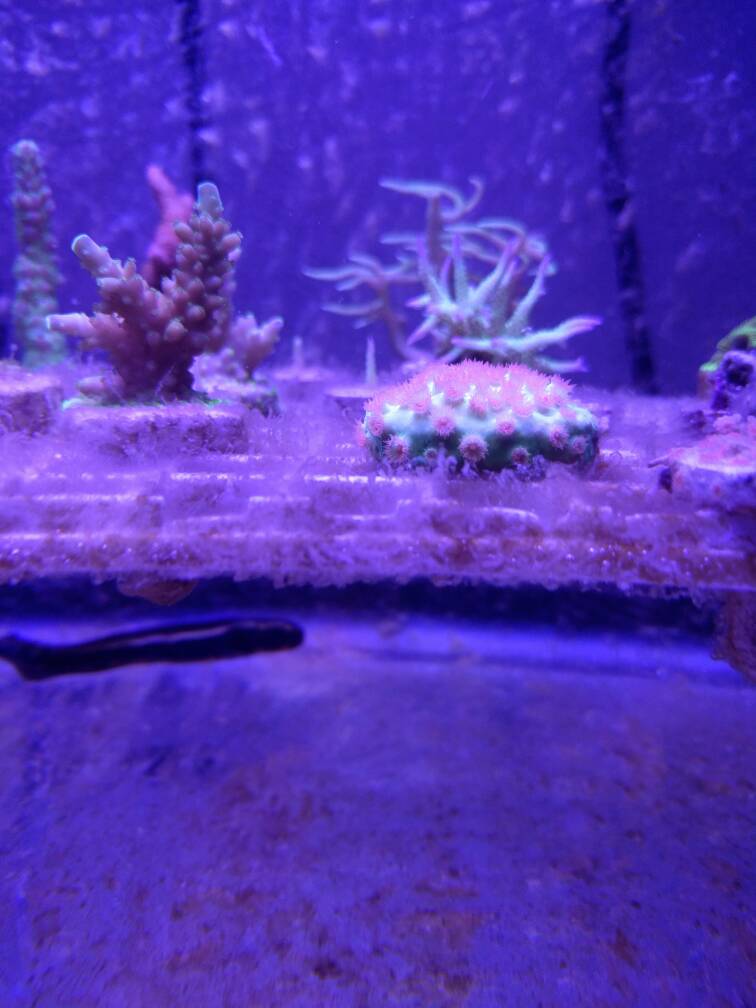
The post DNA mentioned is the one where he suggested fully filling the tank with coral to see if the additional chemical warfare introduced would kill off dynos. It's harder for peeps with large tanks to give that a show as that will require thousands spent on coral to try it out, possibly loosing the livestock and investment, but in a smaller tank its a much cheaper test.
Similar threads

- Replies
- 74
- Views
- 868


