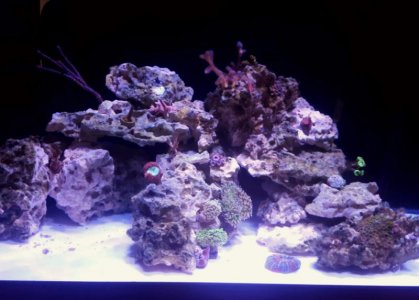
Dinoflagellates.

Thanks for the report on a higher daily H2O2 dose that didn't work, and this thread has seen lots of reports of carbon dosing being associated with onset of dinos. Personally, my crazy high carbon dosing (50% higher than TMZ recommended amount) is what I consider the biggest factor in my dino onset. Interesting that Vit C has same result as other carbon dosing.
You aren't the first to be dosing aquavitro fuel (it's a mix of lots of difference vitamins and trace elements) when dinos arrived.

If you decide to go "dirty method" I'd recommend elevating both N and P.


Cyano provides a lot of things that dinos could be interested in. It's an N source, it can capture Fe, and it produces and exports B12.

It seems like in systems dominated by bacteria (carbon dosing, zeo, etc) dinos have an ability to shape the bacterial community to their liking and can thrive to problem levels.

This is a super-crazy-oversimplification but it really seems to be generally true in our systems: call it Rock-Paper-Scissors - Dinos beat bacteria beats algae beats dinos.

If you have lots of algae, dinos don't thrive. If you grow lots of bacteria to outcompete algae, then you are at risk of the possibility of dinos taking control of the bacteria.

Oh, I don't know about carbon dosing + 0 algae spurring on dinos. I've carbon dosed as my main means to reduce nitrates and maintain low phosphates. 0 algae and it's only when I do something stupid that cyano comes out and dinos follow. Otherwise I don't see either. I like to harvest algae but have gone long stretches not doing that either so 0 algae. Vinegar, a skimmer, and consistent water changes has been my constant.
 
Actually, DNA's Ostis feed on UV and get more powerful!! There's the horror story.

Like shooting lasers at Gojira and having him get bigger.
 
Wish all our responses were actual answers, but for every handful of cases that establish clear trends (slow flow UV kills ostis!) there's a frustrating exception (DNA's super-mutant ostreopsis that's immune to a million watt slow flow UV for months...[horror movie narrator]...coming this summer to a LFS near you AAAAGH! )
Just to be very clear, I suspect that the Ostreopsis is quite vulnerable to UV if it goes through the filter. There's no reason to believe that the dinoflagellates are entering the UV filter at a rate high enough to be of interest, though.
 
I opened my tank up on Friday afternoon. Looks good. Still have not turned lights on higher than 10% blues. Also started dosing microbater as well. Ran rowasphos for the last 3 days of black out. Going to pull it out tomorrow and add carbon to the reactor. So far looks a ton better all my white rock is back to white with no signs of Dino. Started my fuge this weekend as well as going to install an ats up flow as well. More to come

Update.

Pulled the uv off line along with the rowasphos. Added some mangroves and an up flow ats. Turned my blues only up 10% per day currently at 40% blues and 5% whites for 4 hours a day. Run the ats and refug light for 8-12 hours on the off cycle of display. Still dosing microbater and algaefix marine and skimmer. Turning of the skimmer for 4 hours after dose. So far so good. What is left of the stringy Dino's is turning clear and white. I don't want to suck them out manually because I want to see what's left die and make sure it doesn't recover. I have not done a water change. Only top off with fresh ro/di. Also replacing Polly every 3 days. Added pods and cheato as well. Just my small price of the puzzle
 
Just to be very clear, I suspect that the Ostreopsis is quite vulnerable to UV if it goes through the filter. There's no reason to believe that the dinoflagellates are entering the UV filter at a rate high enough to be of interest, though.

That is a very reasonable conclusion. But it wouldn't be much of a horror movie. :-)
 
I have been a battling a massive plague of O. ovata for months now. I ided them under a microscope. I may finally be winning thanks to this thread.

I was running a fairly low nutrient system by having only three small fish in a 65 gallon tank and giving them minimal, but adequate, feeding. My NO3 and phosphate were always measured at zero or very near it. When the dinos hit they covered everything, even my zoas and gorgonians closed up.

After reading this thread a few months ago I decided to start over feeding my tank with frozen food. The dinos actually receded some and mostly covered the rocks, not the livestock, but were still pretty heavy. My bristle worm population exploded along with thousands of brittle stars. A couple months ago I also started dosing Sodium Silicate to kickstart some diatoms into competition but that doesn't seem to have done much. About a week ago I put in a small amount of new live rock from the LFS. Today I noticed that the amount of dino "coverage" is the smallest it has been in months!

With a sample size of one and no control this is hardly a scientific experiment but I think the live rock addition my have really helped. Now I just hope the dinos don't make a comeback.

Its been over two weeks now and the dinos have almost completely disappeared. The live rock infusion seems to have turned the tide in a couple weeks after months of the plague.
 
Just to be very clear, I suspect that the Ostreopsis is quite vulnerable to UV if it goes through the filter. There's no reason to believe that the dinoflagellates are entering the UV filter at a rate high enough to be of interest, though.

In the case of O. Ovata I don't think UV would do much good. I ran a canister with a micron filter for days that would stop any and all dinos and it didn't make much of a dent. Since UV will have a much smaller kill rate than the canister's %100 it doesn't seem very promising. Maybe for other types of dinos it would work better.
 
A quick update. I dipped the rocks i could in freshwater and scrubbed them all with a toothbrush outside of the tank. Then i did a 2 day blackout, then 2 days of 20% blues. I see a couple strands of dinos holding on but the tank looks much better.
A lot of stressed corals. A couple sps browned badly and i lost my strawberry shortcake acro frag...
 

Attachments

  • 20862.jpeg
    20862.jpeg
    57.1 KB · Views: 9
I'm reluctant to celebrate but I do believe I can see the finish line. :) My tank hasn't looked this good since I first set it up. I did have two patches of light dusting in the substrate, so I took three samples. I was unable to find a single Amphidinium anywhere in all three slides. What I am seeing though is diversity. Not a whole lot yet, but encouraging none the less. Lots of diatoms, a tiny nematode with phyto in its gut, an egg shaped thing with pointy things growing off of it scurrying around, also appeared to have phyto in its gut. I also found a larval stage Tigriopus copepod, which I assume was feeding on the diatoms. Snails are constantly cleaning now and my hermits have molted, shedding their orangeish/yellow shell and finally returning to the blood red colors they used to have. I'm relieved at the progress i've already seen, but i'll have my victory dance when my lighting period is back to normal and all still appears well.

Here's two pre-blackout pics and a pic taken tonight:

hccL4k3h.jpg


01XaynIh.jpg


GFCekqdh.jpg


I started out with 4 hours of moonlights on Monday, Dark Blues only set to 1%. The next day, I bumped them up to 2% and increased to 8 hours. Each day I increased intensity until I reached 10% Dark Blue and 5% Blue. Tomorrow, I plan on trying 1 hour of 16000K set to about 25%. If all looks well, then I plan on adding 1 hour every 1 - 2 days. Today is also day 14 of my Microbacter7 dosing, which I plan to continue for the next week and phyto dosing until the bottle is gone. Next Friday is also going to be coral shopping day, I plan on coming home with at least 4 or 5 frags. :bounce3:
 
Last edited:
Fingers crossed strange I hope you beat them back. I'll add pics as well this weekend before and after. So far so good. I'm petrified to do a water change I'm going to try and do one more week without.
 
Fingers crossed strange I hope you beat them back. I'll add pics as well this weekend before and after. So far so good. I'm petrified to do a water change I'm going to try and do one more week without.

Thanks, we'll see. :) I think i've done 3 water changes in the last 10 days if it makes you feel any better, but you might be dealing with a different species than mine.
 
Pulled a sample of what looked like detritus on my live rock. In it, I found bunch of these things that look like Ostracods. Anyone familiar with either of them? Would love to put a name to them as i'm seeing a lot of them pop up now.

Top view

3f2fQkRh.jpg


Side view

Xa6eMahh.jpg
 
Last edited:
Pulled a sample of what looked like detritus on my live rock. In it, I found bunch of these things that look like Ostracods.
Pretty sure those are ciliates - euplotes maybe (Google images of "hypotrich ciliates" for others in that family)

Here's a hypotrich ciliate of some variety from one of my samples that had a taste for amphidinium dinos. I mis-ID'd it as euplotes at the time.
https://youtu.be/f5VctFNP_zs
Most ciliates eat primarily bacteria, but some eat and thrive on larger particles including dinos. And under the right conditions the ciliates can curb the dino population.
 
Pretty sure those are ciliates - euplotes maybe (Google images of "hypotrich ciliates" for others in that family)

Here's a hypotrich ciliate of some variety from one of my samples that had a taste for amphidinium dinos. I mis-ID'd it as euplotes at the time.
https://youtu.be/f5VctFNP_zs
Most ciliates eat primarily bacteria, but some eat and thrive on larger particles including dinos. And under the right conditions the ciliates can curb the dino population.

After looking at some images, i'd agree with that ID. Thanks!
 
I don't know if this has been covered in this thread yet but I ran across this article while reading up on Amphidinium. The part that caught my interest was "The Amphidinium was outcompeted by diatoms if the Si/N ratio was kept at 1:1 or greater. . . I know not all species have the same vulnerabilities, but for those particularly bad cases, I think it would be worth a try. It'd be interesting to see if dosing large amounts of silica encouraged a diatom bloom which would inhibit dino growth or even keep them under control. Just thinking out loud here...
 
It'd be cheap to try silicate dosing. I got a gallon of water glass for $10-20 dollars or so, and it'd last most anyone a lifetime.
 
I don't know if this has been covered in this thread yet but I ran across this article while reading up on Amphidinium. The part that caught my interest was "The Amphidinium was outcompeted by diatoms if the Si/N ratio was kept at 1:1 or greater. . .

It's been talked about, but I don't think it's been given a thorough testing.
 
Back
Top