
You are using an out of date browser. It may not display this or other websites correctly.
You should upgrade or use an alternative browser.
You should upgrade or use an alternative browser.
Dinoflagellates.
- Thread starter DNA
- Start date

tigersmith
New member
Vivid aquariums just used fleischmann's active dry yeast to get rid of dinos in their 800G display.

matt_97055
New member
That was on diatom's not dino'sVivid aquariums just used fleischmann's active dry yeast to get rid of dinos in their 800G display.
sent from a Samsung note 4
tigersmith
New member
That was on diatom's not dino's
sent from a Samsung note 4
Ooops. Thanks for correcting me. I cleared dinos with waste away and manual removal in my frag tank.

StrangeDejavu
Member
Anyone able to ID this thing? Took a sample of my sand today and saw many diatoms, ciliates, copepods and one of these things. It appears to have dinos in its gut, quite small as those are diatoms there at the bottom.
On a side note, going on 3 weeks since I last saw a single dinoflagellate in my tank. I'm up to 40% intensity for 5 hours a day. Corals are doing well and displaying great polyp extension. Each sample I take contains more and more diversity each time, which is a relief.

On a side note, going on 3 weeks since I last saw a single dinoflagellate in my tank. I'm up to 40% intensity for 5 hours a day. Corals are doing well and displaying great polyp extension. Each sample I take contains more and more diversity each time, which is a relief.

karimwassef
Active member
Looks like a kind of pod?
StrangeDejavu
Member
I think it's a marine mite. Look up halacaridae. Seen these in my sand too. Assumed they were related to ostracod, but they aren't really.
I'd have to agree with that ID, thanks!
Follow up on earlier stuff...
So I've done paired light/dark tests, and checked the ostis for any movement the day after adding different amounts of H2O2 (in ml/L).
No = Not a single osti moving
Yes = Somewhere in sample there was an osti still moving
H2O2 - light - dark
1.6 - Yes - Yes
1.8 - Yes - Yes
2.0 - No - No
2.2 - No - No
2.4 - No - No
I'll do a few more sets to confirm numbers for single dose before moving to gradual doses.
What I don't get is that I've seen no difference in any test so far between peroxide applied in the light (beaker lit by sump lights that grow chaeto) and peroxide applied in the dark (inside a cabinet).
There are some good reasons to think that light would make peroxide more effective, and maybe even some arguments that darkness could be better for peroxide use on ostis - peroxide persists longer in the dark, and perhaps more of it can get into the inside of the cell before reacting.
But I honestly can't figure how light/dark has no effect that I've been able to see so far.
The question seems pretty dang straightforward: What level of single-dose H2O2 kills ostreopsis?
...all doses in ml H2O2 per Liter of tank water.
Concentrations of .5 to .8ml/L caused 100% of dinos to stop moving by 30 min after, and some lost theca.
But next day, many of the dinos had recovered in each beaker.
next the one question becomes 2: what peroxide level to kill ostis in the dark, and what level kills them in the light?
...blah blah stuff about studies in light vs dark peroxide application...
side note: I guess, that any application of peroxide to kill photosynthetic stuff should be done in bright light to reduce the amount of H2O2 required.
So I've done paired light/dark tests, and checked the ostis for any movement the day after adding different amounts of H2O2 (in ml/L).
No = Not a single osti moving
Yes = Somewhere in sample there was an osti still moving
H2O2 - light - dark
1.6 - Yes - Yes
1.8 - Yes - Yes
2.0 - No - No
2.2 - No - No
2.4 - No - No
I'll do a few more sets to confirm numbers for single dose before moving to gradual doses.
What I don't get is that I've seen no difference in any test so far between peroxide applied in the light (beaker lit by sump lights that grow chaeto) and peroxide applied in the dark (inside a cabinet).
There are some good reasons to think that light would make peroxide more effective, and maybe even some arguments that darkness could be better for peroxide use on ostis - peroxide persists longer in the dark, and perhaps more of it can get into the inside of the cell before reacting.
But I honestly can't figure how light/dark has no effect that I've been able to see so far.
no one knows what exactly is in it but most think it's basically erhythromycin, the same stuff we take for bacterial infections
Ran across this by RHF in another place laying out the reasons to conclude chemiclean is erythromycin...
"We always suspected it was just because they said, weirdly, that it wasn't erythromycin succinate:
Contains no phosphates, algaecides or erythromycin succinate
Not that it doesn't contain erythromycin or that it doesn't contain antibiotics. Sort of like saying an aquarium additive has no copper chloride in it, when folks are asking about copper and couldn't care less about chloride.
Claude of Fauna Marine comments here that it was analyzed by the government in Germany and found to violate rules due to having erythromycin in it:
We had in germany a big scandal due to this and the product was analyzed by the veterany office of Hannover
and they showed that this product is erythromycine sulfate .. this is a antibiotics whic normaly only a doctor can give up
due to the usage in this case and this ammounts the possibilitly of unwanted resistance is very big
"and they showed that this product is erythromycine sulfate .. this is a antibiotics whic normaly only a doctor can give up
due to the usage in this case and this ammounts the possibilitly of unwanted resistance is very big
karimwassef
Active member
It may be a mix but the physical properties of the water wouldn't change with an antibiotic.
The viscosity and surface tension definitely changed.
Would anyone consider trying this out with dinos using the high foam/air exchange reactor concept?
The viscosity and surface tension definitely changed.
Would anyone consider trying this out with dinos using the high foam/air exchange reactor concept?
karimwassef
Active member
Just be prepared for your tank to looks like a washing machine oversudsing.
I was personally stunned that a teaspoon of powder would agitate a 700gal system like mine. The reaction was violent but the results were astounding and nothing died.
Well... The coral growth spurt did cause a surge in coral on coral violence and death but I consider that a biproduct.
I was personally stunned that a teaspoon of powder would agitate a 700gal system like mine. The reaction was violent but the results were astounding and nothing died.
Well... The coral growth spurt did cause a surge in coral on coral violence and death but I consider that a biproduct.
Would anyone consider trying this out with dinos using the high foam/air exchange reactor concept?
Could you elaborate a little?
You mean using the foaming properties of the cc to supercharge a skimmer mechanism and look for effects on dinos?
karimwassef
Active member
yes, but not as a skimmer... you don't want effluent, you just want a huge number of bubbles to create surface foam with cc. you want to keep it all in the system, but several airstones with a large air pump would have the same effect. I'd add lots of flow to get into all the nooks and crannies.
In your case, take a bucket of dino infested water and add an airstone with a powerful airpump (overdrive the poor bucket) and add the right portion of CC.... then measure the results.
In your case, take a bucket of dino infested water and add an airstone with a powerful airpump (overdrive the poor bucket) and add the right portion of CC.... then measure the results.
StrangeDejavu
Member
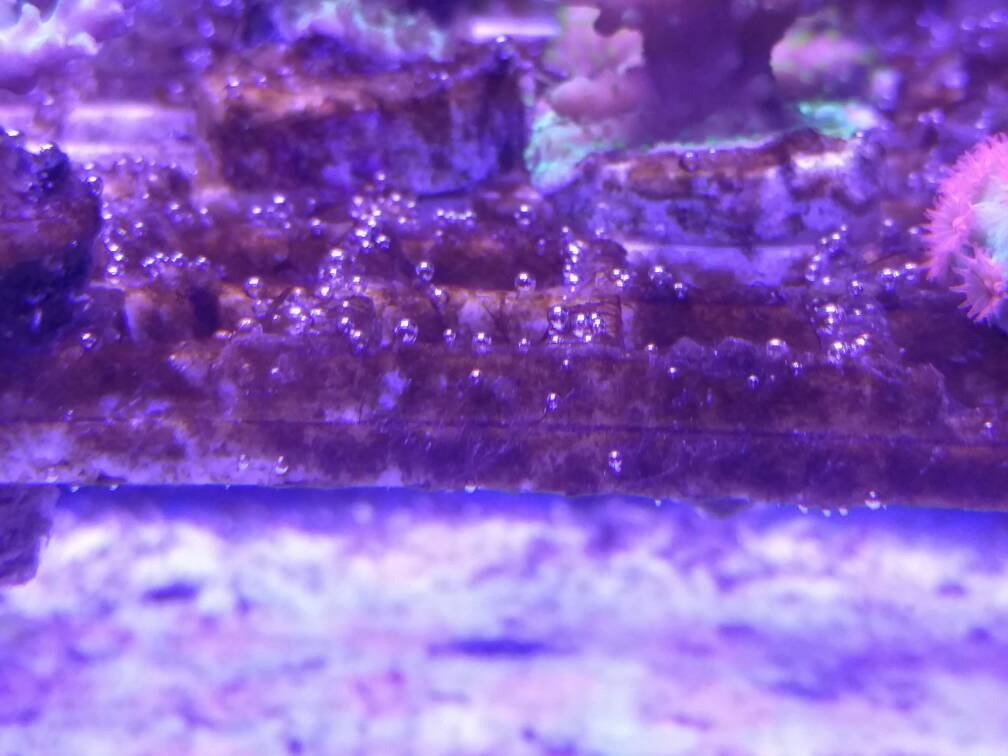
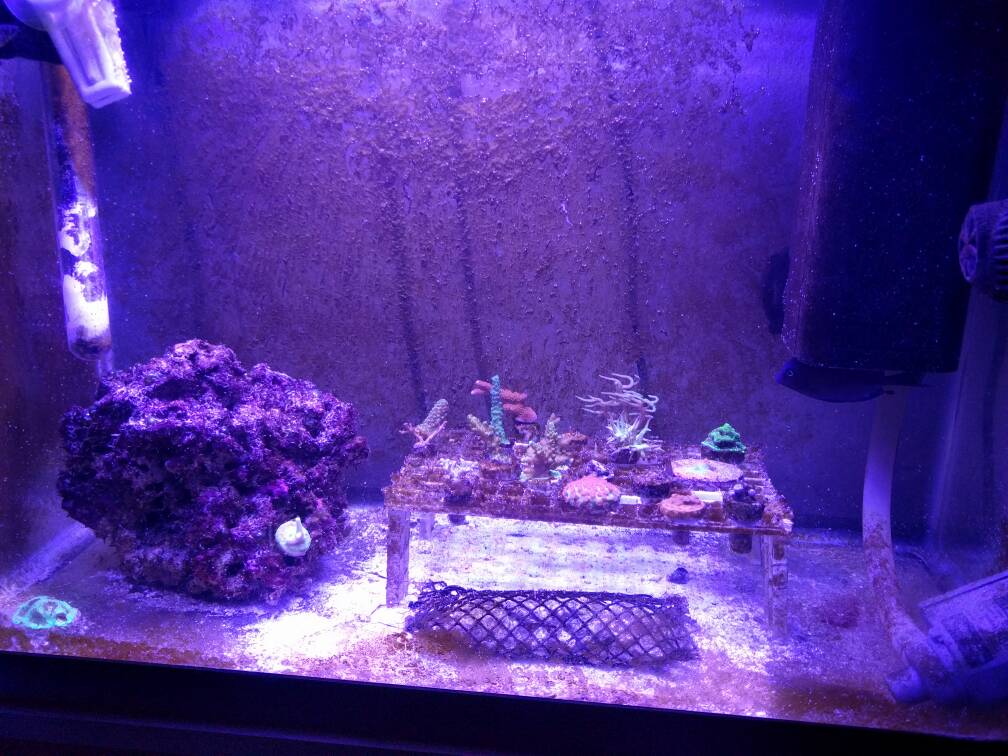
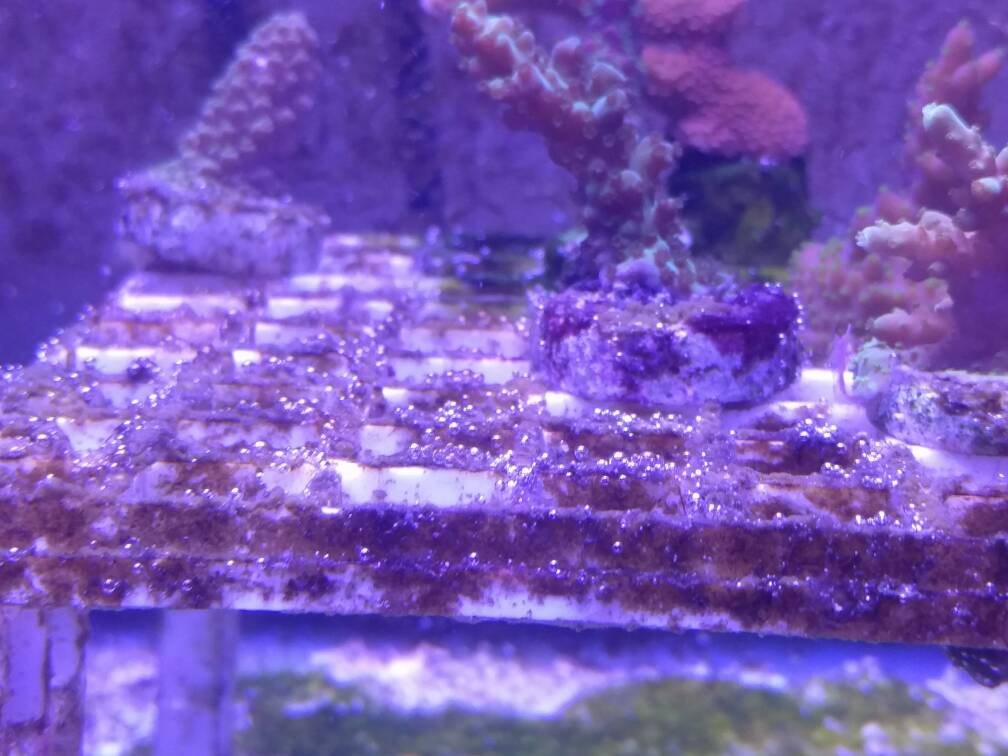
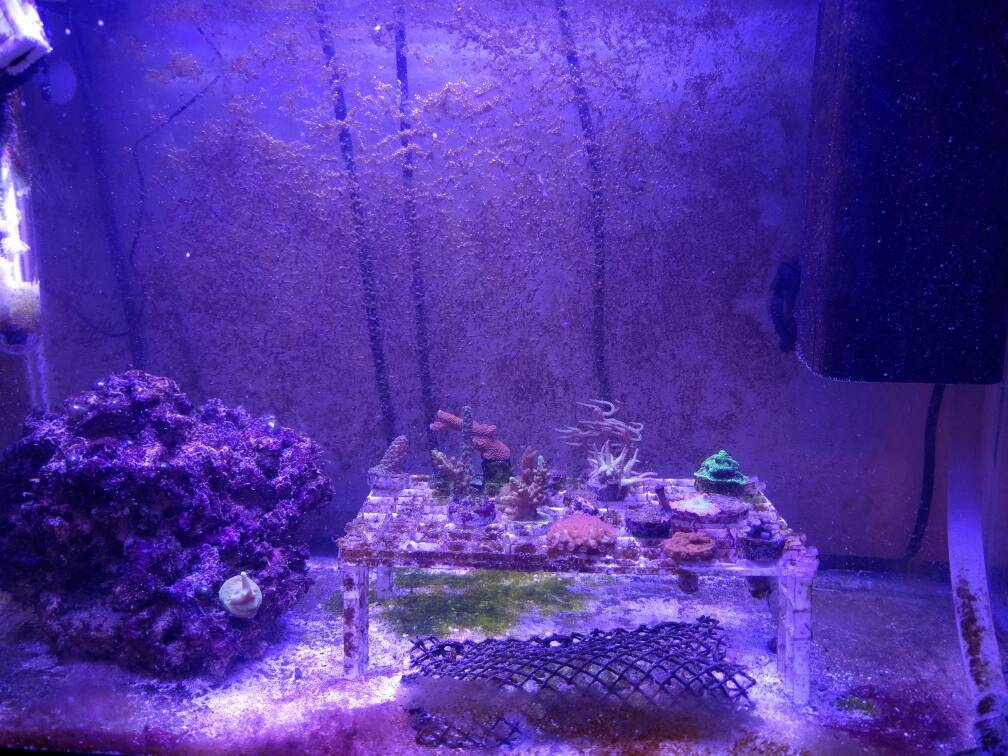
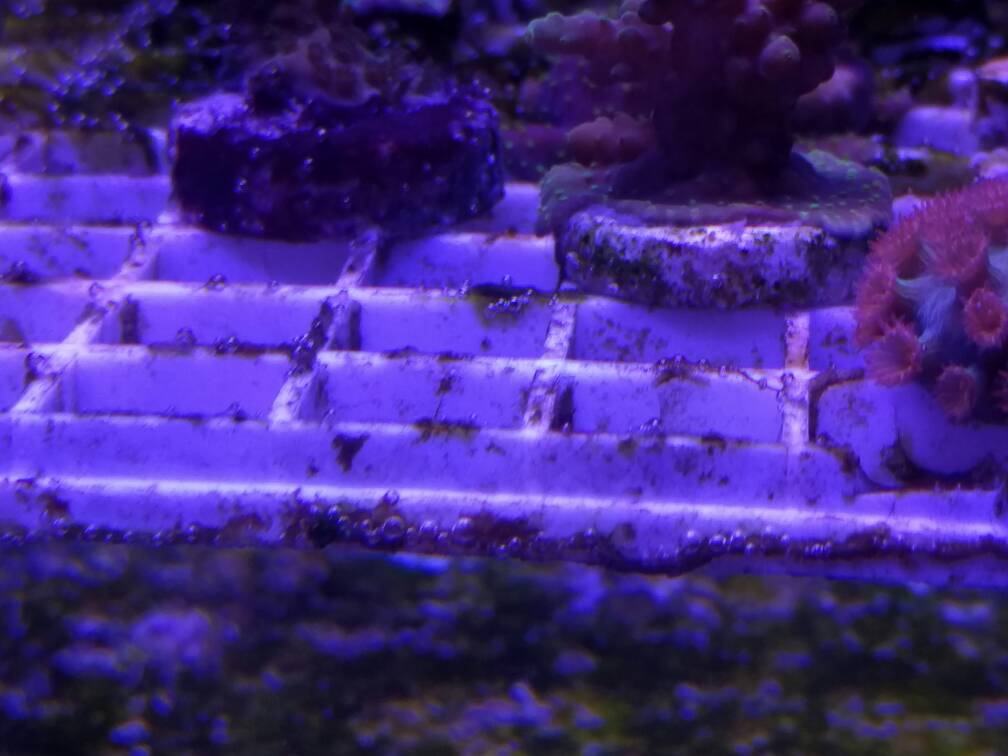
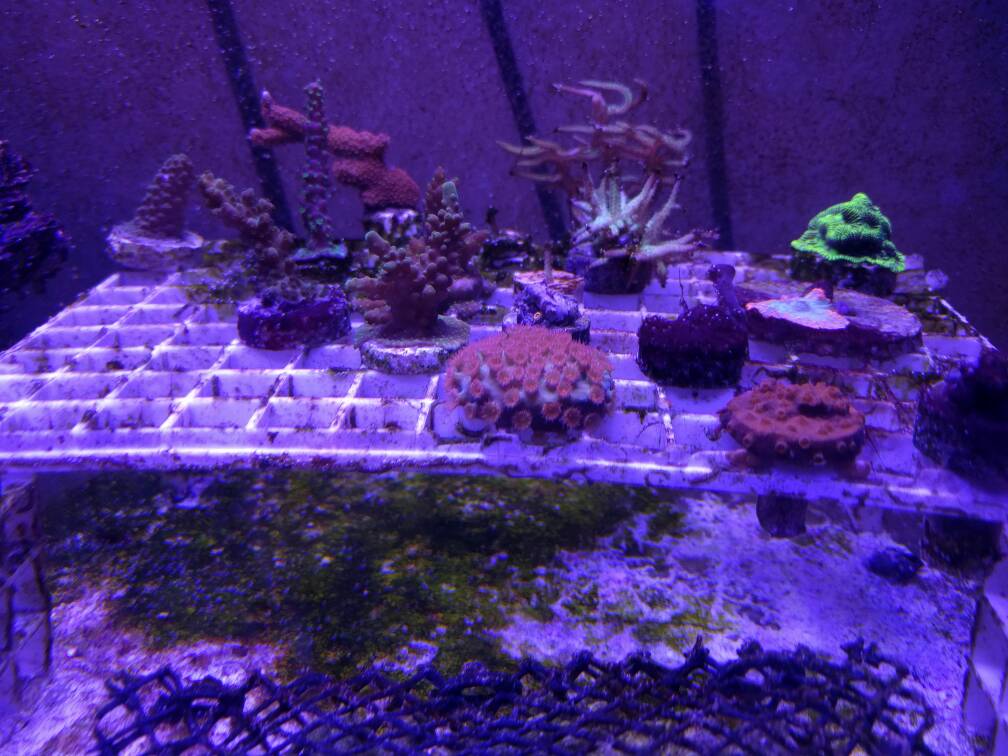
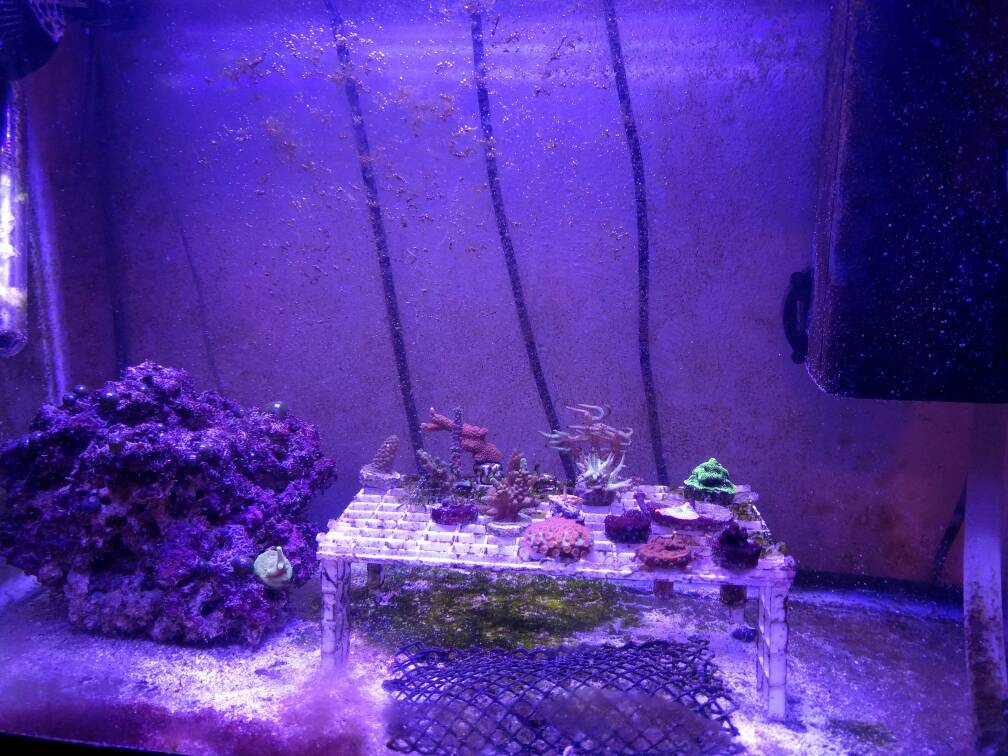
Looks like my Dad's tank recently had an Amphidinium bloom, so as an experiment, he's going to try to win through the biobomb route first. He doesn't want to blackout if he doesn't have to, so this should be a good test on whether Microbacter7 and phyto daily dosing is enough to encourage other diversity to beat Amphidinium naturally without a blackout period. He will be starting with a thorough cleaning of the rock, sandbed and back chambers of the BioCube followed by a 25% WC. Right after the WC, he'll begin dosing 5 mL of Microbacter7 and 2.5mL of Brightwell PhytoChrom daily. I'll post an update in a week or two.
StrangeDejavu
Member
It's getting there!
Nice improvement! Fingers crossed you can beat it back completely.
karimwassef
Active member
Kurt - what are you doing to push them back?
Acromaniac
Member
Could iodine possibly be the cause of Dino?
So I have had Dino's for a year now, they are the free floating rusty bubble kind that get stuck to corals and kill them. The back wall and pumps are also covered in them.
The problem first occured when I changed my T5 bulbs which were about 15-18months old.
I used to be on Zeovit and always has 0 nitrate, and 0.03 phosphate. While on this method I had tried complete black outs, no water changes etc. nothing helped so I just tried to wait it out.
Recently I decided to stop Zeovit, I have added siporax to my sump and I added GFO. Within the first week or 2 of running GFO, the dino's looked as though they shifted to another kind, they were now the more browny hairy kind stuck to the back wall with bubbles in it and my corals were looking cleaner, I thought this might be the beginning of winning the war. I then decided to change the GFO incase it was exhausted so that it could keep up what seemed to be great progress. It then went back to the original type and is strangling my corals again.
After a lot of reading, I have now decided to try nitrate dosing, i'm only a couple days in but I plan to raise this to about 5ppm, currently I have raised it to 0.5ppm.
Then it hit me, even though I havent been doing water changes, what have I been adding to the tank? the only thing I have been adding is Lugols. So today I decided to google Iodine and Dino's. What comes up? Dino's being preserved in Lugols solution along with other micro algae and plankton for Microscopic analysis.
Could I have found the solution? Is it possible that the Dino's are being fuelled and protected within the tank by the Lugols?
If this is possible it got me thinking maybe the reason no water changes works for some people is that the iodine completely bottoms out. Now, apart from me stopping the addition of Lugols, is there anything I can use to deplete the iodine in the system so I can test that this is the case?
So I have had Dino's for a year now, they are the free floating rusty bubble kind that get stuck to corals and kill them. The back wall and pumps are also covered in them.
The problem first occured when I changed my T5 bulbs which were about 15-18months old.
I used to be on Zeovit and always has 0 nitrate, and 0.03 phosphate. While on this method I had tried complete black outs, no water changes etc. nothing helped so I just tried to wait it out.
Recently I decided to stop Zeovit, I have added siporax to my sump and I added GFO. Within the first week or 2 of running GFO, the dino's looked as though they shifted to another kind, they were now the more browny hairy kind stuck to the back wall with bubbles in it and my corals were looking cleaner, I thought this might be the beginning of winning the war. I then decided to change the GFO incase it was exhausted so that it could keep up what seemed to be great progress. It then went back to the original type and is strangling my corals again.
After a lot of reading, I have now decided to try nitrate dosing, i'm only a couple days in but I plan to raise this to about 5ppm, currently I have raised it to 0.5ppm.
Then it hit me, even though I havent been doing water changes, what have I been adding to the tank? the only thing I have been adding is Lugols. So today I decided to google Iodine and Dino's. What comes up? Dino's being preserved in Lugols solution along with other micro algae and plankton for Microscopic analysis.
Could I have found the solution? Is it possible that the Dino's are being fuelled and protected within the tank by the Lugols?
If this is possible it got me thinking maybe the reason no water changes works for some people is that the iodine completely bottoms out. Now, apart from me stopping the addition of Lugols, is there anything I can use to deplete the iodine in the system so I can test that this is the case?
Similar threads

- Replies
- 74
- Views
- 857


