Dinoflagellates.

Your dad's dinos are amphidinium?

Amphidinium and the other unidentified dino from a few pages back, looks like Symbiodinium- round and golden but does not move. It completely encases the live rock in a blanket of dark brown that's very difficult to scrub loose. If not scrubbed, it will eventually develop blobby slime that looks similar to Brown Jelly. My tank developed this to some degree, but not nearly as bad as his. Here's a shot and a video of it when it appeared in my tank. Almost every inch of his rock looked like this a few days ago, where mine was only in this one spot.

Yb45OnNh.jpg


<iframe width="560" height="315" src="https://www.youtube.com/embed/fNy0IcDHvb4" frameborder="0" allowfullscreen></iframe>
 
Last edited:
This may sound stupid, but.... Is phytoplankton considered a dinoflagellate or is it a true algae?
In a lot of lit, dinos, diatoms, cyano are all considered kinds of phytoplankton.
But no.
The ones we mean by phyto are in the group chlorophyta which is distinct from dinophyta

Edit: I know nannochloropsis is chlorophyta, I'm not even sure about isochrys and tetraselmis, and spirulina.
 
Last edited:
By the way, I have some metronidazole on order and planning on doing a tank wide treatment with an exhaustive biodiversity survey before and after.
My scope can't ID bacteria, but I'll track nitrate, nitrite, ammonia, phosphate for the first few days, look for signs of cycling or biofilter crash.
If anyone thinks of something else to check for, lemme know.
 
By the way, I have some metronidazole on order and planning on doing a tank wide treatment with an exhaustive biodiversity survey before and after.
My scope can't ID bacteria, but I'll track nitrate, nitrite, ammonia, phosphate for the first few days, look for signs of cycling or biofilter crash.
If anyone thinks of something else to check for, lemme know.


A photo log would be great.
Do a picture a day with the camera pointed at full tank and showing the bottom.
Best if it could stay there on a tripod so the pictures will be aligned perfectly.

There are lots of things to watch and I'm pretty sure you will do a good job but here are a few pointers.
The type of dinos, the amounts of cyanobacteria, algal growth, algae on the glass, short and long term effects, coral growth, fish breathing rate, water tranparency, skimming rate, etc.
 
Kurt - what are you doing to push them back?

Lots of things :) common goal seems to be create environment that micro fauna can grow.

I feel I noticed the biggest change once I finally got po4 to detectable levels using hanna ulr checker. Only raised to .03 or so by dosing but to even get readable numbers was a challenge at the time. I would test and dose daily to keep it up, eventually it started to stay. I got the idea because I think what started this was dosing of to much lanthium chloride. I'm guessing micro fauna need some po4 to get going.

So here's a list of what I'm doing that seems to be helping.

Mb7, capful a day in the beginning, less often now.
Maintain po4 readings by dosing in the beginning, over feeding helped but still couldn't get readings
Maintain some no3, my target was 5ppm or so
Feed more, rods, lrs, reef chili, phyto, oyster feast, flake. Whatever I have on hand.
Also added some more fish to eat more food
Turned skimmer off and only ran occasionally to clear surface film etc. I'm now running it more as Dino's are disappearing to help remove them. I need to test no3 and po4
Running carbon in tlf reactor.
I've done 2, 2 day lights out that helped but don't want to push the beat up sps to far.
Added the pod hotel and some sand from established tank.
I also dosed some amino acid to feed the sps as the Dino's were starving them out.

While the tank is looking better it's mostly the unknown Dinos that seem to be disappearing. I'm not sure how much progress I'm making on the osteoporosis.

I feel that my rescue tank is ready to clean these corals up so will move them over today or so. Then I will have a tank left with Dino's and a few mollies in it ready to test metro.

This is exciting about the metro, hopefully we can replicate the results. I have some on order and will be here Monday.
 
tldr version: confirming what we already knew, peroxide is nearly useless on ostreopsis dinoflagellates.

Follow up on earlier stuff...

So I've done paired light/dark tests, and checked the ostis for any movement the day after adding different amounts of H2O2 (in ml/L).
No = Not a single osti moving
Yes = Somewhere in sample there was an osti still moving
H2O2 - light - dark
1.6 - Yes - Yes
1.8 - Yes - Yes
2.0 - No - No
2.2 - No - No
2.4 - No - No

But I honestly can't figure how light/dark has no effect that I've been able to see so far.

I did a couple more tests.
H2O2 - light - dark
1.6 - Yes - Yes
1.8 - Yes - Yes
2.0 - No - No
2.1 - Yes - Yes

2.2 - No - No
2.3 - No - No
2.4 - No - No

When the dinos were inhibited by 2.0 ml/L the peroxide bottle had just been opened 5 minutes before dosing. When the dinos remained active the next day after a 2.1 ml/L dose, the peroxide bottle had been opened and sampled from a couple of times a day every day for 2 weeks. Not inconceivable that a fresh bottle might be 10-20% more effective. Or this could just be random error.

secondly, I'd like to point out the massive difference in concentrations required by different dinos:
From study posted a while back:
tiny, unarmoured amphidinium carterae was 90% inhibited by 6.4mg/L (the equivalent of 0.21ml of 3% peroxide per Liter)
medium sized armored prorocentrum micans was only 11% inhibited at that dose.
And the huge armored Ostreopsis Ovata - in my beakers at least - seems to require literally 10 times the dose (2 to 2.5ml/L aka 7.5 to 10ml/gallon) of amphidinium carterae to achieve that level of inhibition.

Another single run possibly interesting result (but it's just one trial):
I dosed 2.5ml/L into two samples: one was just Ostis, the other was ostis + teeny tiny slivers of chaeto and caulerpa to see if the dinos survived better with another oxidizer target in the beaker with them.
The plain ostis beaker was totally inhibited, the one with slivers of macroalgae had half the ostis still spinning around, active. Suggests that in a tankwide treatment, the presence of other targets for the oxidizer would require either even higher h2o2 doses, or more of them, or both.

...and one last part I'll post later.
 
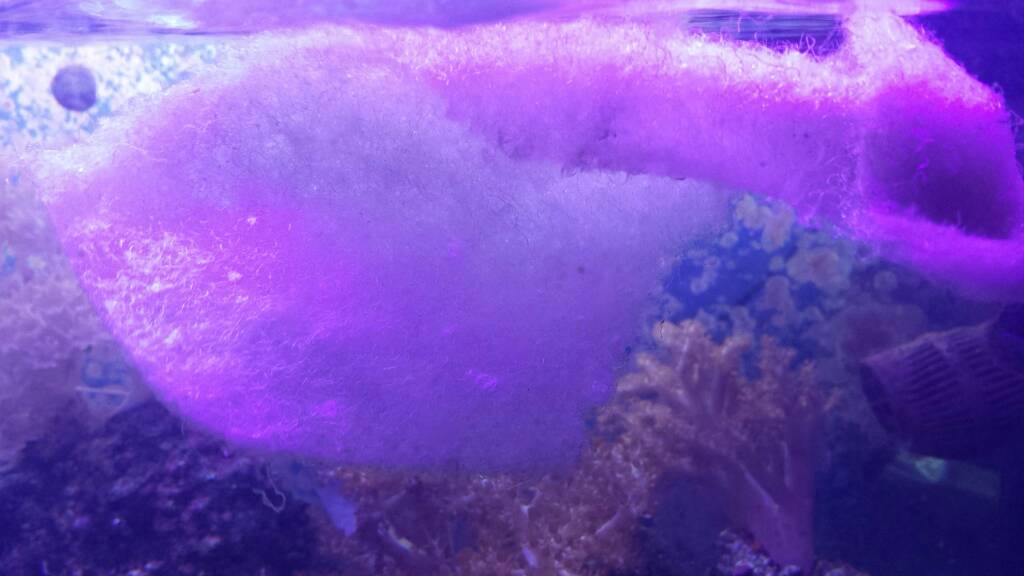
So today is Day 3 on my Dad's BioCube 29 using MetroPlex against Amphidinium carterae and a Symbiodinium lookalike. He is dosing 3 spoonfuls of MetroPlex (70% Metronidazole) to an estimated 23 gallons of water. Only 2 doses and he says he's already seen improvements. His water, when viewed from the side, used to be heavily yellowed/brown (something I noticed when I battled dinos as well). He says his water is much clearer though it still has a slight yellow tinge. Metro appears to be working as planned in keeping them broken up and suspended as his filter floss is catching significantly more than it ever has:

5ICGujgl.jpg


Clownfish, Yellow Watchman Goby and Skunk Cleaner Shrimp show no change in behavior, still eating well. Coral and Ball Anenome are unaffected. CUC doesn't appear to be affected. Collonista snails and Spirobid worms don't appear to be affected. Mini-brittle stars are also fine, and Copepods are active. Two things i've noticed: 1) Metro appears to have decimated the pineapple sponge population that used to live in his rear chambers, 2) Whether coincidence or not, i'm also no longer seeing red flatworms all over his glass.
 
...and one last part I'll post later.

So since something in the ballpark of 2ml/L in a single dose inhibits ostis, I wanted to try smaller doses more often.

So I did four 1ml/L doses spread apart by 12hr, 9hr, and 9hr then checked a day and a half after the last dose. So about 3 days of treatment.

1. There were active moving ostis in both the lighted beaker and the total darkness beaker receiving that treatment.

2. In the lighted beaker (but not the dark), the ostis all changed shape from sesame seed to totally spherical.
[edit: link to paper on ostis changing shapes based on life cycle/conditions. great pics. Guessing our tanks just support the sesame seed morphology/phase the majority of the time.]
Two wild guesses: maybe they deal with ongoing oxidative stress by changing shape to a sphere that minimizes surface area to be oxidized and lets internal cellular machinery be on average further from the outside and less vulnerable.
Or maybe that's the shape they adopt when they operate on photosynthesis only, because the peroxide may have kept all bacteria prey wiped clean.

3. After 3+ days in dark, in the control beaker that got no peroxide, some ostis were still active but the sample was getting overrun with lots of diversity (ciliates etc) scurrying and zooming everywhere.
The treated beakers had literally nothing visibly alive except ostis. Just utterly sterile.
In fact, when I want to culture ostis in a beaker in the future, I would hit the sample with a peroxide dose that the ostis could handle no problem (up to 1ml/L) and put it in the light.
Maybe once every few days hit it with another 1ml/L. I bet it would stay an ostreopsis monoculture.

Some paper I ran across came up with what they declared a safe peroxide dose to use in the environment.
If I were to do more peroxide tests, which I doubt, I would test what many of those small doses repeated frequently (every 2hr) did to an osti sample.
I feel pretty safe guessing that the ostis would be the last thing in a sample to succumb to the h2o2.

I was sort of hoping the unlikely outcome that there was a peroxide dose that could be done/maintained in a tank over a short period of time - 24 hrs or so that would kill ostis, but that would allow multicellular algae and inverts to recover from the surface damage.

It looks like you would literally have to kill everything in a tank under 100 microns to hurt ostreopsis with peroxide.
 
Last edited:
Boiling water seems like a bad idea. The process might volatilize various organics, and there'd be a lot of calcium carbonate precipitation. Neither are desirable. I'm not sure what the point would be. Bleach would work much better for sterilization.
 
I have tried this process and whilst may seem like an unorthodox way of fighting them it has completely cleaned my tank right up.

It's the only method which without doing lights out for 10 days has actually cleared my tank.

I'm still dealing with them on a minor scale,tips of sps, but in the main they've become 99 % gone.

Not had any adverse effects as yet, and been clear for a week so far.
 
Hi taricha

I want to run some tests on dino's myself. Can you please tell me what conditions you leave the beaker in, do I have to keep them at reef temperatures? and how do you light the beakers.

Thanks
 
Hi taricha

I want to run some tests on dino's myself. Can you please tell me what conditions you leave the beaker in, do I have to keep them at reef temperatures? and how do you light the beakers.

Thanks
[Edit: everything seems to do fine at room temperature.]
Depends. Most of what I'm doing is just tests of 1 to 4 days, and for that I simply put the dino sample with tank water in the beaker and either put it next to my sump to be lit that way 20hr/day, or in a cabinet for total darkness, or next to sunny window for intense, but natural period sunlight.

After about four days in stagnant beaker water the dinos start to get overrun by other things, to get a culture to hold together longer, some flow or bubbling helps.
Additionally, I believe, but haven't tried it yet, that an ostreopsis culture would thrive if initially treated with .5 to1ml peroxide per liter of sample, because that would leave almost all the ostis unaffected, but basically sterilize the sample of most anything else.
One last thing, I collect the samples by hanging filter floss blowing in front of a powerhead in my tank then wringing out the ostreopsis water out of the filter floss into a beaker.

Here's filter floss blowing in front of powerhead.
f44084a0794ceb653a4d1ef49cce8047.jpg
 
Hey guys, I am in the same boat with dinos. They have stormed my 1 month old tank and grow so freaking fast. Unfortunately, I am a complete noob to reefing so I have no idea what to do. I bought some peroxide, but I keep reading contradicting things about dosing it. I ordered some Algae X, but it sounds like there are some types of dinos that it does not effect? It looks like metronidazole is the new promising treatment? Should I go ahead and order some and give it a shot?
 
I wait with bated breath to see if the hype over the metronidazole is worth its salt..

Like with most chemicals they always return.

Leyth, if you have little in the way of corals your options are wider than mine.

I have a full sps tank, which seems to cause lots of issues by itself.

You can fight it like I have but it's a long tedious battle..by fighting them you will learn lots about what they are and what encourages them to grow.. It's far easier and more interesting to concentrate on your tank and coral.

If I was you I wouldn't waste your time on them.. It's not really rewarding to any degree.

I Would be tempted to empty your water and start a fresh..

Here's one thing to dwell upon.. As mentioned in my post #3833 and 3835, I boiled my water.. It's the only thing I've done that's kept them at bay..tried your dino X and coral snow , ultra bio etc.. Fruitless..
Maybe I've boiled the entire population leaving the odd ones behind, or I've removed something in the water they rely on to survive..
All I can say is they are not as quick at coming back this time..
 
I wait with bated breath to see if the hype over the metronidazole is worth its salt..

Like with most chemicals they always return.

Leyth, if you have little in the way of corals your options are wider than mine.

I have a full sps tank, which seems to cause lots of issues by itself.

You can fight it like I have but it's a long tedious battle..by fighting them you will learn lots about what they are and what encourages them to grow.. It's far easier and more interesting to concentrate on your tank and coral.

If I was you I wouldn't waste your time on them.. It's not really rewarding to any degree.

I Would be tempted to empty your water and start a fresh..

Here's one thing to dwell upon.. As mentioned in my post #3833 and 3835, I boiled my water.. It's the only thing I've done that's kept them at bay..tried your dino X and coral snow , ultra bio etc.. Fruitless..
Maybe I've boiled the entire population leaving the odd ones behind, or I've removed something in the water they rely on to survive..
All I can say is they are not as quick at coming back this time..

Man I am sorry to hear that for you. I hope you find a solution.

You are right, I don't have much livestock/corals to worry about. In fact, this issue has actually come up as I was upgrading tanks. My new tank is cycling and I was planning to move everything over. Now, I am nervous to move this rock, corals, and CUC crew over because I don't want to infect the other tank with dinos. I really wanted to seed the other tank with this rock as it is cycled and nice quality rock. What do you think I should do? Maybe, I can use this tank as an experiment to help everyone else too?
 
Back
Top
