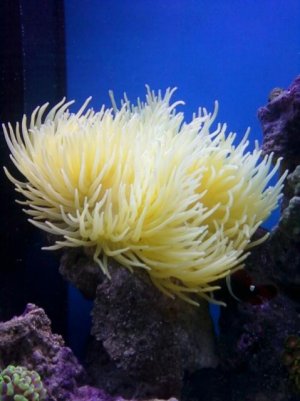
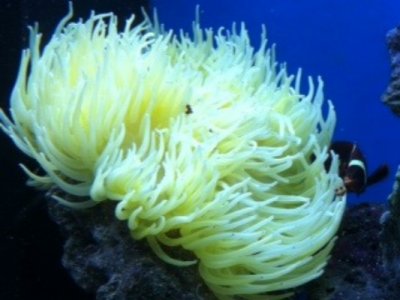
Dyed Yellow ritteri anemone Please help

Glad to hear its eating, that is usually the first issue with those of us who dangerously dabble into anemones, plus the added bonus the clowns took to the nem as well.

You could have two in the same tank, but I woudnt advise doing that. First off its hard keeping an anemone happy and if yours makes it adding another one could start a chemical warfare in your tank in which each nem looses.

I see thanks again
 
Hard to tell from that one picture, but that almost looks like an H. Crispa -- which are pretty common to find dyed that color.

I agree with Todd on this one - I'm pretty sure it's a H. crispa. I have had a H. crispa survive after being dyed, but it took a long time to get healthy. Fortunately your anemone looks to be in better condition; yes it is completely bleached, but the long tentacles indicate that it is not starving (at least not yet). In time (6 months - 1 year) the dye should be completely gone, and you will be left with an off-white anemone. Hopefully it will regain its zooxanthellae and get healthy on you :)

In the wild, H. crispa can be found in sand or rocks. The bigger ones I have only seen on the rocks - typically in branch coral or something similar where their base is protected. Let me know if you'd like that last pair of clowns :)

crispa1.jpg


crispa2.jpg


crispa3.jpg


crispa4.jpg
 
Last edited:
I agree with Todd on this one - I'm pretty sure it's a H. crispa. I have had a H. crispa survive after being dyed, but it took a long time to get healthy. Fortunately your anemone looks to be in better condition; yes it is completely bleached, but the long tentacles indicate that it is not starving (at least not yet). In time (6 months - 1 year) the dye should be completely gone, and you will be left with an off-white anemone. Hopefully it will regain its zooxanthellae and get healthy on you :)

In the wild, H. crispa can be found in sand or rocks. The bigger ones I have only seen on the rocks - typically in branch coral or something similar where their base is protected. Let me know if you'd like that last pair of clowns :)

crispa1.jpg


crispa2.jpg


crispa3.jpg


crispa4.jpg


What kinda clowns are they
 
I was just kidding about the clowns - or I should say that I don't own the clowns they are still in the ocean :)

I believe they are black A. clarkii. One mid-body bar away from being $6000 A. mccullochi :) I don't doubt that someone could breed them and end up with offspring that were visually indistinguishable from the later.
 
I was just kidding about the clowns - or I should say that I don't own the clowns they are still in the ocean :)

I believe they are black A. clarkii. One mid-body bar away from being $6000 A. mccullochi :) I don't doubt that someone could breed them and end up with offspring that were visually indistinguishable from the later.


They are great looking truly great but i dont think i would ever get rid of my maroons they are great
 
I was just kidding about the clowns - or I should say that I don't own the clowns they are still in the ocean :)

I believe they are black A. clarkii. One mid-body bar away from being $6000 A. mccullochi :) I don't doubt that someone could breed them and end up with offspring that were visually indistinguishable from the later.

Not to be a PITA, but I think that last pair are dark akindynos based on the bright white tail and flesh colored nose, but I could be wrong.

Back to the OP. H. crispa in my experience are very often in the rocks. Most of the wild pics you see (like BonsaiNuts) are in the rocks, not the sand.

Most dyed crispas have suffered all sorts of bad treatment besides just being dyed. You are lucky in that, other than being dyed, yours looks pretty healthy. If it has good conditions in your tank, it has a good shot at making it. Wetwebmedia is a good site, but has been know to exaggerate to make a point.

Good luck
 
Not to be a PITA, but I think that last pair are dark akindynos based on the bright white tail and flesh colored nose, but I could be wrong.

Back to the OP. H. crispa in my experience are very often in the rocks. Most of the wild pics you see (like BonsaiNuts) are in the rocks, not the sand.

Most dyed crispas have suffered all sorts of bad treatment besides just being dyed. You are lucky in that, other than being dyed, yours looks pretty healthy. If it has good conditions in your tank, it has a good shot at making it. Wetwebmedia is a good site, but has been know to exaggerate to make a point.

Good luck

Thank you so much the H. crispa is eating really well about 2 times a week is this enough ? mysis shrimp mix what else should i feed it . I will take a picture and post it
 
Mysis are good. I also like about 1/2 a thawed Formula 1 cube. It is a little more of a complete diet. 2 times a week is a good feeding schedule until it regains its zooxanthellae. Once it regains its algae, you can cut back to once every 2 weeks or even eliminate spot feeding all together. It will probably be able to catch as much food meant for the fish as it needs.
 
Mysis are good. I also like about 1/2 a thawed Formula 1 cube. It is a little more of a complete diet. 2 times a week is a good feeding schedule until it regains its zooxanthellae. Once it regains its algae, you can cut back to once every 2 weeks or even eliminate spot feeding all together. It will probably be able to catch as much food meant for the fish as it needs.


Ok Thank you
 
Up date 8/29/11

Up date 8/29/11

Well the Nem is doing great I think eating really well . It started to move and then went right back to where it was and has not moved . if you look at the first picture and today's you can see the yellow has faded a lot .
 

Attachments

  • Photo0389.jpg
    Photo0389.jpg
    38 KB · Views: 15
Looking good so far! Long tentacles are a good sign with this species. When they start to starve they begin to absorb their own body for energy, starting with the tentacles. They can get shorter and shorter until they are nubs. Normally by then it is too late to save them. Yours looks much healthier than in the first photo even. Just keep doing what you are doing and don't bother it overmuch - let it get settled in and regain its strength and zooxanthellae. I have a feeling it may get really big when it colors up - it is already a big guy :)
 
Not to be a PITA, but I think that last pair are dark akindynos based on the bright white tail and flesh colored nose, but I could be wrong.

I'll take you word for it. I give myself a B- when it comes to clown identification, particularly in the clarkii complex :)
 
Looking good so far! Long tentacles are a good sign with this species. When they start to starve they begin to absorb their own body for energy, starting with the tentacles. They can get shorter and shorter until they are nubs. Normally by then it is too late to save them. Yours looks much healthier than in the first photo even. Just keep doing what you are doing and don't bother it overmuch - let it get settled in and regain its strength and zooxanthellae. I have a feeling it may get really big when it colors up - it is already a big guy :)


Thank you . I will keep doing what I have been doing I'm doing weekly water changes and feeding good I would like to give it the best chance possible . as for the size of the h. crispa anemone it is about the size of a dinner plate .
 
the more and more i look at it, the more and more it doesnt look like a crispa.

I have seen ritts with tents like that, its position on the rock and how none of the base is showing has me perplexed.
 
the more and more i look at it, the more and more it doesnt look like a crispa.

I have seen ritts with tents like that, its position on the rock and how none of the base is showing has me perplexed.


I here you i was told by the guy i got it from it was sold to him as a ritt . Time will tell what is it im guessing it really like this spot has not moved .
 
A good pic of the base would do ypur case some justice. From how that anemone is placed on the rock it looks more like a mag then a crispa. Ive seen crispa in the rocks as well but most of those pics look like they are near the edge of the rock and sand. Which is where crispa are found.

In those pics i think the food is attached to a rock under the sand and alot of those pics they are in branchy lookin rock.
 
Back
Top