
From New to the Hobby Forums: Help! Nitrate War and I'm Losing! (African Cichlids)

greenladdy

New member
FROM NEW TO THE HOBBY FORUM:
This noob's ongoing nitrAte war =( Now trying Instant Ocean's Nitrate Reducer. HELP!

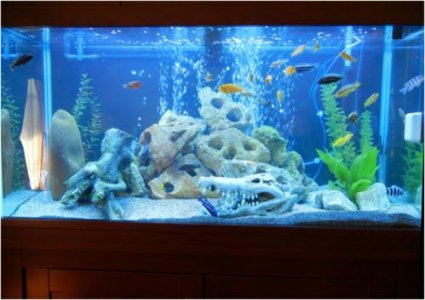
Hi everyone. My 7 month old 90 gal cichlid tank is probably overstocked (25 fish.) I realize there are lots of fish in there, but I don't mind regular cleanings. Well, my nitrates are off the chart. The test turns DARK RED almost immediately after shaking the tube after the 2nd drops are added. I've been doing 40% water changes every week for 2 months and the conditions haven't changed. I clean my Rena Filstar 3 basket filter about once every month too. I have that black/gray sand substrate and when I do a WC I try to agitate the sand after taking any gunk off the top layer. The sand is pretty deep (about 2 inches.) I know this is bad, but I just added the amount the guy at the LFS told me to. I also remove all rocks and ornaments for every other WC. I just can't get my nitrates down!

I purchased Instant Oceans Nitrate Reducer and double dosed yesterday. I will do the same in a week. Live plants are a no go in my tank. Am I missing something? I feel like with the amount of work I've been putting into the tank, I should see results. I don't know what skimmers are, but I don't really want to add anything else to my set up. I heard some sort of algae house filter may work too, but I feel like many other people don't need to mess with this stuff. Any advice for a struggling noob? I just feel like I must be doing something wrong. Thanks. :confused:
 

Attachments

  • MyTank.jpg
    MyTank.jpg
    30.9 KB · Views: 7
Change/clean your filter more than once a month. Try cleaning it every few days. Try to clean all the gunk out of the sand when you do water changes. Not just off the top. You have a fresh water tank, so a skimmer will not help you. Why can't you have plants?
 
Thanks, EC. I try to goof the sand up quite a bit during WCs. The guy at my LFS told me not to do more than 1 40% wc/week so I don't kill the bacteria. I will try cleaning the filter more though! I heard cichlids just destroy plants and you end up getting more dead organic matter in the long run. Not sure if this is the case or not though. I'm hoping that Instant Ocean stuff is a miracle worker. Thank God I don't do marine. It seems like you guys have 1000 other things to worry about too! fun fun fun! :)
 
There usually isn't a lot of anoxic zones in a freshwater tank, and the picture in the OP looks like probably none. They're usually a bad idea anyway, especially in a heavily stocked cichlid tank, so you're doing good not to have that.

But it does preclude you from dosing organic carbon for nitrate and phosphate removal since that mostly happens at very low O2 concentrations. So don't be surprised if you don't see much effect from the Nitrate Reducing products.

That being said, nitrate isn't a huge concern in a cichlid tank. You can let it run pretty high. Some big water changes and maybe cleaning up the substrate and filters a little will probably help out a lot.
 
Thanks, EC. I try to goof the sand up quite a bit during WCs. The guy at my LFS told me not to do more than 1 40% wc/week so I don't kill the bacteria. I will try cleaning the filter more though! I heard cichlids just destroy plants and you end up getting more dead organic matter in the long run. Not sure if this is the case or not though. I'm hoping that Instant Ocean stuff is a miracle worker. Thank God I don't do marine. It seems like you guys have 1000 other things to worry about too! fun fun fun! :)


Water changes of any frequency or size will not kill your bacteria, unless your using water with chlorine or chloramines...which need to be removed for even small water changes.

In this situation, I would vacuum that sand bed (a low flow vacuum won't remove the sand ;) ). Do a large (50%) water change every other day until those nitrates come down. They'll start coming down fairly quickly after a few day of that.
 
Since when are trates a concern in FW tanks?

High nutrients lead to algae growth, and most FW people don't want to see that. Controlling nutrients, reduces algae growth, both in fresh and salt water. Plus it just provides a cleaner environment for your pets to live in.
 
They can also lead to health issues with some fish, even FW.

Algea growth makes sense...but I thought fish health wasn't a problem till you were at or upwards of 1000ppm? I'm not trying to say anyones wrong, just trying to correct my perception if its that far off...
 
Algea growth makes sense...but I thought fish health wasn't a problem till you were at or upwards of 1000ppm? I'm not trying to say anyones wrong, just trying to correct my perception if its that far off...

I've read studies that pretty much agree with what you just said. From what I've read, they don't detect problems until the nitrate level gets insanely high. Then it usually starts off with problems associated with reproduction. I have some serious problems with these types of studies. For one, it can be hard to judge the health of a fish until problems become life threatening. You can't really check their pulse, blood pressure, or temperature. If the fish isn't loosing mass, or color, it's assumed to be healthy. I've read several studies that suggest that nitrate isn't harmful until levels are extremely high, but I've seen zero that prove it. Then you have the problem that nitrate rarely becomes elevated by itself. It's typically accompanied by phosphate, heavy metals, and many other elements. Nitrate is relatively easy to test for, so it can be used as an indicator of the overall health of the system.
 
Algea growth makes sense...but I thought fish health wasn't a problem till you were at or upwards of 1000ppm? I'm not trying to say anyones wrong, just trying to correct my perception if its that far off...

It can be species dependant. Some are fairly bullet proof, and some can have issues. Often the issues are somewhat non descript and fall under the heading of failure to thrive. Things like a lack of breeding activity, poor coloration, sluggish behavior, etc.

Then you have the problem that nitrate rarely becomes elevated by itself. It's typically accompanied by phosphate, heavy metals, and many other elements. Nitrate is relatively easy to test for, so it can be used as an indicator of the overall health of the system.

All those other items can indeed often be the major problem. It can be difficult to seperate them out since they all typically go hand in hand with such large increases in nitrates. Most studies done with direct boosting of nitrates are also typically short duration of weeks or months, as opposed to the long term of months to years that are common in hobbyists tanks.
 
Back
Top