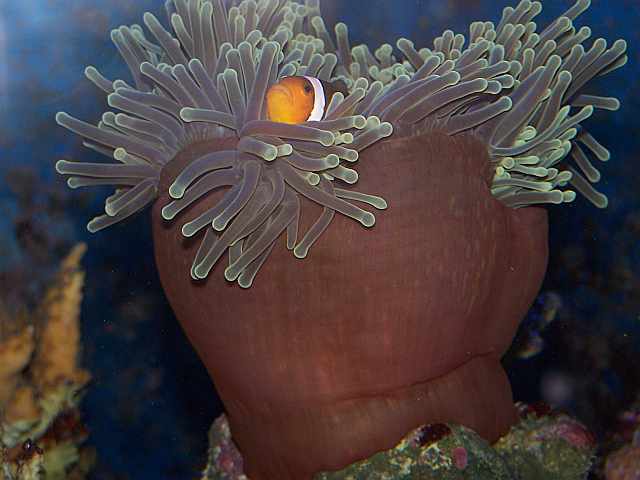
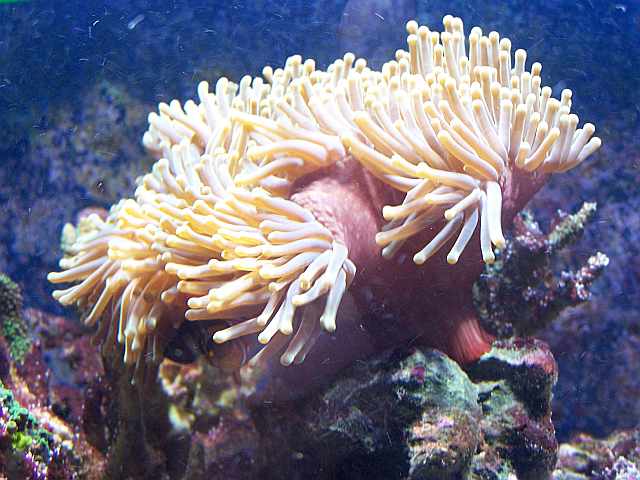
H. Magnifica clone color change pic

Flighty

Premium Member
Thought you all would be interested to see the difference a change of environment can make in a Magnifica. A friend's magnifica split several times and I bought two of the clones about three weeks apart. Here is a pic of the two next to each other after one had spent time in my tank and the other had been in his frag tank.

The yellow/green one has been in my tank and the closer one has been in his and retains the color of the parent. In this photo the yellow one appears a little bleached, but in person both have about the same depth of coloration. It is interesting to note that they both have some bleached tentacles near their split sites.

56032DSC09586.JPG


I am still unsure of the health of these guys and am keeping my fingers crossed. This anemone(s) has been in captivity for ~7 years. I am seeing some signs in both the parent and splits of what I would have previously been sure were terminal problems. I am now hoping that I was wrong and they are normal signs that a captive magnifica can show (and recover from) during the stress of splitting.

This magnifica has never spawned in captivity.
 
not to sound presumptious but its my understanding that h. magnifica does not split as a form of reproduction. are you sure these are h. magnifica and not something else?
 
not to sound presumptious but its my understanding that h. magnifica does not split as a form of reproduction. are you sure these are h. magnifica and not something else?

Oh yes they do.

here is a picture of mine splitting a few years ago
nem3.jpg


I posted a thread about it at the time.
 
Yes, they do split (rarely). It is not clear to me yet if the particular cloans I have split due to trauma or health problems. The parent was in a system that experienced an ozone overdose several months ago and the parent was damaged in a rock slide prior to splitting.

There is no doubt to the id though. The parent colony was much larger than it is possible for a BTA to get and it displays all of the identifying charactoristics and behaviours of a Magnifica.

Here is a pic of the colum for confirmation.
56032DSC09607.JPG
 
<a href=showthread.php?s=&postid=7465839#post7465839 target=_blank>Originally posted</a> by Flighty
Here is a pic of the colum for confirmation.
Great picture for an ID :>)
 
<a href=showthread.php?s=&postid=7465703#post7465703 target=_blank>Originally posted</a> by oosurfin
not to sound presumptious but its my understanding that h. magnifica does not split as a form of reproduction. are you sure these are h. magnifica and not something else?

H. magnifica split frequently in the wild. In fact, aside from E. quadricolor, I believe they are the most common splitting clown anemone. In the wild you will often see entire colonies of H. magnifica together - most often clones from a single parent.

393939new.jpg
 
It seems like there may be two different "types" of H. mag. One grows in groups and splits when it gets to 18" diameter or so and the other grows to 30"+ as a single animal. It might be conditions or genetics which cause the difference, but there is generally no way to find out how your anemone was living when it was in the ocean.

Edit: feel free to use any of the pics in my galery that are not marked as "not mine" for ID posts or guides.
 
the H. Mag i have which has a tan base is now starting to turn red at the very base of the foot and is slowly working its way up.. i wonder why its doing this??
 
<a href=showthread.php?s=&postid=7482056#post7482056 target=_blank>Originally posted</a> by SVXH6
the H. Mag i have which has a tan base is now starting to turn red at the very base of the foot and is slowly working its way up.. i wonder why its doing this??

Probably its natural color. The magnificas in French Polynesia have dark blood red bases, brown tentacles and white tips. The magnificas in the Red Sea have deep purple bases and yellow tentacles. There are probably many other local color morphs out there.
 
then it would be just another color change for this Mag.. if you have seen any of my previous posts, i obtained it only about 2 inches across extremely bleached.. now 10months later, its 14 inches across, tan tentacles green tips, pic is in my avatar, also in my gallery from different points in change for the Mag.. its crazy to see what it turned into..
 
In Polynesia, Tonga and Fiji most of the H. Mag in captivity are collected from the colonial groups in the wild. The single anemones are too big to ship and not common enough to bother with. If you check wild anemones it is common for many of the anemones in a group to show signs of splitting. Some clonal aggreagations in Polynesia are reported to have 500,000 individuals in them.
 
<a href=showthread.php?s=&postid=7469918#post7469918 target=_blank>Originally posted</a> by Flighty
It seems like there may be two different "types" of H. mag. One grows in groups and splits when it gets to 18" diameter or so and the other grows to 30"+ as a single animal. It might be conditions or genetics which cause the difference, but there is generally no way to find out how your anemone was living when it was in the ocean.

Edit: feel free to use any of the pics in my galery that are not marked as "not mine" for ID posts or guides.

would this be h. mag and h. crispa? i cant use the search right now so i cant find the thread but all of the identifications i have seen for h.mag state they lack the verruce on the foot that are pictured in the id pics here.
 
Wow the colors all of you have are amazing. My ritteri that I have had close to 5 months now is very bleached and the foot is a very rich brown. It appears the coloring is coming back as the tentacles are getting spots of color.

Just for FYI I feed a (silverside, squid or krill one of the three) daily. Should I go with a different food or feed twice a day, what do you guys do?
 
No, I think you are mistaken. H. mag always has the verruce. The ID on the guys pictured here is pretty much 100%
 
H. mag always has the verruce...

it is correct ritteri anemone has them , but IMO lack of verrucae shouldn't be only identifier when trying to ID anemone.. Some observations made me conclude that magnifgica might retract them for some reason. I'm not really sure why but some experiments made me think weak water movement might be the reason..

my anemone during feeding session with streamers switched off

anemona%20zatvorena.jpg


same anemone under current with visible verrucae

anemona%20i%20struja.jpg
 
Back
Top