H.magnifica health & melanism in Percs?

No doubt it was much more riveting and exciting on Vicoden...

;)

All kidding aside, its a good article. Thanks.

Hope your back is okay.

Nick
 
No doubt it was much more riveting and exciting on Vicoden...

;)

All kidding aside, its a good article. Thanks.

Hope your back is okay.

Nick

Thanks Nick. I just aggravated doing a room make over for Make-a-Wish over the weekend. After having a spinal fusion I have to remember that I can't do the same things I did 10 years ago. :)


And back to this thread; When my clowns lost their black/regained it, the only thing that changed was the anemone. Their food stayed the same, the lights, everything. All I did was pulled the M. doreensis out and put in an S. haddoni. The whole process took maybe a minute, and the clowns were being hosted by the S. haddoni before I even had it all the way inside the tank.
 
Fair enough statement. Yes, I've developed allergies over the years.

Question though:

I have two Heteractis magnifica anemones. The brown based, yellow tipped one in the pictures has been with me since 03-10-2006. This is the one that raises welts and causes "burns" when I make contact with the tentacles.

The other H. magnifica has only been with me for a year, and came in seriously under the weather...(for pics and more on it, visit this thread: Heteractis Magnifica - Tell me some success stories)

This is the same species of anemone, yet I get no allergic response (currently) when touching the tentacles or being brushed by them. They are sticky, and the anemone is healthy now, but I get no burning sensation like I do with the yellow tipped anemone, no raised welts, basically no allergic reaction.

If "Almost all the zooxanthellate fish-hosting sea anemones have the same compliment and size of nematocysts", then its probably safe to assume that members of the same species would have same chemical make up and composition of nematocysts?

And since the short version of an allergic reaction in humans is the protein receptor sites on the cells binding the protein, (nematocyst in this case) that the body has "decided" is something that is foreign and needs to be removed and dealt with, (allergic reaction...please dont make me go back downstairs and dig up my old A&P, and EMS textbooks so that I can get more detailed...I suspect you already know this information and its late for me)...

Wouldn't I have the same allergic reaction when I touch the newer purple based/tipped H. magnifica anemone as I do I when I touch the yellow tipped, brown based H. magnifica anemone?

I don't get the allergic reaction when I touch the H. crispa anemone that's been in my care for the past 4 something years.

I don't get the allergic reaction when I touch the two E. quadricolor anemones I've had for over a year.

I think its fair to assume that the E. quadricolor and the H. crispa anemones have a different chemical composition to their nematocysts, since they are different anemones, and I don't get the allergic reaction to them.

However, I highly doubt that the "new" H. magnifica has a different chemical composition, (therefore different proteins which would bond to different protein receptors on the cells, thereby NOT eliciting an allergic reaction), than the "old" one.

I am allergic to Urushiol which is the toxin/allergen found in Poison Ivy.
When I touch poison oak or poison sumac, I get the same reaction as if I touched poison ivy. The urushiol is what causes that reaction. What is it in the nematocysts of the yellow tipped H. magnifica that causes me to have an allergic reaction? Why is that missing in the other H. magnifica, and why/how is that missing from the other anemones I keep as well?

I freely admit I'm neither a scientist, nor a marine biologist.

I could be wrong, which is why I'm trying to see what others who are more knowledgeable think and see where the discussion takes us.

Thanks for joining in the discussion.

Nick

Link?

From my understanding, Daphne Gail Fautin states differently,

From the abstract, http://www.nhm.ku.edu/inverts/pdf/TOXCON3456.pdf

Plus, as someone who has been stung by an E. quadricolor and than an S. haddoni, I say that there is a huge difference.

I am not 100% sure on why you are having a reaction to one anemone and not the other. Are they both from the same area in the wild? There is genetic variation within species and it may be that different localities have different variations of the same toxin leading you to have a different reaction.

From Fautin, D.G. 2009. Structural diversity, systematics, and evolution of cnidae. Toxicon. 54: 1054-1064
"A problem with taxonomic diagnosis based on nematocysts is that all members of a species may not have the same cnidom."

Your H. magnifica may not have the same cnidom. You may be developing a reaction now, I suggest wearing gloves in an aquarium when working with cnidarians. What I said before was qualified with an almost all, anemonefish hosting anemones don't vary much in their cnidom (type of cnidae), but the toxins involved and the concentration of the toxins may vary greatly, nematocyst toxin research is very underdeveloped.

From Fautin, 2009
"Although cnidarian venoms are the subject of intensive study (e.g. Smith and Blumenthal, 2007), ascertaining that the venom is from nematocysts can be very difficult (reviewed in Hessinger, 1988; McKay and Anderson, 1988)."

"For the anemonefish anemones, although a size range of particular nematocysts characterizes each species, it cannot be used to distinguish among all of them (Dunn, 1981), possibly because these animals are similar in ecology: evolutionary pressure may tailor nematocyst size (and perhaps even complement) to niche.

"In sea anemones, nematocyst size is charateristic of a species but does not necessarily differentiate species (Stephenson, 1929; Fautin, 1988; Williams, 1996, 1998), and no species can be identified solely by cnidae (Fautin, 1998)."

Personal communication between myself and Dr. Fautin on nematocysts received on 8.21.11
"MANY species are indisginguishable on the basis of nematocysts. All anemonefish hosts have the same cnidom and many have pretty much identical sizes of those cnidae. I suspect this is because they are so similar ecologically, and that nematocyst types and sizes are the products of selection due to diet, enemies, symbionts, etc. But those animals differ in many other ways so analyzing their cnidae is pretty immaterial for the purposes of identification. (I know of no species that is identifiable solely by nematocysts -- the family Actinodendridae is the only taxon that comes readily to mind that can be identified solely by nematocysts -- but members of the family are so distinctive otherwise that cnidae need not be invoked.)"

Thanks Nick. I just aggravated doing a room make over for Make-a-Wish over the weekend. After having a spinal fusion I have to remember that I can't do the same things I did 10 years ago. :)

And back to this thread; When my clowns lost their black/regained it, the only thing that changed was the anemone. Their food stayed the same, the lights, everything. All I did was pulled the M. doreensis out and put in an S. haddoni. The whole process took maybe a minute, and the clowns were being hosted by the S. haddoni before I even had it all the way inside the tank.

The only thing we know is that it is invoked by certain anemones with certain anemonefishes. What is happening is still a mystery.

In case anyone was wondering, I am a cnidarian biologist and ecologist at the University of New Hampshire focusing on Actiniaria (sea anemones).
 
Nematocysts and it's toxin are expensive for anemone to produce. It is well know to anemone keepers that unhealthy anemones are "much less sticky" than healthy anemones.

One very possible explanation why he did not react to anemone in poor health but a healthy Magnifica cause problem is just due to the health thus nematocyst density of the anemone. As in science, logical explanation without any experimental fact to back it up does not always the correct explanation.
 
Nematocysts and it's toxin are expensive for anemone to produce. It is well know to anemone keepers that unhealthy anemones are "much less sticky" than healthy anemones.

One very possible explanation why he did not react to anemone in poor health but a healthy Magnifica cause problem is just due to the health thus nematocyst density of the anemone. As in science, logical explanation without any experimental fact to back it up does not always the correct explanation.
 
I am not 100% sure on why you are having a reaction to one anemone and not the other. Are they both from the same area in the wild? There is genetic variation within species and it may be that different localities have different variations of the same toxin leading you to have a different reaction.

From Fautin, D.G. 2009. Structural diversity, systematics, and evolution of cnidae. Toxicon. 54: 1054-1064
"A problem with taxonomic diagnosis based on nematocysts is that all members of a species may not have the same cnidom."

Your H. magnifica may not have the same cnidom. You may be developing a reaction now, I suggest wearing gloves in an aquarium when working with cnidarians. What I said before was qualified with an almost all, anemonefish hosting anemones don't vary much in their cnidom (type of cnidae), but the toxins involved and the concentration of the toxins may vary greatly, nematocyst toxin research is very underdeveloped.

From Fautin, 2009
"Although cnidarian venoms are the subject of intensive study (e.g. Smith and Blumenthal, 2007), ascertaining that the venom is from nematocysts can be very difficult (reviewed in Hessinger, 1988; McKay and Anderson, 1988)."

"For the anemonefish anemones, although a size range of particular nematocysts characterizes each species, it cannot be used to distinguish among all of them (Dunn, 1981), possibly because these animals are similar in ecology: evolutionary pressure may tailor nematocyst size (and perhaps even complement) to niche.

"In sea anemones, nematocyst size is charateristic of a species but does not necessarily differentiate species (Stephenson, 1929; Fautin, 1988; Williams, 1996, 1998), and no species can be identified solely by cnidae (Fautin, 1998)."

Personal communication between myself and Dr. Fautin on nematocysts received on 8.21.11
"MANY species are indisginguishable on the basis of nematocysts. All anemonefish hosts have the same cnidom and many have pretty much identical sizes of those cnidae. I suspect this is because they are so similar ecologically, and that nematocyst types and sizes are the products of selection due to diet, enemies, symbionts, etc. But those animals differ in many other ways so analyzing their cnidae is pretty immaterial for the purposes of identification. (I know of no species that is identifiable solely by nematocysts -- the family Actinodendridae is the only taxon that comes readily to mind that can be identified solely by nematocysts -- but members of the family are so distinctive otherwise that cnidae need not be invoked.)"


The only thing we know is that it is invoked by certain anemones with certain anemonefishes. What is happening is still a mystery.

In case anyone was wondering, I am a cnidarian biologist and ecologist at the University of New Hampshire focusing on Actiniaria (sea anemones).


If I'm understanding your post and what I've read correctly, cnidom is another term for nematocyst. Cnidae is a group of cnidom/nematocysts.

So, not all members of the same species will have the same nematocysts/cnidom.
But all fish hosting anemones have the same cnidom and pretty much identical sized cnidae.

Why am I more confused now?

I don't know the origin, (region wise) of the yellow tipped H.magnifica anemone. The purple tipped one is allegedly from Fiji. Assuming the collection chain was correct and maintained.

Nick
 
This in an interesting topic from the past.
This one bit observation I also have about dark coloration of clown fishes.
A. percula and A. ocellaris often have mottled dark spots on their skin whey the hosted in strong stinging corals like mushrooms or polyps. This, I think (only my opinion with nothing to back this up), is from the scars and injury from sting of the polyps and mushrooms on the clown fish
 
I agree Minh.

Would have been nice if Anemone Fan had answered my questions and clarified things somewhat. He logged on 3 days ago so I know he's still around...

Nick
 
Hopping to add to this as well. I have a WC Onyx perc from SI that I have had for over a year. She has always had very dark black that has covered most of her body except her fins and head. Since introduction to a H. Magnifica that is very healthy (sticky/full at all times) she has lost most of her black and faded to a fairly bright orange. She still has thick black bars outside her white stripes but she no longer has solid connecting black like she did before. Also to note is her now mate (a B/W false perc that has been with her for 5 months) has lost the orange in his nose and turned completly black with the exception of his stripes. Here are some pictures for example. I will have to get a better picture of the females current coloration to show how much she has really changed.

Here is a picture of the female the day the nem got added to the tank, she has very vivid black marking.
Magnifica004.jpg


Here is a picture of her and the male from the same day, you can see the male still has quite a bit of orange on his nose.
Magnifica006.jpg


For good measure here is a video of the two clowns taking the same day.


Here is a bad cellphone picture taken last night showing how much the coloration has changed.
C056CB83-orig.jpg


I will have to add another photo showing just how much of the orange the female has lost. It is very suprising to see her looking closer to a false perc then an onyx, but I love the anemone and would not change it out for anything.
 
Tyler,
IMO, we can attribute the Ocellaris lost of orange face is due to maturation, normal color development for Black Ocellaris. I think your Percula lost of black is the effect this threat is all about.
 
Two parts:
Part 1. Fish colors
I had a pair of tank bred picasso clowns (had meaning I lost the female 3 months ago.) They showed alot of black. They were purchased with their M doreensis and my observation of their coloration began there. This was the arrangement for 2 years. Then, I added a S Haddoni to the tank, and, the pair remained hosted by the M doreensis primarily. When the eggs hatched, they would spend a bit of time in the S haddoni, but always slept in the M doreensis. The anemones were about 10 inches apart in a 180 tank. I didn't notice a pigmentation change. The two anemone situation was for a year, all together, 3 years observed.

I broke down the tank (sold both the M. doreensis, and the S. Haddoni, and went with a 60 cube. I obtained a S gigantea from a fellow reefer. The clownfish pair were moved into the 60 cube and within seconds, were hosted by the S gigantea. Again, pigmentation seems unchanged.

Part 2. Anemone "sting"
The M doreensis, in 3 years of tank maintenance never "stung" me. It was extremely healthy, stable, etc. No discomfort from touching it whatsoever.
The S haddoni. I ordered it, and acclimated it to tank life. It was super sticky, and very healthy. I had it for a year, and touching it (to clear out the snail shells under it or pick up a frag that fell beside or into it...) no discomfort, no "sting" and no rash or any other word that would describe it. The guy that bought it removed it from my tank. It stung, burned, whatever you want to call it, the heck out of him. And still does if he touches it.
The S gigantea. Very healthy, a couple years in captivity to my knowledge. I've had it since Feb 2012. If I even look at it too hard through the glass, my arm welts up. Ok, I'm exaggerating a bit, but, even incidental, brush by contact (a 60 cube isn't very big) result in rashes that last at least a week.

I don't believe that it's an acquired immune response (primarily.) I am forced to wonder, the M doreensis was happy in my tank, and never "felt" (yes.. dangerous word, I know) threatened and had no need to protect itself (and it may have realized my arm was too large to eat. The S haddoni literally taco'd my arm once (it's amazing how fast they move!!) I thought for sure I was going to regret trying to save that frag. Not so much as a minor rash. Yet when the new owner was disturbing it's foot (6 inches plus of sand) perhaps it "felt a need" to protect itself? I'm convinced the S. gigantea is just out to get me ;)

Seriously though, this conversation is wonderful! I just wanted to share my experiences with different anemones and ask you to keep it up!
 
Tyler,
IMO, we can attribute the Ocellaris lost of orange face is due to maturation, normal color development for Black Ocellaris. I think your Percula lost of black is the effect this threat is all about.

I agree that the maturation could be a contributing factor for the finished black of the Ocellaris, I just wanted to mention it in case it was caused by the nem (I could always remove him to a no nem tank to test the theory). The true perc is a prime example of what this thread talks about and thought it would be relevant because it is a wild caught onyx vice a Rod's Onyx. The change in my fish was fare more apparent then just turning brown. I will post a better picture for you guys tonight or tomomrow.
 
Just to bring this thread from the oblivion because I have another wrench to throw into the whole thing.
This pair of A. percula have been in this Magnifica for the alt 6+ months. When I first put them in the male coloration is the same, and the female was much darker, full Onyx with black dorsal fin. I am sorry I did not think to take a picture of them on arrival. However, their coloration quickly change to the picture below. Both fish are very healthy and growing. They are near breeding at this time. In this tank, there is another anemone, a Gigantea/Haddoni hybrid also.

I think the color change definitely have to do with the fish, but also the anemone. It is going to be some sort of interaction between the fish and anemone. In the future, I will try to change host for a time and the reintroduce to this host again and see if there is any changes.
With this observation, I think I can safely eliminate health of the fish and health of the anemone as factors that can impact this phenomenon.


attachment.php
 

Attachments

  • PerculaColorLost.jpg
    PerculaColorLost.jpg
    70.6 KB · Views: 10
Here is the female before she went into my Magnifica.


attachment.php
 

Attachments

  • PerculaColorLost2.jpg
    PerculaColorLost2.jpg
    23.8 KB · Views: 10
I have a new mag that seems it will make it through initial acclimation and 2 clowns are in it, I'll take pics and compare on down the road
 
nice thread........

observing pictures of Percs in the wild......we can see that Percs in Mags do not show sign of melanism........and they live in deeper Waters.......


in shallows........where Gigs live...... they show melanism.............

I never saw pictures of them hosted in other anemones in the wild........except (S. gigantea)....and (H. magnifica)...........


I don´t think that the nematocyst have an issue.......

Maybe the mucus composition.....some kind of protein.........that the clown ingest when they bite the tentacles...........to achieve symbiont equilibrium.......

Gerald Allen did an experiment with (A. tricinctus ).......in the wild (Marshalls)..........
 
What about in this last pair in my Magnifica. The female lost melaninism while the male is as black as he can be. They are in this anemone for the last 6 months or so. Become like this since I put them in there.
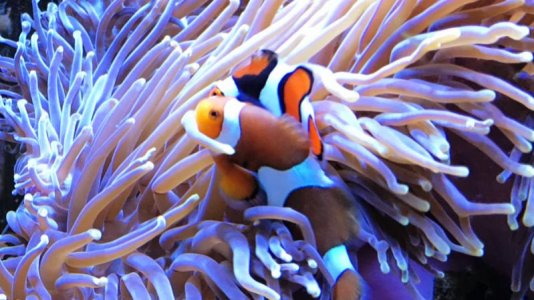
 
In the next few weeks I will swap the Magnifica out and put a Gigantea in this tank. There is also a Gigantea/Haddoni hybrid in this tank but the clowns never go into this anemone.
I will try to document the color change that this will result from this anemones changes.
 
What about in this last pair in my Magnifica. The female lost melaninism while the male is as black as he can be. They are in this anemone for the last 6 months or so. Become like this since I put them in there.

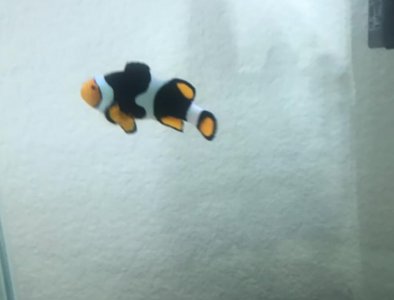
ah....there´s another issue........I remember Bill Addison and the fishes from C-Quest.....Onyx Percula........that have a genetic issue...........I read an article about that.....
 
Back
Top
