Toddrtrex
Premium Member
Love the late night light reading material Todd.
Thanks....
Nick

Ha. I know I wasn't 100% sure about that article, it was late and I had already taken a couple of vicodine for my back.


Love the late night light reading material Todd.
Thanks....
Nick
No doubt it was much more riveting and exciting on Vicoden...
All kidding aside, its a good article. Thanks.
Hope your back is okay.
Nick
Fair enough statement. Yes, I've developed allergies over the years.
Question though:
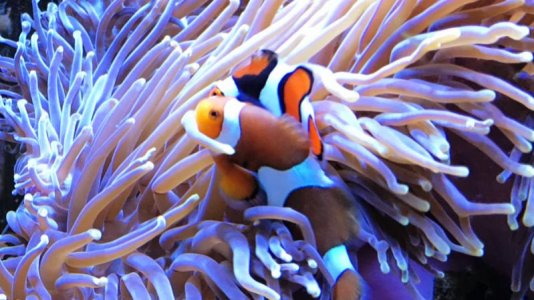
I have two Heteractis magnifica anemones. The brown based, yellow tipped one in the pictures has been with me since 03-10-2006. This is the one that raises welts and causes "burns" when I make contact with the tentacles.
The other H. magnifica has only been with me for a year, and came in seriously under the weather...(for pics and more on it, visit this thread: Heteractis Magnifica - Tell me some success stories)
This is the same species of anemone, yet I get no allergic response (currently) when touching the tentacles or being brushed by them. They are sticky, and the anemone is healthy now, but I get no burning sensation like I do with the yellow tipped anemone, no raised welts, basically no allergic reaction.
If "Almost all the zooxanthellate fish-hosting sea anemones have the same compliment and size of nematocysts", then its probably safe to assume that members of the same species would have same chemical make up and composition of nematocysts?
And since the short version of an allergic reaction in humans is the protein receptor sites on the cells binding the protein, (nematocyst in this case) that the body has "decided" is something that is foreign and needs to be removed and dealt with, (allergic reaction...please dont make me go back downstairs and dig up my old A&P, and EMS textbooks so that I can get more detailed...I suspect you already know this information and its late for me)...
Wouldn't I have the same allergic reaction when I touch the newer purple based/tipped H. magnifica anemone as I do I when I touch the yellow tipped, brown based H. magnifica anemone?
I don't get the allergic reaction when I touch the H. crispa anemone that's been in my care for the past 4 something years.
I don't get the allergic reaction when I touch the two E. quadricolor anemones I've had for over a year.
I think its fair to assume that the E. quadricolor and the H. crispa anemones have a different chemical composition to their nematocysts, since they are different anemones, and I don't get the allergic reaction to them.
However, I highly doubt that the "new" H. magnifica has a different chemical composition, (therefore different proteins which would bond to different protein receptors on the cells, thereby NOT eliciting an allergic reaction), than the "old" one.
I am allergic to Urushiol which is the toxin/allergen found in Poison Ivy.
When I touch poison oak or poison sumac, I get the same reaction as if I touched poison ivy. The urushiol is what causes that reaction. What is it in the nematocysts of the yellow tipped H. magnifica that causes me to have an allergic reaction? Why is that missing in the other H. magnifica, and why/how is that missing from the other anemones I keep as well?
I freely admit I'm neither a scientist, nor a marine biologist.
I could be wrong, which is why I'm trying to see what others who are more knowledgeable think and see where the discussion takes us.
Thanks for joining in the discussion.
Nick
Link?
From my understanding, Daphne Gail Fautin states differently,
From the abstract, http://www.nhm.ku.edu/inverts/pdf/TOXCON3456.pdf
Plus, as someone who has been stung by an E. quadricolor and than an S. haddoni, I say that there is a huge difference.
Thanks Nick. I just aggravated doing a room make over for Make-a-Wish over the weekend. After having a spinal fusion I have to remember that I can't do the same things I did 10 years ago.
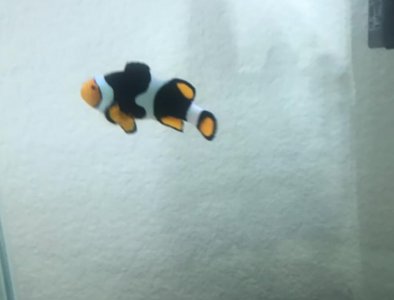
And back to this thread; When my clowns lost their black/regained it, the only thing that changed was the anemone. Their food stayed the same, the lights, everything. All I did was pulled the M. doreensis out and put in an S. haddoni. The whole process took maybe a minute, and the clowns were being hosted by the S. haddoni before I even had it all the way inside the tank.


I am not 100% sure on why you are having a reaction to one anemone and not the other. Are they both from the same area in the wild? There is genetic variation within species and it may be that different localities have different variations of the same toxin leading you to have a different reaction.
From Fautin, D.G. 2009. Structural diversity, systematics, and evolution of cnidae. Toxicon. 54: 1054-1064
"A problem with taxonomic diagnosis based on nematocysts is that all members of a species may not have the same cnidom."
Your H. magnifica may not have the same cnidom. You may be developing a reaction now, I suggest wearing gloves in an aquarium when working with cnidarians. What I said before was qualified with an almost all, anemonefish hosting anemones don't vary much in their cnidom (type of cnidae), but the toxins involved and the concentration of the toxins may vary greatly, nematocyst toxin research is very underdeveloped.
From Fautin, 2009
"Although cnidarian venoms are the subject of intensive study (e.g. Smith and Blumenthal, 2007), ascertaining that the venom is from nematocysts can be very difficult (reviewed in Hessinger, 1988; McKay and Anderson, 1988)."
"For the anemonefish anemones, although a size range of particular nematocysts characterizes each species, it cannot be used to distinguish among all of them (Dunn, 1981), possibly because these animals are similar in ecology: evolutionary pressure may tailor nematocyst size (and perhaps even complement) to niche.
"In sea anemones, nematocyst size is charateristic of a species but does not necessarily differentiate species (Stephenson, 1929; Fautin, 1988; Williams, 1996, 1998), and no species can be identified solely by cnidae (Fautin, 1998)."
Personal communication between myself and Dr. Fautin on nematocysts received on 8.21.11
"MANY species are indisginguishable on the basis of nematocysts. All anemonefish hosts have the same cnidom and many have pretty much identical sizes of those cnidae. I suspect this is because they are so similar ecologically, and that nematocyst types and sizes are the products of selection due to diet, enemies, symbionts, etc. But those animals differ in many other ways so analyzing their cnidae is pretty immaterial for the purposes of identification. (I know of no species that is identifiable solely by nematocysts -- the family Actinodendridae is the only taxon that comes readily to mind that can be identified solely by nematocysts -- but members of the family are so distinctive otherwise that cnidae need not be invoked.)"
The only thing we know is that it is invoked by certain anemones with certain anemonefishes. What is happening is still a mystery.
In case anyone was wondering, I am a cnidarian biologist and ecologist at the University of New Hampshire focusing on Actiniaria (sea anemones).


Tyler,
IMO, we can attribute the Ocellaris lost of orange face is due to maturation, normal color development for Black Ocellaris. I think your Percula lost of black is the effect this threat is all about.

What about in this last pair in my Magnifica. The female lost melaninism while the male is as black as he can be. They are in this anemone for the last 6 months or so. Become like this since I put them in there.