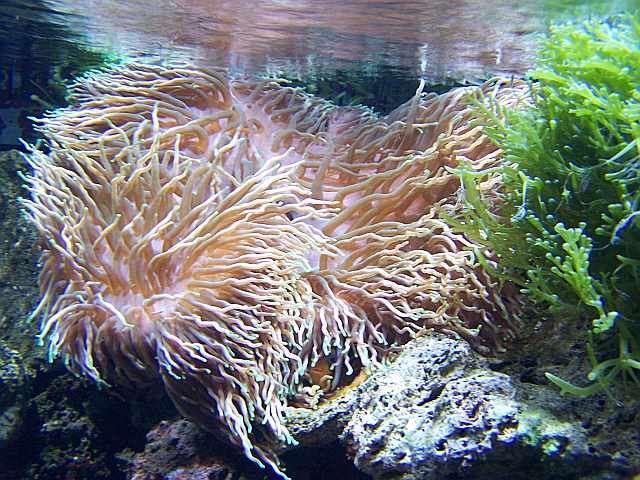
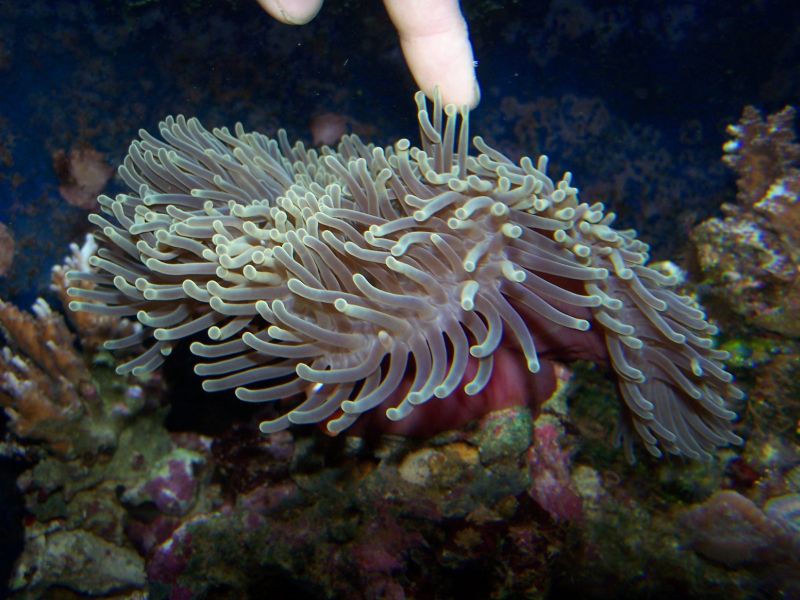
Heteractis Magnifica

i understand i don't have any established credibilty. but you should never assume anyone's. take other's experience as a guideline b/c you are bound to gain your own. history seems to laugh at us with facts, phender, as a teacher of science you well know how conventional wisdom seems to be unendingly squashed. i'm sure you've even found stuff you've read by the published guru's to be way wrong.

by saying mine balls up i should have been more explicit, i was just trying to say mine exhibits the behavior that is very characterisitic of mags.
in my experience po4 is akin to poison, if i wanna follow rigid thought processes, i could back up my claim by saying mag's occur on coral reefs where po4 is virtually zero. but i won't back myself into that kinda corner.

who's to say that svxh6's mag could not have lived a long life under pc's.......it regained health....as far as color goes ric's love light and color in best under halides but have no problem living under pc's, etc.

i think we can all agree that the hobby has afforded us the priceless opportunity to learn first hand that animals evolve and adapt.

check out this heteractis magnifica at the bottom of this page.

http://www.wetwebmedia.com/marine/inverts/cnidaria/anthozoa/hetmagnifica.htm
 
for someone with relatively little experience you are making pretty strong statements with no evidence.

Not saying it is impossible just that you are making grand generalizations about how easy they are to keep. If your only basis for making this generalization then that has no credibility. If you have a long experience keeping them (i.e. not one or two anemones) then please post details about your experiences including pictures. If you have problems posting feel free to email them to me using the e-mail link in this post and I'll put them up for you.
 
interesting topic, here goes my opinion


I think the main key is that you actually can get a healthy specimen!!

absolutely correct.. All anemones are poor shippers but I think major blame for Mags poor survival record should be pointed to collectors and way they collect these animals.. These creatures are attached to rock structures with their basal disk and when you disturb one it shrinks and fastens to its rock even harder..When I think of this I ask myself what is the chance here to quickly collect one specimen without hurting and injuring it? My honest opinion is if these creatures would be collected and shipped together with piece of rock on which they are attached we would have much greater survival rate..

a few anemone keepers were able to keep H. magnifica alive longer than 7+ years

With all respect to everyone here on board I seriously doubt there are many reefers out there who have their tanks unchanged up and running for 10 years or more.. Most of us change things, rearrange scape, go bigger or get other setup, move to other species (sps are popular way to go once some basic experience is obtained), run broke or lose interest ..but thats definitely great accomplishment for devoted few..

friend's 15 years old crispa display..;)
anemona%7E0.jpg


All anemone species that I've had experience with can easily tolerate levels of PO4 that are detrimental to the growth of scleractinians.

same here, not that I would recommend keeping these anemones to people who can not keep their water on the level but still during some wild crashes when acroporas collapsed and many died magnifica looked good as always..That might been a pure luck but I concluded that anemone if healthy will tolerate some minor screw ups here and there... I believe that mega pure water theory as essential for anemones survival doesn't hold to much water.. but than again I might be wrong..

And for the lighting , I think MH are really best option.. Not only cause of light intensity (theoretically one can also keep it in darkness and keep it in life with daily feeding.. if that would be only issue) but also because of central lighting point which to anemone represents the sun and help to keep it directly under it (in other words together with good arranged aquascape can prevent it from wandering)


just my 2 cents
 
Hey, I didnt even realize that this thread was still alive...
I am actually not sure what type of anemone mine is now, i have posted pics before but got mixed responses.
I dont have any recent pics since its regained some of its brown, it does not ball up when it eats, it is sitting low in the tank, foot wedged between rock and sand, tentacles are more rounded (not stringy). It was sold to me as a bta but I never agreed with that.
Here is a pic. Also the foot is a gold or yellow color.
newane.jpg


It is no longer white, its more tan/brown, but it has retained its purple tips.
Anyone with a solid ID would be appreciated.
 
From that pic and your description, I would say probably H. crispa. There is a small chance that it could be a BTA. IMO, no chance that it is a magnifica.

My guess is that it has prominant bumps on its underside. If it does, then it is H. crispa (sebae anemone)
 
it does have the prominant bumps, and after my original post in this thread I did realize that it wasnt a magnifica, but it also doesnt resemble most crispa's that i have seen, I guess that it is just an unusual looking sebae.
 
Magnificas

Magnificas

I have succesfully kept a Magnifica for almost 6 years. It has survived all the "disasters" that the SPS corals and even some LPS corals did not: heat spikes, AEFWs, red bugs, algae blooms, etc. Who says these are harder to keep than corals?:D

B4 I purcahsed the anemone I did a lot of research and came across some great literature by Joyce Wilkerson. Basically I found the following:


1. Getting a healthy specimen is paramount to successfully keeping this anemone long term

2. Initial placement is key: Place the anemone directly under a MH bulb, feed it daily for a week or so, and do not give it strong current.
If it is initially happy, it will not move much and will attach more quickly and establish a good footing with all its lighting, food and water flow requirements.
3. Strong current can be used to stop the anemone from wandering by pointing the current flow perpindicular to the path of travel.

4. Splitting may be induced via gravity ( see my previous post on this )

5. Once acclimated, these anemones do not require target feeding. They get most of their energy via photosynthesis and stray fish food that passes into its tentacles. I feed mine rarely if ever.....maybe once or twice every 2 months or so. Anemones will also consume themselves if not fed adequately and under insufficient light . If u want the beast to grow then feed it. If not, then do not target feed it except on rare occasion. Once you get the hang of it you can feed just enough to keep it happy without growing if that is your goal.

I originally got my Mag since my favorite clown is the ocellaris species that readily accepts Magnificas, but few other anemones. Plus I love the look of the Magnifica. The anemone and the two breeding clowns hosting in it have given me endless viewing pleasure through the years. It is eally incredible to me to observe how hard they work to clean off a space at the base of the anemone to lay and fertilize the eggs and how the male aerates and guards the eggs daily.

I also have a Haddoni with a pair of breeding Clarkiis at the other end of my tank. They too are wonderful to observe in their daily routine of cleaning around the anemone, monthly egg laying, and sleeping directly in the mouth of the Haddoni.
 
well i was moving a rock in my tank and my H. Mag latched on to my forearm...WOW was this painful.. i have been stung by 17 bees at once(walked into a nest), but this was uncomparable.. i had a huge red circle up 1/2 of my forearm along with welts where the tentacles were attached.. it burned, itched and was bright red..i have heard a healthy Mag will get ya good well i felt it..
 
I also have a Haddoni with a pair of breeding Clarkiis at the other end of my tank...

wild, how big is your display and does female clarkii play nice with percs.?

i was moving a rock in my tank and my H. Mag latched on to my forearm...WOW was this painful..

ouch, i noticed it too :D, when I clean front glass sometimes I feel light irritation at my forearm, not that I pressing arm against the anemone but still feel its presence.. On the other hand I play with my anemone often, tickle it and so, but thats harmless.. Skin on our fingers is way to rough to be irritated by it..

mag_02.jpg
 
Family Feud

Family Feud

Well the Clarkiis, as you know, are much bigger than the ocellaris clowns. Frequently, the clarkii would race over to the Magnifica and challenge my two ocellaris clowns. It really started getting out of hand as the Clarkii got more and more comfortable leaving his Haddoni. My display is 300 gallons. The Haddoni is down low in the sand on the right side of the tank. The Magnifica is up high on the rocks on the left side of my tank. The tank is 8 feet long but the 2 anemones are probably 6 feet apart in horizontal distance and around 1 foot apart in vertical distance.

To calm the Clarkii down, I got another small Clarkii and they paired up instantly. :) I figured a mate would be a diversion for the original Clarkii and leave him/(now a her) less time for other mode destructive behaviors. I am no clown fish expert, but it worked! Both pairs stay pretty much close to their host anemones. The Clarkii rarely if ever bothers the Ocellaris pair now.
I think she is in love! :p


<a href=showthread.php?s=&postid=7281088#post7281088 target=_blank>Originally posted</a> by Jadran
I also have a Haddoni with a pair of breeding Clarkiis at the other end of my tank...

wild, how big is your display and does female clarkii play nice with percs.?

 
Anemone Pic

Anemone Pic

Mario, here is a picture of the display tank with both anemones visible:

showphoto.php
 
Re: Family Feud

Re: Family Feud

<a href=showthread.php?s=&postid=7290813#post7290813 target=_blank>Originally posted</a> by spyro
To calm the Clarkii down, I got another small Clarkii and they paired up instantly. :) I figured a mate would be a diversion for the original Clarkii and leave him/(now a her) less time for other mode destructive behaviors. I am no clown fish expert, but it worked! Both pairs stay pretty much close to their host anemones. The Clarkii rarely if ever bothers the Ocellaris pair now.
I think she is in love! :p

Are either pair breeding?
 
Re: Re: Family Feud

Re: Re: Family Feud

Yes, both pairs breed regularly (around once every 3 weeks ).


<a href=showthread.php?s=&postid=7291252#post7291252 target=_blank>Originally posted</a> by dantodd
Are either pair breeding?
 
Back
Top