
I think i'm cycled & have a few questions...

Atom75

New member
5 weeks into cycling and these are my test results: Ammonia=0 (with a slight green tinge), Nitrite=0, Nitrate= somewhere between 20-40ppm

Ive tried to attach pictures of my test results but its not workking!!:headwallblue:

Why does the 0ppm ammonia reading have a green tinge? Im fairly sure its still 0 becuase i tested the LFS's saltwater and it came up the exact same colour, but it doesnt match the yellow on the colour card.

Sorry if this question has been asked heaps but, now that im cycled, i need to do a water change right? how much (%) water should i take out?

This weekend im hoping to add 1 fish (a clown OR a bicolour blenny) and clean up crew (a cleaner shrimp, snails), is it ok to add them together?

Also can corals be added at the same time as a fish/invertebrates? im asking this as my nearest LFS is a 2 hour drive away, so driving down frequently is both expensive and a pain.
 
Last edited:
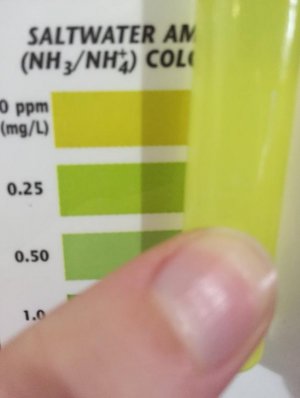
this is what the ammonia test looks like...
image.jpg
 
Looks fairly yellow to me; those charts are a pain. Is that the API kit? Get one of those ammonia badges. Less than $10 and you can hang it in the corner of your tank and eyeball your ammonia daily. Keeps me from slipping into paranoia
 
Since your tank is brand new, now is your one chance to decide if you are going to make the effort to keep ick and other parasites and disease out of your tank by quarantining your fish. Search for TTM to learn about options.

I would do a 25% water change if you can manage it and see if you can get your nitrates down before starting with coral. Some are sensitive to nitrates.

Coral don't add to the bioload the way fish do, so adding them together is not a problem per se. However, going slow is always a good idea. Do you have a local reef club? Fellow reefers are usually selling small coral that you can use as starters.


Sent from my iPhone using Tapatalk
 
Since your tank is brand new, now is your one chance to decide if you are going to make the effort to keep ick and other parasites and disease out of your tank by quarantining your fish.

While i would obviously prefer to quarantine my fish i currently just cannot afford another tank, heater, filter, wave maker/powerhead, light etc. The first fish i add will most likely be the only inhabitant (apart from cuc) for quite a few months because I'm really focusing on corals. I do plan on setting up a quarantine tank but it won't be until i have the funds.
 
Is that the API kit? Get one of those ammonia badges. Less than $10 and you can hang it in the corner of your tank and eyeball your ammonia daily. Keeps me from slipping into paranoia

Yes its the API kit. Haha clearly i'm already paranoid about it
 
Since you say you would prefer to quarantine your fish, and that you will eventually, I'd like to point out that used 10 gallon tanks with a heater and a basic Hob filter or powerhead are usually available dirt cheap on Craig's List. You need two for TTM. What are you going to do if that first fish has ick or something worse? You'll have to leave the tank empty for 76 days.

I'm not trying to be obnoxious. It just breaks my heart to watch the postings go by every week about someone losing all their fish because they didn't think it would happen to them. If you are just concerned about economics, it doesn't take many fish lost to cost as much as two 10 g tanks.

Okay, I've preached enough.:-) I hope you enjoy your new tank!


Sent from my iPhone using Tapatalk
 
I'd like to point out that used 10 gallon tanks with a heater and a basic Hob filter or powerhead are usually available dirt cheap on Craig's List

I am in Australia, so no craigs list here. Putting that aside though, if i were able to get a hold of some used tanks, i have no spare filter media to quick cycle them with.

If i were to cut a part of my sponge filters off from my DT and place them in the QT will that harm the bacteria i have already establised in my current tank?

Also, while my first fish is in QT, how do keep the bacteria in my current tank from starving due to a lack of ammonia source? (eg fish waste). i do not have access to pure ammonia in australia
 
Atom75, the slight greenish tint may be due to a small amount of ammonia or a test kit that isn't just right... or a test that wasn't done just right (no offence intended). I've been in the hobby for 12 years and I still use API test kits for Ca and alk. If I get a crazy reading I redo the test with the API kit. If I duplicate my reading, and 99 times out of 100 I do, then I test again using a Salifert kit. And again 99 times out of 100 the Salifert kit agrees with the API. BTW I don't even test for ammonia, nitrate or phosphate unless I see some something in the tank that gives me reason to think I should. But my system is 450g in total and has been up and running for about 6 years.

As for QTing your fish, I used to, but I don't any more. I even do a fair amount of collecting in the wild (with the proper licenses) and add those critters to either my 65g shallow reef or my 180g mixed reef of sps & lps. If you don't have much to lose, I don't see it as a big deal. And even though my 180g reef probably has several thousand dollars worth of coral, fish and inverts, it's a risk I'm willing to take. In 12 years of being in the hobby, the only issue I've ever introduced into my tanks has been aiptasia and flat worms, neither of which is a huge big thing to deal with.
 
No Craig's List! You poor thing.:-) sorry for being Americacentric.

Here's a link about TTM: Tank Transfer Method for eliminating Marine Ich
http://www.reefcentral.com/forums/showthread.php?t=2507836

You don't use any filtration to do TTM because you effectively change all the water every couple of days. The question the becomes how long do you want to observe after that, and that's when having effective filtration is helpful.

How much live rock do you have in your tank and how big is it? You shouldn't need any sponge filtration at all if you have enough rock so you could move the sponge filter to the QT tank after TTM (not during or the sponge may get contaminated).

I left my whole tank fallow for 76 days when I set it up before putting the first fish in to make sure I didn't inherit any parasites from the previous owner. Didn't have any cycle when I added two baby clowns. I did have a lot of rock though that had been in a functioning tank for years. Reportedly 200 pounds.


Sent from my iPhone using Tapatalk
 
Atom75, the slight greenish tint may be due to a small amount of ammonia or a test kit that isn't just right

I'm fairly certain I'm using the test kits the right way, but there could be trace amounts of ammonia in my tank, i guess theres just no way i know for certain unless i try a different test kit or brand.

The only thing that makes me think it might be the test kit is that i tested the saltwater from the pet/aquarium shop and it came up with the same reading (yellow but with a greenish tinge) as it did when i tested with my tank's water

Thank you for your opinion on QT, i'm still deciding i think. It's a little overwhelming because it seems like there's always something more to buy or set up with this hobby!
 
Isn't that the truth. I embrace the go slowly philosophy so I only have to learn one thing at a time.


Sent from my iPhone using Tapatalk
 
As for QTing your fish, I used to, but I don't any more. I even do a fair amount of collecting in the wild (with the proper licenses) and add those critters to either my 65g shallow reef or my 180g mixed reef of sps & lps. If you don't have much to lose, I don't see it as a big deal. And even though my 180g reef probably has several thousand dollars worth of coral, fish and inverts, it's a risk I'm willing to take. In 12 years of being in the hobby, the only issue I've ever introduced into my tanks has been aiptasia and flat worms, neither of which is a huge big thing to deal with.

That is awesome that you get to collect from the wild! I know some people are firm believers in QTing everything wet, and some people (yourself included) don't QT anything, but I do want to say that there is a middle ground. Also, if I was collecting from the ocean I probably wouldn't QT either, I don't QT non-coral inverts, and I don't QT delicate fish that I have observed in the main tanks (not low-salinity + copper) at my LFS over a period of time (i.e., leopard wrasses).

BUT fish that come straight from a distributor, and/or have been at a LFS but in a copper/low-salinity tank are at much greater risk of carrying disease, and I would never put those fish straight into my DT. If the supply chain in Australia is such that a given fish doesn't come in contact with hundreds of other fish then I also might not QT those, but I don't know if that's the case. Anyway, I just wanted to remind everyone that with QTing, like most everything else it life, we're balancing the risks involved. Knowing the likelihood of various risks is tough, especially for inexperienced aquarists, and I think it's important for people to think about what some of these risk factors are.
 
This weekend im hoping to add 1 fish (a clown OR a bicolour blenny) and clean up crew (a cleaner shrimp, snails), is it ok to add them together?

Also can corals be added at the same time as a fish/invertebrates? im asking this as my nearest LFS is a 2 hour drive away, so driving down frequently is both expensive and a pain.

I'd do a ~25% water change and then add a clean up crew. Ideally you'd wait a little longer before adding a fish, though you could get the fish and put it in a QT while your CUC adjusts to your tank. You could get a pair of clowns or a blenny, put them in an uncycled QT with a heater, powerhead, and Prime, do a 50% water change every 3 days, and observe for 1-2 weeks. It's not a full QT, you're not guaranteeing that you display will be ich free, but IMO it is wayyyy better than no QT at all, and of course you could treat if you notice anything amiss.
 
I don't think anyone has answered you questions...so I will give my two cents. I don't think you mentioned the size of your tank??

1. Your Ammonia test looks fine based on the picture. As long as your Nitrites have also returned to zero, you should be cycled. However, move slow adding fish to you tank.

2. Nitrates at 20-40 is a little high, but it is not that much of a concern. I would do a 20% water change and move forward. After that, I've had great success with 10% to 15% every two weeks.

3. Adding a CUC and 1 small fish should be fine. Again...move slow with fish. And remember...fish have very small stomachs...Don't over feed. As for QT, it's a very good idea. However, I've been in the hobby for 10 yrs, never had a QT, have several fish, and have only lost one wrasse. I guess I've been lucky. Do some reading...not everyone has been as lucky as me.

4. As far as adding coral, this really depends on the type of coral you want to keep. IMHO I would wait on SPS -- some are more sensitive than others. However, you could add mushrooms, zoas/palys, and even LPS. Corals are not going to have a large effect on your bio-load; however, I would probably only add two or three starting out...just in case you have a problem. Once you have your routine down (maintenance, water changes, testing, ect...), you can start adding more.

Hope this helps...Happy Reefing.
 
I saw on another post that your tank is 9 gallons. That's a real challenge! I can see why you might balk at setting up a QT tank that's bigger than your display tank.

I'd suggest that you might want to check out some build threads on similarly sized tanks to see how other people have approached the same issues and find out what works. For instance, I recently traded for a sea urchin from someone with a small tank and she has given up on fish entirely because of the problems trying to keep the salinity stable without an ATO.


Sent from my iPhone using Tapatalk
 
Ammonia and nitrites being zero does not really tell us enough.

1. Did you observe Ammonia clearly rise, and then clearly fall back to zero?
2. Did you observe Nitrites clearly rise, and then clearly fall back to zero?

Only if you answer yes to both of these questions can your tank be cycled.
 
Ammonia and nitrites being zero does not really tell us enough.

1. Did you observe Ammonia clearly rise, and then clearly fall back to zero?
2. Did you observe Nitrites clearly rise, and then clearly fall back to zero?

Only if you answer yes to both of these questions can your tank be cycled.

I was just trying to keep the post a bit shorter by adding in less details but..

Ammonia went up to 8ppm (and then some, off the charts) and back down to 0, helped along by a few water changes.

Nitrites to 5ppm (perhaps a bit higher) and now 0

The tank was cycled with live rock, nothing else

So in short YES to both.
 
Back
Top