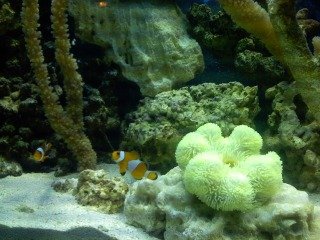
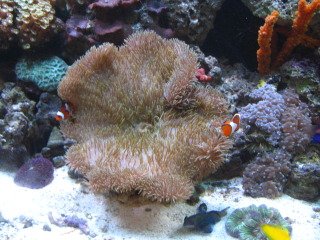
ID this Anemone please

Tourpicks1

New member
If i have this correct i think it is a carpet of some sort Anemone perhaps (Stichodactyla gigantea) I have had it for 3 years, some say its hard to keep long term, im not too sure. I purchased it bright yellow and very small perhaps 3 inches and as it grew it got more tan/light brown and over 3 years has grown to over 12+ inches.

attached some photos. from almost the beginning to a few months ago.
 

Attachments

  • FamilyPictures2246.jpg
    FamilyPictures2246.jpg
    49.9 KB · Views: 1
  • FamilyPictures1155.jpg
    FamilyPictures1155.jpg
    53.3 KB · Views: 1
Yep, looks like Gigantea Carpet anemone. It looks like it could use some more light or feeding but its pretty healthy otherwise.
 
Yep, looks like Gigantea Carpet anemone. It looks like it could use some more light or feeding but its pretty healthy otherwise.

how do you tell if it needs more light or feeding from the picture? Its at the bottom of the tank so if it wanted more light it would move up right?
It looks really healthy.
 
I feed it Mysis shrimp 1-2 a week or formula 1 or 2 frozen cubes and its directly under MH lighting maybe 18 inches from it and 130 of actinic pc's.
 
Yep, looks like Gigantea Carpet anemone. It looks like it could use some more light or feeding but its pretty healthy otherwise.

I agree. IMHO, The anemone has expanded the area between the tentacles to allow more light to reach the zooxanthellae living in the oral disk. It has reduced any light blocking pigments and allowed the zooxanthellae population to flourish. Judging from the first pic, the anemone would probably turn more green, if it was exposed to brighter light, and you wouldn't see as much void space between the tentacles.

Anemones don't always move up if they would do better in brighter light. There are other environmental influences that effect an anemone moving or not. Like flow, water quality, or a comfy spot for its foot.

In captivity, with the absence of predators, anemones can survive much harsher environments than they could in the wild. These are shallow water, bright light, anemones. In deeper/darker water these anemones would become weaker, and have a higher probability of falling prey to other animals. This doesn't happen in captivity, so the anemone can survive these conditions. Even if they aren't in peak physical condition.

If it were my anemone, I'd move it, along with the rock it's on, to the highest and brightest spot of the tank. I would insure that it had plenty of flow. After several months, I'd take a pic to compare with the pic from today. I'd bet that the anemone would look better and be a much healthier animal.

Again, this is just my humble opinion.
 
I agree. IMHO, The anemone has expanded the area between the tentacles to allow more light to reach the zooxanthellae living in the oral disk. It has reduced any light blocking pigments and allowed the zooxanthellae population to flourish. Judging from the first pic, the anemone would probably turn more green, if it was exposed to brighter light, and you wouldn't see as much void space between the tentacles.

Anemones don't always move up if they would do better in brighter light. There are other environmental influences that effect an anemone moving or not. Like flow, water quality, or a comfy spot for its foot.

In captivity, with the absence of predators, anemones can survive much harsher environments than they could in the wild. These are shallow water, bright light, anemones. In deeper/darker water these anemones would become weaker, and have a higher probability of falling prey to other animals. This doesn't happen in captivity, so the anemone can survive these conditions. Even if they aren't in peak physical condition.

If it were my anemone, I'd move it, along with the rock it's on, to the highest and brightest spot of the tank. I would insure that it had plenty of flow. After several months, I'd take a pic to compare with the pic from today. I'd bet that the anemone would look better and be a much healthier animal.

Again, this is just my humble opinion.

What he said. :)

As another, less direct clue, giganteas get to be nearly 3 feet wide. 12 inches after 3 years is a pretty slow growth rate.
 
is this anemone considered hard to keep, im looking to get another anemone for my 150 gallon RT and i have 2 ocellaris clowns but 1 250w MH and pc's what would be a good choice or choices and if anyone can rate the ease of care from 1-5. starting with another one of the anemone above.-to other anemones.
 
What he said. :)

As another, less direct clue, giganteas get to be nearly 3 feet wide. 12 inches after 3 years is a pretty slow growth rate.

Well not exactly. Giganteas strangely enough are actually the smallest of the hosting carpets. 20" is around their max size. Merten's carpets are the largest at ~39" and haddonis fall somewhere in between.

Giganteas are one of the more difficult anemones mostly because it is extremely difficult to find a healthy one to start with. They ship very poorly and seem to be very susceptible to bacterial infection deep within their tissues.

As far as ease of keeping, I would rank them in this order from least difficult (1) to most difficult (5).
1) E. quadricolor (BTA)
2) S. haddoni (Saddle carpet), S. mertensii (Merten's carpet)
3) H. crispa (sebae)
4) H. magnifica (ritteri), M. doreensis (Long Tentacle anemone)
5) S. gigantea (Giant Carpet)

There are other pluses and minuses for each species, but by far the biggest factor as to whether or not you are successful is the ability to choose a healthy individual to start with.

Check the Anemone FAQ for more info http://www.reefcentral.com/forums/showthread.php?t=1381958

Note: the anemone FAQ lists S. mertensii as being most difficult, but that was written before many people had any experience keeping them. They are hard to find, especially aquarium size individuals, but their needs are not hard to meet.

 
Last edited:
Oh, sorry. I was under the impression it was haddoni, gigantea, merten's. Crap, now I'm gonna hafta accomodate my bleached haddoni differently as it grows...
 
looking for anemone for mating clowns

looking for anemone for mating clowns

:spin1::spin1:
Well not exactly. Giganteas strangely enough are actually the smallest of the hosting carpets. 20" is around their max size. Merten's carpets are the largest at ~39" and haddonis fall somewhere in between.

Giganteas are one of the more difficult anemones mostly because it is extremely difficult to find a healthy one to start with. They ship very poorly and seem to be very susceptible to bacterial infection deep within their tissues.

As far as ease of keeping, I would rank them in this order from least difficult (1) to most difficult (5).
1) E. quadricolor (BTA)
2) S. haddoni (Saddle carpet), S. mertensii (Merten's carpet)
3) H. crispa (sebae)
4) H. magnifica (ritteri), M. doreensis (Long Tentacle anemone)
5) S. gigantea (Giant Carpet)

There are other pluses and minuses for each species, but by far the biggest factor as to whether or not you are successful is the ability to choose a healthy individual to start with.

Check the Anemone FAQ for more info http://www.reefcentral.com/forums/showthread.php?t=1381958

Note: the anemone FAQ lists S. mertensii as being most difficult, but that was written before many people had any experience keeping them. They are hard to find, especially aquarium size individuals, but their needs are not hard to meet.

thanks for the info i order my livestock online so i found that really its hard to get especially in the winter an anemone to ship well the carpet anemone i have is in my 125 RT and i got it at a LFS but i need an anemone for my RT 150 that im filling up with corals and would like to add 1 anemone. since i am buying livestock online im going to go with a rose tip BTA- im running a phoenix 14k lamp MH light and 260 watts of actinic pc's- i have a female ocellaris clown 3 " and a male 1.75 " - any idea of what size anemone i should get ? for the best survival rate, i can feed them 1-2 a week frozen krill or mysis and the 250 watt MH should be adequate light along with the decent flow i have in the 150 RT, any advice or help would be greatly appreciated, i got some info from bob fenners book- but i value experience all the time with anyone that has kept these speciemens and have had them thrive, also would the rose tip BTA or another bta, be OK for the ocellaris clowns to host ? thanks and happy holidays!
 
Back
Top