I'm considering adding a Mandarine fish.

Scoted

New member
I just added some Cheato with Tisbe copepods in my sump.
Questions=
Should i add sand in the refuguim section?

How long should i wait to get the fish?

Should i feed the refugium with Phytoplankton?

What am i forgetting

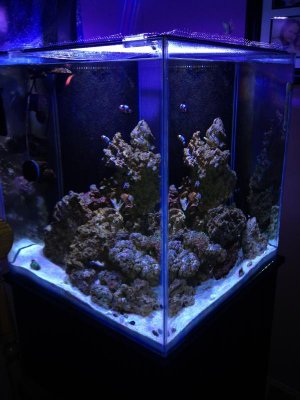
Tank= 60 cube 2" sand bed fine sand
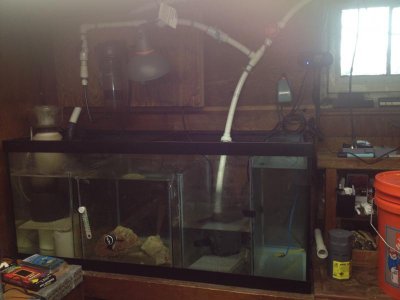
Sump= Basement converted 75Gallon with 17.5 Refugium section.
Thanks.
 
It's been up since jan 2015. I see tiny specks here and there but i cant say what the are for sure.
 
I have a bunch of Vermetid Snails and a tone of Spirorbid snails in my tank and sump. A few Aptasia and some Coralline algae. A pair of clown fish and a McCloskers flasher wrasse and a pistol shrimp.
 
I'm pretty sure you need a very seasoned well established tank for those, I would wait a little before getting one.
 
I agree. These fish feed almost exclusively off of pods in your tank, it takes a long time to establish them well enough to sustain a mandarin. You can buy pod starter kids to boost or replenish your pod population but I would hate to see the fish starve in the meantime. Good luck.
 
i like having sand in as many areas as possible when dealing with dragonets. it helps give more surface area for pods to populate.

your tank size sounds promising, especially with the fuge. how do you look on rock in the display? i like to go fairly rock heavy for my mandy's feeding pleasure.

january 2015 is closing in on a year. that's my typical suggestion for "best practice" as far as length of time on a new tank.

your stock list seems good too. no major conflicts there as far as competition or aggression, with the exception of the pistol shrimp. i don't know enough about them to say whether they are OK or not with dragonets. my assumption would be that they're just fine, but since i haven't personally kept them together, you might want to get a better opinion on their compatibility from someone more familiar with keeping the two of them together.

you also might want to check out some supplementary feeding options like mandarin diners, pod condos, or PaulB's feeding station:

http://reefcentral.com/forums/showthread.php?t=2113800&highlight=feeding+station

it's never bad to have some of those techniques in your back pocket just in case.

all in all i'd say your system is making all the right noises, and if i were you, i would probably move forward with looking for a good specimen.

if you're not familiar with eyeballing a healthy mandy, there are a couple real important things to look for:

1. should be bright, alert, and responsive. moving around at a nice page, and pecking every few seconds at the substrate. the S. splendidus and S. picturatus i've seen tend to move methodically and smoothly. generally unaware/unconcerned about things going on around them. pectoral fins fluttering gently. where as S. ocellatus and S. stellatus typically seem to have a more stacatto type of motion to them.

2. should not have a pinched stomach, sunken stomach, sunken sides, or "sharp" lines visible on the side. these are indications of starvation, and it can be hard to bring them back from the brink.

3. coloration should be good. vibrant, and almost oily/shiny.

4. no visible paralysis, especially in the back/tail area. sadly sometimes these little jewels are collected with cyanide or harpoons. cyanide collection often manifests itself as lethargy and refusal to forage. which is covered under #1. the harpoon collection can present as partial or full paralysis of the back half of the animal.

it is also my preference to start towards the smaller end of the size scale if you have the choice. the smaller ones can be more difficult to ship, but if you can get them in good condition, it's reall nice to watch them grow in your tank.

good luck! under the right conditions these fish are some of my favorite animals to watch.

 
Mandarins will also eat live white worms and black worms. This is a great way to supplement their feeding. One piece of worm equals about 100 pods.
 
you need a healthy breeding population of pods in your refugium to take feed a mandarin. that can take a while. i wouldnt go for it.
 
Thanks for the answers and direction. I'm not looking to get one right away, maybe 2-3 months or more away but i want to start to prepare my system to accommodate one. I was thinking of moving the ato reservoir out of the sump and reclaiming the 10 gallon section as a second refugium section fed from the return pump. Then more sand, rock and maybe some space for pod condos!
 

Attachments

  • 002.jpg
    002.jpg
    39.2 KB · Views: 4
  • 109.jpg
    109.jpg
    62.5 KB · Views: 3
That's a rather arbitrary estimation. I don't think it's very useful from a comparative standpoint.
 
Yes it is an arbitrary number. Would it be better to just say many? The fact is it is very easy to get Mandarins to eat worms, especially live white worms. They are many times the size of pods. Mandarins have a short digestive system and need a lot of food. Therefore, getting them to eat a piece of worm is a better return on the amount of energy required in food gathering. On the reef, Mandarins eat whatever they can, not just pods. So a diverse diet is beneficial. Plus, eating a large piece of worm also takes pressure off of the pod population. So it may be arbitrary, but it is a good guess.
 
Yes it is an arbitrary number. Would it be better to just say many? The fact is it is very easy to get Mandarins to eat worms, especially live white worms. They are many times the size of pods. Mandarins have a short digestive system and need a lot of food. Therefore, getting them to eat a piece of worm is a better return on the amount of energy required in food gathering. On the reef, Mandarins eat whatever they can, not just pods. So a diverse diet is beneficial. Plus, eating a large piece of worm also takes pressure off of the pod population. So it may be arbitrary, but it is a good guess.

but you're assuming that their nutrional composition is the same, or better, per volume than other things, and that's just not a good assumption.

i'm a big proponent of feeding worms to all fish, especially white worms. i don't care for the black worms as much due to how fast they die in saltwater, but since they're the easiest to come by, i will use them in a pinch.

but making blanket statements with no information backing them about how one food item equals hundreds of others serves no purpose other than to confuse and obfuscate the argument. you don't have any kind of data that points to the nutritional superiority of one versus the other, but you make some bold claims.

Therefore, getting them to eat a piece of worm is a better return on the amount of energy required in food gathering.

^ that is entirely conjecture.

imagine if you made the statement about human food consumption that a pound of potato chips was better than a half pound of mixed vegetables. if you're only looking at one measurement, the weight, you're not getting the whole picture.
 
Also: Are we talking copepods, amphipods, or tiggerpods? I've got some pods (amphipods especially) that are too large for my mandarin pair to eat and will damn near choke out many other smaller fish if they tried to eat them. I consider these to be vital since they should be around (if they hide quickly after the lights come on) to continue to breed and populate generations to come.

The OP has a good idea about the pod condos as well. As long as they have a place to populate without being preyed upon, they will be able to establish a self sustaining population. This is especially important for the OP with the size tank he has. I've found that the more LR available, the more spaces the pods have to live, hide, breed, eat, etc. Cheato in the sump is a good idea as well...
 
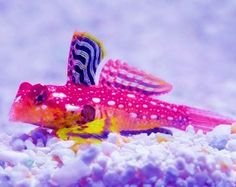
I picked up some sand today and two large pieces of dry rock. I'll take a hammer to them over the weekend and finish cleaning the sand. There is a 1" ball of cheato that came with the pods so ill wait and see how that grows. It's $10 a handful at the LFS but there is always a bit of unwanted algae mixed in with it. The LFS had 4 of these today! very tempting. Are there any major differences between the red vs green vs red scooter?
 

Attachments

  • red dragonet.jpg
    red dragonet.jpg
    10 KB · Views: 4
I haven't kept the red scooter but I do have a regular scooter. Synchiropus ocellatus. As far as care, feeding, and the like I haven't seen any differences. If you can care for one, the other should be no problem.
 
I picked up some sand today and two large pieces of dry rock. I'll take a hammer to them over the weekend and finish cleaning the sand. There is a 1" ball of cheato that came with the pods so ill wait and see how that grows. It's $10 a handful at the LFS but there is always a bit of unwanted algae mixed in with it. The LFS had 4 of these today! very tempting. Are there any major differences between the red vs green vs red scooter?

Be careful with the ruby red scooters, of the scooter family, they are the most difficult to get to acclimate to frozen/pellet food if you ever choose to do so.

There are three types of scooters typically available, the regular scooter (black/white spots), the red scooter (pale red/white), and the ruby red scooter (the one in your pic). The ruby red are known to be the most difficult to acclimate to any type of non-live food. The black/white are the easiest to acclimate to non-live foods, I have two that readily eat frozen food.

If you want to get a mandarin or a ruby red scooter, one or the other, and have it's primary food be the copepods, then go for it. If you want to get both a scooter and a mandarin, then probably better to get a black/white scooter that is known to already eat non-live foods, it'd be better to try and only have one fish which will go after the copepods, because either will go through copepods by the high hundreds, even thousands, in a day.
 
Back
Top