Saw the pic on their site and the spread does look narrow, but that could be how the light is mounted. Who knows. The original specs that were released on their website showed the spread but gave no indication ( to me atleast) what the intensity was. For example directly below the light at 24" a chart was provided but I could not tell if it was an intensity level of 100-40000000 par. So hard to comment on its ability. I hope they actually do have some sort of way to guage its intensity of this light so we as a consumer can make an educated purchase instead of one on hype.

You are using an out of date browser. It may not display this or other websites correctly.
You should upgrade or use an alternative browser.
You should upgrade or use an alternative browser.
Kessil A350
- Thread starter Alex T.
- Start date

rupert3k
New member
http://www.marinedepot.com/ps_ViewItem.aspx?idproduct=YH1131&idCartRow=33642573&isKit=0
Hey Joe what's the noise level of the fans like?
Apart from the usual I can't hear them above my other tank noise observations can we assume it's the same fan noise the A150 makes?
Can you chuck a decibel meter on yah iPhone and test it for us?
Hey Joe what's the noise level of the fans like?
Apart from the usual I can't hear them above my other tank noise observations can we assume it's the same fan noise the A150 makes?
Can you chuck a decibel meter on yah iPhone and test it for us?
Last edited:
joesreeftank
New member
I am sorry i do not have an Iphone.
I have never heard the fans, I think my pumps are making all the noise.
I have never heard the fans, I think my pumps are making all the noise.

ihavtats29
New member
spread is short due to the fact that it is the narrow lens that will be first released and later in may the wide angle will be released .
franklypre
New member
I honestly thought the tighter optics had a good spread, color is as close to perfect as you can get, adjustable blue.

Hammerleaf
New member
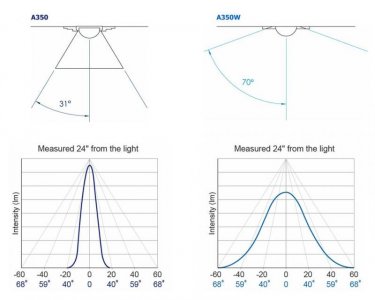

Japsican
Beans&Rice
What's the measurement on the bottom? Inches? Is this saying that the narrow version has a spread of almost 40"?
That's the way I'm seeing it...and I HOPE that we're correct.
Hammerleaf
New member
I'm anxious to see the par readings on these. I'm surprised that Kessil didn't release any results on par themselves. I guess we have to wait for some bloggers to test it out.
Hammerleaf
New member
I was hoping for some intensity readings myself mainly par readings.
Right, the chart doesn't really show anything other than spread. I really want to know if these can support large SPS tanks without any supplementation.
ihavtats29
New member
What's the measurement on the bottom? Inches? Is this saying that the narrow version has a spread of almost 40"?
Its 40 degree's not inch's, measured from 24 " below the light . it more of a focused light for tanks more than 24'' deep where the wide angle is for tanks 24'' and below in depth
Hammerleaf
New member
Its 40 degree's not inch's, measured from 24 " below the light . it more of a focused light for tanks more than 24'' deep where the wide angle is for tanks 24'' and below in depth
I see that, the degrees figure is on the very bottom in blue. The line about it appears to be some other measurement.

Frick
AZ FRAG President
I was hoping for some intensity readings myself mainly par readings.
Here is a statement i got from Kessil about PAR on the A150Ws;
"We do not have official PAR readings. There are some posted on different forums, but there seems to be some inconsistency. The linked post from reef central has PAR numbers on post #10. This is only for 1 light and would not reflect how multiple lights would read.
From what I understand there are a few things to note about PAR-
1) PAR is usually a flat value of light between 400-700nm and does not take into account the efficacy of each wavelength.
From what I understand most of the light coral use efficiently is from 400-500nm. PAR readings should be higher from a broad source of light like halides, t5s, or all "white" LEDs that have a good portion of light in the 500+ nm range vs. LEDs that have a mix of wavelengths. That is why most LEDs can be so much more power efficient. Because we can target individual wavelengths that may be most beneficial, and eliminate ones that may not be. PAR typically does not measure what blend of spectrum is the most usable, only photons in a given spectrum range.
For example, and please keep in mind these values are exaggerated for discussion, let's say 1mW of 460nm is 100% effective and 1mW of 560nm is 8% effective, typically your PAR meter will still read a total of 2mW of power and give you a reading based on those results.
2) Our A150W contains a portion of its light in the UV range and that will not be detectable unless the PAR meter is specifically designed to read UV.
We spent over 1 year testing the lights performance and they have been on display at stores for an additional 6-9months. While the A150W is not a direct comparison to a 150 halide in terms of coverage or visual brightness, the feedback we have received is that the penetration, shimmer, and growth has been comparable and in some cases better. Some testers bleached the tips of SPS because they underestimated the power that comes from the lights. Any change in light should be done carefully and thoughtfully especially on an established reef tank.
I hope this helps. Let me know if you have any further questions."
My two cents would be when comparing PAR on reef lights, you are comparing apples to oranges.
franklypre
New member
PAR is just to give us an idea as to how powerful a light source is, it's not a definative answer as to whether it will grow coral or not, same with Lux. As far as spread I don't see anyone having an issue once the wider version is released. Like everything else we probably won't know exactly what it will do for a little while. Definately could be the game changer we have been waiting for, a good price as well.
Frick
AZ FRAG President
Well I took a few PAR readings on my prototype and I do not know what to tell everyone. Out of the water the #s seemed low. In a small tank (about 12 gallons) they seems really high, and in a larger tank it seemed to be what i expected. Unfortunately i did not bother writing the results down. Not to mention my model will not be the same as the final released models.
bboudreaux
New member
Some testers bleached the tips of SPS because they underestimated the power that comes from the lights.
amen to that i have 2-10k and 2-15k over a 4' 120g that i upgraded from a 6 bulb t-5 with geismenn bulbs. well i bleached several sps: a large colony of red planet, ora hawkins, green milli, some unknown acro, and 3 chalice i had on the sand. all have since recovered their color, and maybe its just me but their color looks better than before. i would have never thought these lights would be this powerful. very pleased with their performance.
amen to that i have 2-10k and 2-15k over a 4' 120g that i upgraded from a 6 bulb t-5 with geismenn bulbs. well i bleached several sps: a large colony of red planet, ora hawkins, green milli, some unknown acro, and 3 chalice i had on the sand. all have since recovered their color, and maybe its just me but their color looks better than before. i would have never thought these lights would be this powerful. very pleased with their performance.
Hammerleaf
New member
Frick, based on your experience with the prototype what do you feel is an accurate spread on this light?
Last edited:
Grendel0501
New member
Yeah we need some spread info!!! I'm hoping the people who got A350's early can give some info on how far the spread is on the A350 vs the A350w.
I have a 120 (4x2x2) that I want to light with two of them. If the narrow lens covers ~2ft I'd prefer to use those, for more intensity. Instead of the A350w which looks like it is made to cover a larger than 2x2ft area.
I have a 120 (4x2x2) that I want to light with two of them. If the narrow lens covers ~2ft I'd prefer to use those, for more intensity. Instead of the A350w which looks like it is made to cover a larger than 2x2ft area.


Similar threads

- Replies
- 1
- Views
- 735


