LaCl Reactor

I agree with you 100%. I plan on using 3 chamber unit with floss and 5 micron filter with out straight to input of skimmer.
I been dosing directly because there is nothing in the tank except for water and rocks.
It's funny that seaklear makes this product Aquaria phosphate remover just for aquarium use and in direction or warning no where they mention to use a filter or sock etc. Their directions says to put 1oz for every 5000 gal straight into tank and if cloudiness occurs to use an other of their product to clear it.

Not really surprising. There are a number of phosphate products branded for the aquarium industry that use LaCl and none of them include the recommendation for using filter socks or something to capture precipitate. Not sure why that is because the precipitated is well documented to be dangerous to the fish. Most public aquariums does directly into their fluidized reactors to prevent precipitant from escaping. The SeaKlear stuff that you are using is typically marketed towards public aquariums and perhaps they just assume that the curators know what's best.

Personally, I use the commercial SeaKlear phosphate remover (not the CR version) that is marketed towards the pool industry. For me, 5ml of LaCl reduces Po4 by .05-.06 ppm in a 600 gallon volume. I typically dose half that or 2/3 that diluted in 1 liter of RODI water over an 7-8 hour period via an IV bag at a rate of 1 drop per second. I always dose into a 10 micron sock and watch my sock and water like a hawk during dosing. I've never had clouding in my water because of how I dose. I avoid dropping my Po4 by more than .03 in a session due to the alk drop and the fact that a .05 drop in my Po4 ****es my BTA off.
 
after 4 days of constant daily dosing directly into tank i noticed today that there is precipitation starting to deposit on equipment/pvc etc inside the tank.
 
update and need some info from experts.
i have been dosing 1 gal of RO DI water mixed with 1 oz of LaCl. it was holding phos at 0.06 ppm (hanna phosphorus). Dosed every 15 min for 10 sec via BRS 50ml/min (actually 60ml/min) for 10 sec each run (basically 10ml every 15 min = 40ml per hour) gal last 3-4 days.
Lately its been not keeping phos at 0.06 ppm and doubled to 0.13 ppm. so i doubled the LaCl to 2 oz in 1 gal and i dropped it down to 0.08.. is there something i am missing?
should i add more LaCl to mixture? or should i dose more ml per day...
 
time to update, 1/4" tubing that delivers the lanthunum to pump got clogged with with some white residue and no wonder how much more i told doser to dose phos levels didnt drop at all. so i took it out and cleaned it and diluted the mixture a lot more.
Phos according to ULR hanna is under 5ppb = 0.02 ppm.
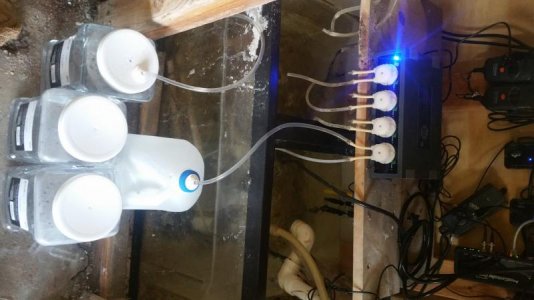
here is what my setup looks like now.
1 gal of RoDi water mixed with 2oz of LC. dosed 10 ml per hour.

Mag 5 pumps water from sump with a long extension on intake with a small hole drilled for 1/4" tubing to deliver LC to the front of the pump impeller. then it travels to a 3 chamber reactor.
1st chamber is empty for reaction. Only mod i did is to add a 6" pvc pipe so water entering the chamber has time to react and flow downwards before entering the 6" pvc and flowing throw upwards to second chamber where there is a floss filter then it travels to third chamber with 5 micron sediment filter and them back out to near intake of skimmer.
 

Attachments

  • 20170318_095431.jpg
    20170318_095431.jpg
    50 KB · Views: 10
time to update, 1/4" tubing that delivers the lanthunum to pump got clogged with with some white residue and no wonder how much more i told doser to dose phos levels didnt drop at all. so i took it out and cleaned it and diluted the mixture a lot more.

Phos according to ULR hanna is under 5ppb = 0.02 ppm.

here is what my setup looks like now.

1 gal of RoDi water mixed with 2oz of LC. dosed 10 ml per hour.


Mag 5 pumps water from sump with a long extension on intake with a small hole drilled for 1/4" tubing to deliver LC to the front of the pump impeller. then it travels to a 3 chamber reactor.

1st chamber is empty for reaction. Only mod i did is to add a 6" pvc pipe so water entering the chamber has time to react and flow downwards before entering the 6" pvc and flowing throw upwards to second chamber where there is a floss filter then it travels to third chamber with 5 micron sediment filter and them back out to near intake of skimmer.


Looking good


Sent from my iPhone using Tapatalk
 
time to update, 1/4" tubing that delivers the lanthunum to pump got clogged with with some white residue and no wonder how much more i told doser to dose phos levels didnt drop at all. so i took it out and cleaned it and diluted the mixture a lot more.
Phos according to ULR hanna is under 5ppb = 0.02 ppm.
here is what my setup looks like now.
1 gal of RoDi water mixed with 2oz of LC. dosed 10 ml per hour.

Mag 5 pumps water from sump with a long extension on intake with a small hole drilled for 1/4" tubing to deliver LC to the front of the pump impeller. then it travels to a 3 chamber reactor.
1st chamber is empty for reaction. Only mod i did is to add a 6" pvc pipe so water entering the chamber has time to react and flow downwards before entering the 6" pvc and flowing throw upwards to second chamber where there is a floss filter then it travels to third chamber with 5 micron sediment filter and them back out to near intake of skimmer.

bnumair, how is your Lacl reactor working out for you?
 
To everyone else that created a LaCL reactor, how long have you been using it and are you happy with the results? I ask because I dosed into 10 micron socks but have found that it leaked into the DT. Whenever I stir up the sand in the DT, I'll get a nasty cloudiness that lasts for hours. I believe the cloudiness is floculant that settled in the sand. The fish, inverts and corals are fine, it just looks bad.
 
To everyone else that created a LaCL reactor, how long have you been using it and are you happy with the results? I ask because I dosed into 10 micron socks but have found that it leaked into the DT. Whenever I stir up the sand in the DT, I'll get a nasty cloudiness that lasts for hours. I believe the cloudiness is floculant that settled in the sand. The fish, inverts and corals are fine, it just looks bad.

If the stuff from your sand were in fact precipitate from the LaCl dosing, you would see it clouding up the water when you dose. My guess is that what you think is precipitate in your sand bed is actually detritus or some other precipitate for dosing. If you are concerned about precipitate from LaCl, then dose into a 5 micron sock. FWIW, I have been dosing directly into a 10 micron sock on an as needed basis for several years now and never had an issue with precipitate in my tank.

Here is my process..
<iframe width="1280" height="720" src="https://www.youtube.com/embed/pg01FIN4n-w" frameborder="0" allowfullscreen></iframe>
 
Last edited:
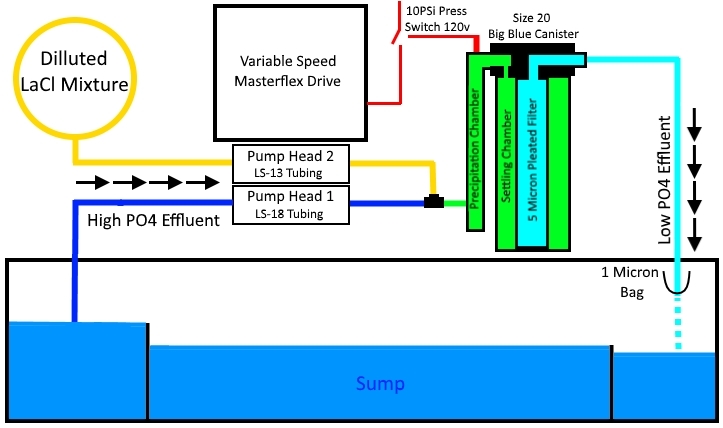
I built a system using a size 4 Big Blue canister. I used a 5 micron pleated sediment filter cartridge and dripped it into a 1 micron sock.

I fed the system with a masterflex continuous duty peristaltic pump with dual heads. I used the smallest tubing set to dose a diluted mixture of seaklear and a larger tubing set to feed the reactor. Phosphate levels were adjustable simply by adjusting the speed of the pump. A few inches after the pump the seaklear solution was mixed with effluent water, there was about 3 feet of 3/8" poly tube to allow a reactor to occur.

Flow was set low to maintain levels or high to drop levels. Most of the precipitation settled at the bottom of the chamber due to the high water volume inside the reactor. This combined with the pleated filter allowed the system to run for months without maintenance. It clogged after about 5 months. I haven't cleaned it but suspect some muriatic will dissolve the precipitate and allow the filter to run again. I simply don't need to run it at the moment.
 
I built a system using a size 4 Big Blue canister. I used a 5 micron pleated sediment filter cartridge and dripped it into a 1 micron sock.

I fed the system with a masterflex continuous duty peristaltic pump with dual heads. I used the smallest tubing set to dose a diluted mixture of seaklear and a larger tubing set to feed the reactor. Phosphate levels were adjustable simply by adjusting the speed of the pump. A few inches after the pump the seaklear solution was mixed with effluent water, there was about 3 feet of 3/8" poly tube to allow a reactor to occur.

Flow was set low to maintain levels or high to drop levels. Most of the precipitation settled at the bottom of the chamber due to the high water volume inside the reactor. This combined with the pleated filter allowed the system to run for months without maintenance. It clogged after about 5 months. I haven't cleaned it but suspect some muriatic will dissolve the precipitate and allow the filter to run again. I simply don't need to run it at the moment.


I like that idea.
 
It works great. It is very easy to control levels and precipitate never makes it into the system. It was a little expensive to set up but was a fun experiment. Once my system is fully loaded I may need to use it again. I was using it to cure a bin of 1500lbs of rock.

Here is the first 40 days running it on the vat. I lost the next 40 days in a hard drive crash but it leveled out and I reduced flow to keep it riding steady. By the time it clogged I was using 1 cap full of seaklear in 5gal of rodi over a period of 2 weeks.
31228802584_fed49d686f_c.jpg


Interesting enough this chart shows a few things.

A: The steep negative slopes represents free po4 in the water that is easily removed.
B: Steep positive slopes represent the phosphate leaching back into the water
C: Shallow negative slopes represent the rate po4 leaches from the rock.
D: The difference between A and C is the amount removed at a given time.

I really enjoyed this experiment and feel like the consistent nature of this reactor was telling.
 
Last edited:
I haven't been around much, but thanks for posting the great feedback on your results.

I moved about 2 years ago. During this move, I changed tanks. Since then, i have had a terrible experience with every aspect. Re-cycle, flow issues, sump configuration, etc. Man I miss my old setup about now....

So anyway, I decided to omit my reactor for a good while, to see if i could get closer to a natural balance. Long story short, I'm still fighting an endless war on algae and phosphates (I had this nipped in the bud with my old configuration).

So, v2 of my reactor is coming soon. After I have run it a while, i will post my results and feedback. This reactor design is centered around no clogging. Not that I had any big issues with it, but id rather avoid it in the future!

Basically, it's an open top reactor which LACL3 drips into. Reacted water drips down and through filter floss and then back up to the top of the reactor where it outputs into my theiling roller mat for additional filtering. I have some more moving parts, but you get the idea. :)

It works great. It is very easy to control levels and precipitate never makes it into the system. It was a little expensive to set up but was a fun experiment. Once my system is fully loaded I may need to use it again. I was using it to cure a bin of 1500lbs of rock.

Here is the first 40 days running it on the vat. I lost the next 40 days in a hard drive crash but it leveled out and I reduced flow to keep it riding steady. By the time it clogged I was using 1 cap full of seaklear in 5gal of rodi over a period of 2 weeks.
31228802584_fed49d686f_c.jpg


Interesting enough this chart shows a few things.

A: The steep negative slopes represents free po4 in the water that is easily removed.
B: Steep positive slopes represent the phosphate leaching back into the water
C: Shallow negative slopes represent the rate po4 leaches from the rock.
D: The difference between A and C is the amount removed at a given time.

I really enjoyed this experiment and feel like the consistent nature of this reactor was telling.
 
If the stuff from your sand were in fact precipitate from the LaCl dosing, you would see it clouding up the water when you dose. My guess is that what you think is precipitate in your sand bed is actually detritus or some other precipitate for dosing. If you are concerned about precipitate from LaCl, then dose into a 5 micron sock. FWIW, I have been dosing directly into a 10 micron sock on an as needed basis for several years now and never had an issue with precipitate in my tank.

Here is my process..
<iframe width="1280" height="720" src="https://www.youtube.com/embed/pg01FIN4n-w" frameborder="0" allowfullscreen></iframe>

That cloudiness I mentioned last month wasn’t lacl after all. It turned out to be caused by artificial rock and was thanks to a scarus quoyi dwarf parrot fish. I won a raffle for two large boxes of Carabsea “life” rock recently. The parrot would bite on the life rock all day long and eventually I could see that he was actually biting into and eating the outer layer of the rock. The inner layer is a powdery cement of some type. The parrot was ingesting the cement and pooping it out like a fine powder. Pretty soon the whole tank was starting to cloud up all the time. It looked like a bacteria bloom but it wasn’t. I removed all of the carabsea rock and replaced it with 100% Haitian rock. It’s been weeks and I’ve stirred up the sand enough that it’s all out of the system now. Go figure!
 
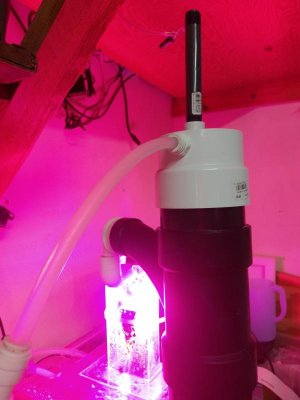
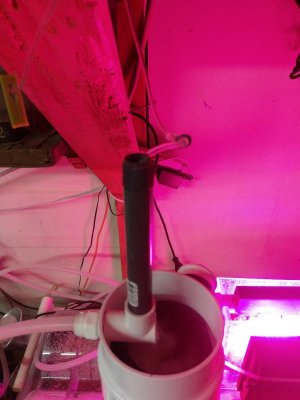
And here is v2 in all it's glory. Note that this rig is in my garage, so looks and space taken is not an issue.

I decided to go with a larger chamber and an upflow design. The 2 combined should help with creating a settling area. Pictures will give you a much better perspective. Note the cap on the top. It it just slipped over the top, which allows for easy and instant removal of the media area (3" pvc pipe which holds the filter floss). The threaded pipe on the top give a nice place to put an IV drip, while keeping the LC isolated from the water. The water contact happens at the bottom of the large T and is immediately dumped into the floss. Absolutely no way to clog.

If the floss gets too clogged, the water will overflow the 3" pipe and flow into the containing 4" pipe and out the Y as designed.

Just to stem any questions, the weird red light and area that the reactor overflows into is an ATS. The ATS overflows into my rollermat for additional filtering before it heads back to my tank.

And yes its ABS :) PVC is preferred i suppose, but I believe ABS to be perfectly safe.
 

Attachments

  • IMAG0303.jpg
    IMAG0303.jpg
    40 KB · Views: 12
  • IMAG0306.jpg
    IMAG0306.jpg
    44.4 KB · Views: 17
Yes it is. I have the drip rate set to match my tanks bio load. For me, this is about 30ml /hr. My solution is the same as the original amount that i posted in the first post (In the picture)
 
If one were to use something similar but instead of poly-fill, use a filter sock.... does anyone know, what size micron sock one would use?

I used a 10 micron sock. I can't remember where I saw that recommendation, but I know I read it in a few places. It was hard to find the 10 micron socks. Ended up buying them from Duda Industries on Amazon.

Roy
 
Back
Top